

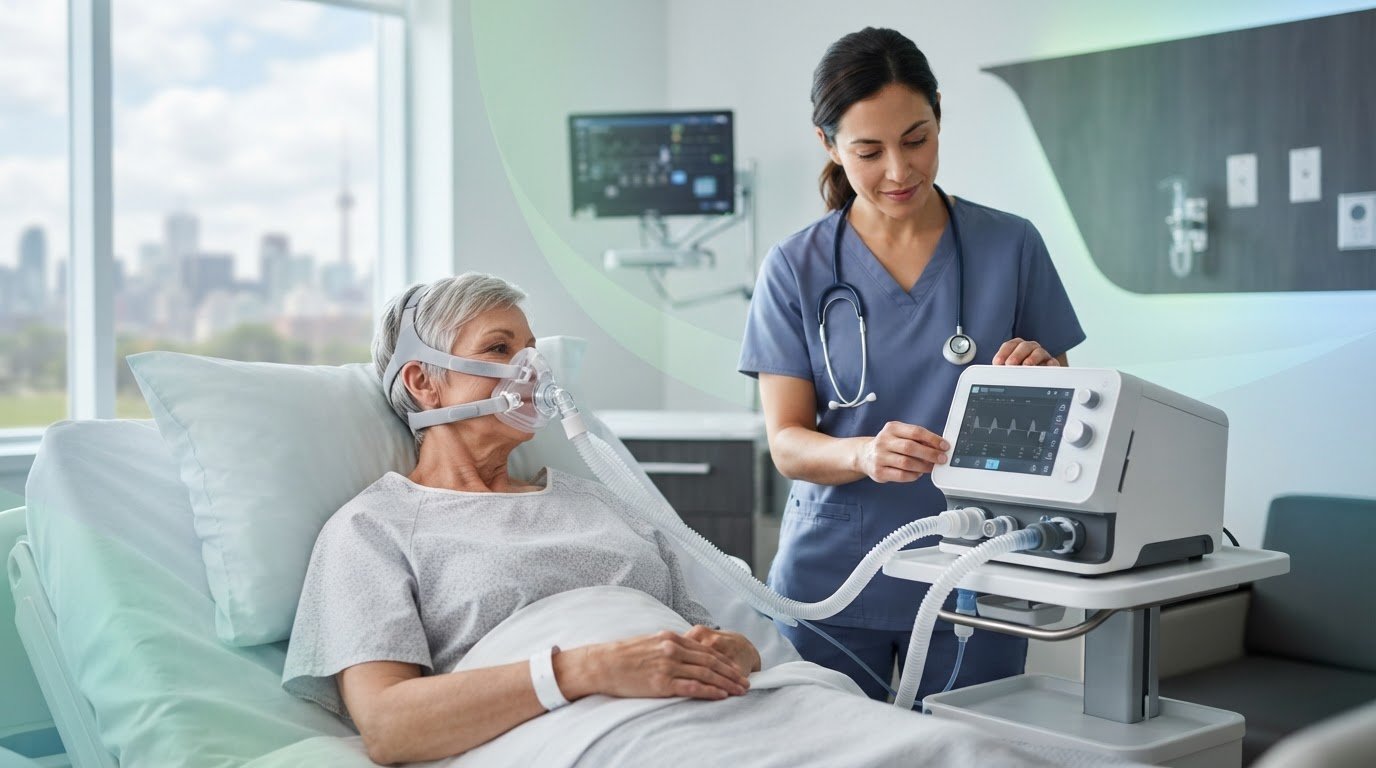
A breathing mask can sometimes avert a breathing tube, but it can’t replace invasive ventilation when a patient needs more support. In Canada, non-invasive ventilators deliver breathing support through an interface rather than an inserted tube: CPAP maintains continuous pressure, while BiPAP provides different pressure levels for inhalation and exhalation. For some patients, BiPAP may provide enough support to avoid intubation.
Choosing between CPAP, BiPAP and invasive ventilation depends on the patient’s breathing needs, response to therapy and level of monitoring. This article explains how the two non-invasive approaches work, when hospital teams may use them to support respiratory failure, and how home ventilation differs in safety and care requirements. You’ll also see where non-invasive ventilation has limits, so the role of the equipment is clear in both clinical and home settings.
Key Takeaways
- Non-invasive ventilation can support breathing without an inserted tube, and may help some patients avoid intubation when it provides sufficient support.
- CPAP maintains continuous airway pressure, while BiPAP provides separate pressure levels for inhalation and exhalation.
- Home therapy and hospital ventilation have different monitoring and safety needs; understand the limits of the device and the patient’s ability to tolerate interruptions.
- For respiratory therapy equipment needs, Novus Medical offers LungFit® PH, alongside ventilator options including the EO-150 and Monnal™ T60 Advanced.
Avoiding unnecessary intubation
Non-invasive ventilation (NIV) supports breathing through an external interface, without inserting a breathing tube. For some patients, BiPAP can provide enough respiratory assistance to avoid invasive mechanical ventilation. The goal is not to delay intubation when support is inadequate, but to provide the appropriate level of respiratory support.
Clinical guidelines help care teams determine when NIV is suitable and when it should not be used. Its effectiveness depends on the severity of acute respiratory failure, staff training and experience, and the care setting. In a monitored hospital, clinicians can assess the patient’s response and recognize when NIV is not providing enough assistance.
- Assess the clinical situation: NIV may be considered for some patients with acute respiratory failure. In severe illness, it may not provide sufficient support, and invasive ventilation may be required.
- Monitor the response: Health Canada advises close monitoring during NIV, including heart rate, respiratory rate, blood pressure and oxygen saturation. These observations help clinicians assess whether respiratory support remains adequate.
- Use appropriate precautions: NIV is considered an aerosol-generating medical procedure. Clinical teams need appropriate infection-control precautions when providing it.
During early SARS-CoV-2 disease, NIV and high-flow nasal oxygen may serve as supplementary treatments and may help prevent intubation. Earlier in the pandemic, early intubation was considered more effective for severe COVID-19 respiratory failure. These differing approaches underline why clinicians assess the patient’s condition rather than applying one method to every case. Intubation is also associated with aerosolisation and infection risk for healthcare workers, making appropriate precautions important with either approach.
Device safety matters alongside treatment choice. Health Canada advises reporting serious or unexpected adverse incidents involving NIV devices. Suspected incidents can be reported through the Health Canada Inspectorate Hotline at 1-800-267-9675. Clinical teams should also distinguish NIV devices from life-supporting ventilators, which have different capacities and limitations.
CPAP and BiPAP
CPAP delivers continuous positive airway pressure, while BiPAP provides separate pressures for inhalation and exhalation. A home ventilator is equipment used to provide prescribed breathing support at home. It is not interchangeable with either pressure mode simply because all provide breathing support.
With CPAP, continuous pressure helps keep the airway open during breathing. BiPAP, also called non-invasive BiLevel ventilation or NIPPV, changes pressure between inhalation and exhalation. The difference is how the support is delivered, not whether a mask is used.
- CPAP: Maintains continuous positive pressure through the breathing cycle. Clinicians consider it when continuous pressure meets the patient’s respiratory support needs.
- BiPAP: Inspiratory positive airway pressure (IPAP) rises during inhalation to assist a breath. Expiratory positive airway pressure (EPAP) maintains pressure during exhalation, helping prevent alveolar collapse.
- Home ventilation: Describes ventilation delivered in a home-care setting. Health Canada advises that non-invasive ventilators aren’t designed for life-supporting ventilation or for patients unable to tolerate brief therapy interruptions.
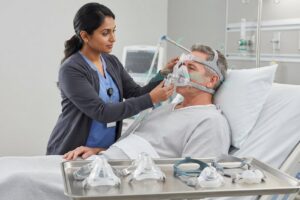
BiPAP uses a closely fitting mask that covers the nose, mouth or both. A softly inflated rim helps create a seal and maintain the prescribed pressure. Fit matters: leaks can interfere with pressure delivery, and the interface must be suitable for both the patient and the device.
Health Canada advises using a mask system that is compatible with and recommended by the device manufacturer. This guidance applies when selecting an interface for CPAP or BiPAP, since mask compatibility is part of a safe system setup. BiPAP can also help some people with chronic lung or heart disease transition from invasive ventilation to spontaneous breathing.
For respiratory care teams comparing equipment categories, ventilator equipment information can support the next step in evaluating clinical needs.
Home ventilation therapy
Planning for home ventilation involves therapy, access to equipment, patient safety and ongoing supplies. The care setting and the patient’s ability to manage the interface help shape the plan.
Coverage and funding
Provincial and territorial programs and private insurance may be funding options, each with its own eligibility terms. To assess coverage, identify the prescribed equipment and whether the plan includes its interface and related supplies. A funding application can outline the patient’s respiratory support needs and intended home-care setting. Reviewing these details helps families understand what a program or policy may cover.
Prescriptions and Canadian requirements
For home use, the treating respiratory-care team should determine the therapy, equipment and settings for the patient. Health Canada advises that non-invasive ventilators are not designed for life-supporting ventilation or for people unable to tolerate brief interruptions. It also advises attending patients who have limited ability to remove their mask, to reduce the risk of suffocation if the device fails unexpectedly.
A well-fitting interface minimizes the dispersion of exhaled air. The patient’s ability to remove the mask is also a key safety consideration, particularly if therapy is interrupted. Health Canada’s guidance covers these device limits and precautions, but does not establish a named technical standard in this section.
Supplies and maintenance
Home therapy requires a device and compatible interface suited to the prescribed setup. Keep the device instructions accessible so patients and caregivers can follow the stated cleaning and care procedures. Include supply replacement and equipment upkeep in the home-care plan, and review these needs with the respiratory-care team as therapy continues.
Buying or renting a ventilator
The respiratory-care team and an equipment supplier can help coordinate a purchase or rental. Start with the prescribed therapy and intended setting, then match the device, interface and setup to that plan. During fitting, review mask placement and make sure the patient can remove it, or arrange attendance if the patient has limited ability to do so. This links equipment access to home-use safety.

Hospital ventilation for respiratory insufficiency
In hospital, non-invasive ventilation (NIV) supports breathing while clinicians monitor the patient’s response. Canadian guidelines recommend non-invasive positive pressure ventilation as the first choice for patients with COPD or cardiogenic pulmonary edema.
Evidence is strongest for acute hypercapnic respiratory failure during a COPD exacerbation and acute hypoxic respiratory failure associated with congestive heart failure. Canadian guidelines also describe NIV use after surgery and for people with compromised immune systems. The clinical context matters: the severity of respiratory failure, staff experience and care setting all affect treatment effectiveness.
- Assess the indication: COPD exacerbation and cardiogenic pulmonary edema are situations where Canadian guidance recommends NIV as a first choice.
- Monitor response: Health Canada advises assessing heart rate, respiratory rate, blood pressure and oxygen saturation during therapy.
- Prepare for escalation: NIV can fail to provide enough support for very ill patients. Invasive mechanical ventilation may then be required.
Safe implementation involves more than equipment. Canadian guidance recommends strategies for physicians, respiratory therapists and nurses, supported by clinician education. Effective implementation may also require additional personnel, organizational changes, or beds and equipment for cardiopulmonary monitoring. Training should help staff distinguish NIV devices from life-supporting ventilators and understand their different capacities and limitations.
Teams must also plan for infection prevention. NIV is considered an aerosol-generating medical procedure, so appropriate precautions are required. Canadian implementation guidance also emphasizes having an experienced team available around the clock. Staffing, monitoring and escalation plans help determine whether a hospital can safely manage NIV.
For respiratory care teams reviewing equipment needs, discuss ventilator requirements as part of planning for clinical capacity and patient monitoring.
Hospitals may need to plan for transitions to non-invasive ventilation as patients need less respiratory support or are weaned from invasive ventilation. Non-invasive ventilation is not always effective, even when experienced clinicians provide it.
Canadian noninvasive ventilation guidelines recommend developing implementation strategies for physicians, respiratory therapists, and nurses. Implementation may require clinician education, additional healthcare personnel, organizational changes, or resources such as equipment or beds with cardiopulmonary monitoring. A related commentary says implementation can require an experienced healthcare team able to provide service 24 hours a day. Non-invasive ventilation in the prone position was described as feasible for patients with COVID-19.
Novus Medical: LungFit® PH
LungFit® PH uses patented Plasma Pulse Technology® to generate inhaled nitric oxide (iNO) from ambient air. For Canadian healthcare teams evaluating respiratory therapy equipment, the system is an option to consider alongside the facility’s clinical requirements and care workflows.
Novus Medical also offers the EO-150 Ventilator and Monnal™ T60 Advanced ventilator. These are separate equipment options for respiratory care planning. Match each product discussion to the intended application, patient population and care setting.
Contact Novus Medical to discuss LungFit® PH and respiratory equipment needs, or visit novusmedical.ca.
Plan the next step in respiratory care
For Canadian teams assessing non-invasive ventilators, equipment decisions should be part of a clear clinical implementation plan. Consider how staff education, patient assessment, monitoring workflows and escalation pathways fit together in the intended care setting. This keeps device selection aligned with operational readiness, rather than treating procurement as a stand-alone decision.
Novus Medical offers respiratory care equipment, including LungFit® PH and the EO-150 Ventilator. Its MagVenture Accelerator Training Program supports a separate area of clinical practice, so match any equipment or training discussion to your facility’s specific requirements.
Bring your respiratory equipment priorities and care-setting needs into the conversation. Contact Novus Medical to discuss ventilation and identify a practical next step for your team. With a defined clinical plan, your organization can move forward with greater clarity and confidence.
Frequently Asked Questions
What types of non-invasive ventilators are available in Canada?
Canadian options include CPAP, BiPAP and ventilators prescribed for non-invasive support at home or in hospital. CPAP provides continuous pressure; BiPAP delivers distinct inspiratory and expiratory pressures. A dedicated ventilator may provide a different form of prescribed support. For example, overnight home therapy and acute-care support in a monitored hospital involve different equipment needs and clinical oversight.
Which non-invasive ventilator brands and models are sold in Canada?
Novus Medical offers the EO-150 Ventilator and Monnal™ T60 Advanced, along with NIV Masks. The EO-150 delivers therapy from newborn to adult, while the Monnal™ T60 Advanced is designed for critical-care transport ventilation. These examples address different clinical contexts; the device and interface should match the prescribed therapy, patient population and care setting.
What Canadian standards or regulations apply to non-invasive ventilators?
Health Canada advises using a manufacturer-recommended, compatible mask, closely monitoring heart rate, respiratory rate, blood pressure and oxygen saturation, and attending patients who cannot readily remove their mask. Canadian guidelines recommend NIV as a first choice for COPD or cardiogenic pulmonary edema, alongside staff training and appropriate monitoring.
What are the risks and side effects of non-invasive ventilation?
NIV may not provide sufficient support, particularly for very ill patients, who may need invasive ventilation. If a patient cannot remove the mask and the device fails, suffocation is a risk. NIV is also an aerosol-generating procedure that requires infection-control precautions.
Disclaimer
Disclaimer: Articles on this website are produced with the assistance of automated content tools (AutoSEO) and are intended solely for general informational purposes. This content does not constitute professional advice. While we strive to maintain accurate and up-to-date information, readers should verify key details independently before taking action based on any content found on this site.
Leave a Reply
Your email is safe with us.