
Did you know that up to 40% of non-invasive ventilation cases fail because of interface intolerance? Choosing the right NIV mask for patients is frequently the deciding factor between a successful clinical recovery and an avoidable intubation. We understand the daily frustration of managing persistent air leaks or treating a painful pressure sore on a patient’s nasal bridge after only a few hours of therapy. These complications often stem from a mismatch between the interface and the patient’s unique anatomy.
This guide provides a technical framework to help you select the optimal interface to improve patient adherence, maintain seal integrity, and prevent skin breakdown. You will find a detailed look at specialized options like the Respireo Hospital F2 and Respireo SOFT, alongside a five-step workflow to organize your bedside selection process. By matching specific mask geometry to individual facial features, your team can reduce clinical complications and improve overall treatment outcomes throughout your facility.
Key Takeaways
- Understand how matching mask geometry to individual facial anatomy is the first step in choosing the right NIV mask for patients to reduce therapy intolerance.
- Distinguish between vented and non-vented interface configurations to maintain circuit integrity and prevent carbon dioxide rebreathing during acute care.
- Apply precise sizing and fitting techniques using integrated gauges to minimize air leaks and protect patients from medical device-related pressure injuries.
- Improve hospital operational efficiency by adopting disposable interfaces that support infection control and simplify training for respiratory care teams.
The Clinical Impact of NIV Interface Selection on Therapy Adherence
Patient compliance is the primary determinant of success in acute respiratory failure. When clinicians are choosing the right NIV mask for patients, they’re not just selecting a piece of plastic; they’re establishing the foundation for physiological stability. An uncomfortable interface leads to premature therapy discontinuation, which often results in invasive intubation. By adhering to established non-invasive ventilation principles, respiratory teams can balance effective pressure delivery with the patient’s subjective tolerance.
To better understand how a correct fit impacts therapy, watch this practical clinical guide:
When choosing the right NIV mask for patients, avoiding excessive air leaks is a significant priority. Leaks don’t just reduce the delivered pressure; they cause ventilator asynchrony and increase the patient’s work of breathing as the system struggles to compensate. Additionally, upward leaks often cause severe eye irritation, further decreasing patient cooperation. Clinicians must prioritize a secure seal through proper sizing rather than relying on excessive strap tension, which only exacerbates discomfort.
Preventing Skin Breakdown and Pressure Injuries
A pressure injury in this context is localized damage to the skin and underlying soft tissue, typically over the nasal bridge, resulting from prolonged compression. Rigid mask frames and high-tension headgear restrict capillary blood flow, leading to rapid skin necrosis. Soft-seal technology and adjustable forehead supports, like those found in the Respireo line, redistribute these forces across broader facial surfaces. This approach maintains seal integrity while protecting delicate tissue from ischemic damage.
Managing Patient Anxiety and Claustrophobia
The psychological impact of the interface is often overlooked in busy clinical settings. While total face masks provide a broad seal, they can trigger intense claustrophobia in conscious patients. Nasal masks or pillows offer a less intrusive alternative that preserves the patient’s field of vision. High-clarity materials help patients maintain a sense of openness, reducing the anxiety that frequently leads to therapy rejection.
Evaluating Mask Types: Technical Specifications for Hospital Use
Technical precision is essential when choosing the right NIV mask for patients. Clinicians must match the interface to the specific circuit architecture of the ventilator, such as the EO-150. Oronasal masks, like the Respireo Hospital F2, provide a secure seal for acute patients who breathe through their mouths or require higher pressure settings.
Respireo Hospital F2 Series: Vented and Non-Vented Options
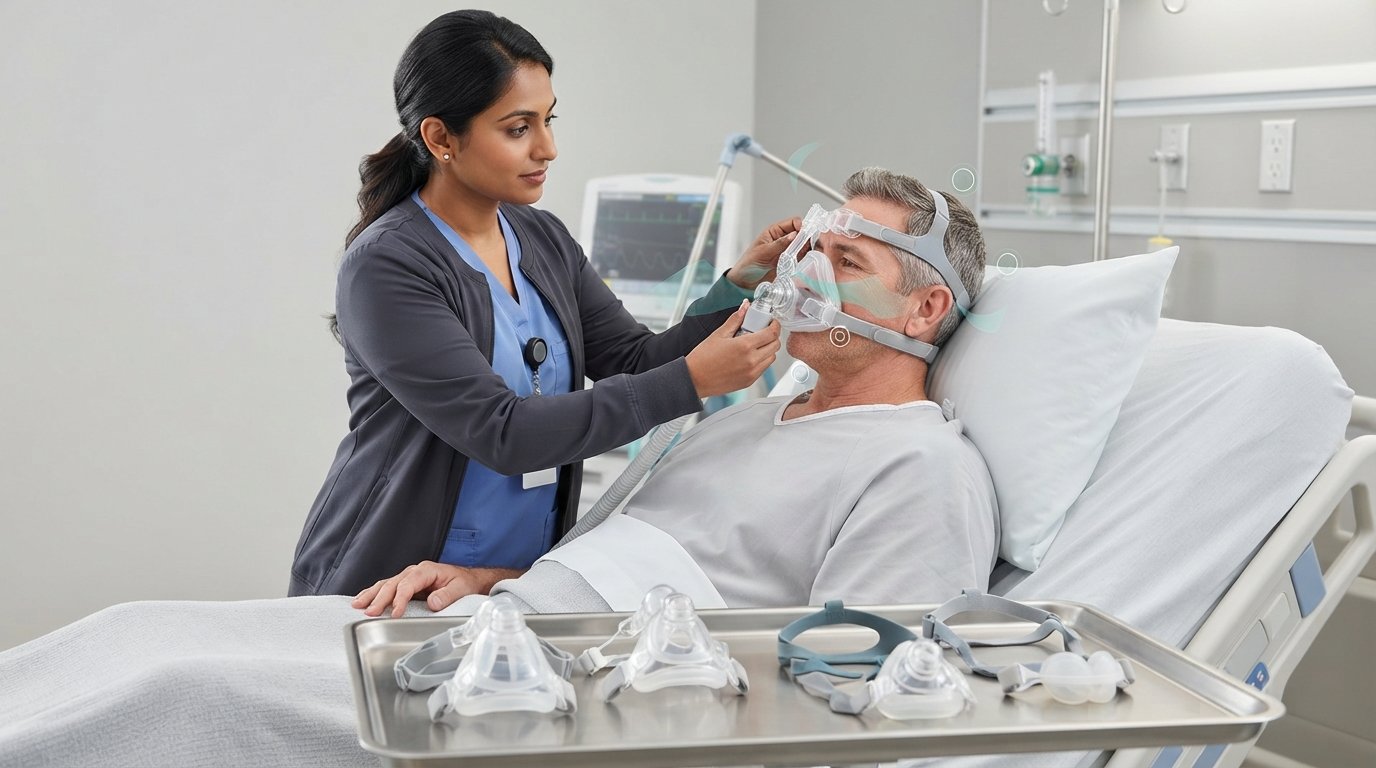
The Respireo Hospital F2 Vented Disposable is engineered for single-limb circuits requiring calibrated exhalation orifices. Conversely, the non-vented configuration is essential for dual-limb architectures. A vital safety component in the non-vented model is the integrated anti-asphyxia valve. This valve opens if pressures fall below 3 cmH2O to prevent CO2 rebreathing. It’s a critical safety feature. These masks feature a silicone double-wall cushion and a 16-position forehead adjustment dial to customize the fit. Modular, interchangeable elbows don’t just simplify inventory; they allow a single mask frame to adapt to different ventilator requirements.
Nasal Interfaces for Long-Term Adherence
The Respireo SOFT Nasal Mask provides a lightweight solution for stable patients in step-down units. Its design focuses on biocompatible medical silicone and a minimal contact frame that avoids the nasal bridge entirely. This allows patients to maintain normal activities like wearing glasses or speaking, which significantly boosts psychological well-being. Choosing the right NIV mask for patients involves balancing these comfort factors with the technical demands of the respiratory circuit. When you browse our respiratory care portfolio, you can find interfaces that bridge the gap between acute intervention and long-term recovery.

5 Steps to Achieving the Optimal Mask Fit
Choosing the right NIV mask for patients requires a systematic clinical approach to ensure therapy success. First, select the interface style based on the patient’s primary breathing route. While mouth breathers typically require an oronasal interface, patients who can maintain a closed mouth often find nasal masks more comfortable. Next, use the manufacturer-specific sizing gauge to measure the height and width of the nasal bridge. This precision prevents clinical teams from wasting sterile supplies through trial-and-error fitting.
Once you’ve selected the size, position the mask at the centre of the face. Secure the lower headgear straps first to anchor the interface before adjusting the upper straps. You should then adjust the forehead support to stabilize the seal. This step is vital to redistribute pressure away from the nasal bridge, preventing the tissue ischemia discussed earlier. Finally, perform a leak test at the prescribed pressure settings to realize the final fit under actual operating conditions. Choosing the right NIV mask for patients is only effective if the seal remains stable during peak inspiratory pressures.
Managing Large Leaks and Seal Integrity
Clinicians must distinguish between intentional flow from calibrated exhalation ports and unintentional seal leaks. If an unintentional leak occurs, organize a secure seal by adjusting the headgear tension in small increments. Don’t over-tighten the straps; excessive tension often causes the silicone cushion to collapse, which actually increases the leak and patient discomfort.
Sizing Considerations for Diverse Facial Morphologies
Standard interfaces often present challenges for patients with facial hair, dental absence, or unique bone structures. In these cases, the Respireo Primo P Vented nasal pillow interface can be a superior choice. It bypasses traditional bridge contact points by sealing directly at the nares, accommodating diverse facial profiles that standard masks cannot. To ensure your facility is equipped for every clinical scenario, contact our clinical specialists for a product demonstration.
Optimizing Hospital Workflow and Patient Outcomes
Successful NIV programs depend on more than just clinical skill; they require efficient operational systems. Standardizing a mask portfolio significantly reduces the training burden on nursing and respiratory therapy staff. When a team is familiar with a single, high-performance line like Respireo, they can troubleshoot leaks and manage patient-ventilator asynchrony more effectively. Choosing the right NIV mask for patients becomes a streamlined process that minimizes bedside trial-and-error, allowing clinicians to focus on direct patient care.
The Role of Disposable Interfaces in Infection Control
Single-patient use interfaces are now the standard in acute care across Canada. The Respireo Hospital F2 Vented and Non-Vented Disposable masks are specifically designed for these high-pressure environments. By using disposables, facilities eliminate the cross-contamination risks inherent in reprocessing reusable silicone components. This shift doesn’t just protect vulnerable patients from healthcare-associated infections. It removes the labour-intensive multi-stage cleaning and sterilization protocols that often slow down critical hospital workflows.
Partnering with Novus Medical for Respiratory Excellence
Choosing the right NIV mask for patients is more effective when backed by a partner that understands the national healthcare landscape. With over 40 years of experience, Novus Medical provides nationwide technical support and clinical education through our dedicated team. We act as a steady guide for respiratory teams, offering phone and remote connection assistance to resolve technical challenges quickly. Clinicians can realize better patient outcomes by integrating our specialized interfaces with advanced systems like the EO-150 ventilator. We encourage you to view our full respiratory catalogue to find integrated solutions that support your facility’s long-term commitment to clinical excellence.
Advancing Respiratory Care Through Clinical Precision
Success in non-invasive ventilation depends on the delicate balance between technical circuit requirements and patient comfort. By choosing the right NIV mask for patients, clinical teams can significantly reduce therapy intolerance while protecting against common complications like nasal bridge pressure injuries. Adopting a standardized, disposable interface portfolio simplifies training and ensures high infection control standards across acute care environments. It’s a strategy that prioritizes both patient safety and operational efficiency.
Novus Medical is the exclusive Canadian distributor for specialized respiratory technology, offering clinical expertise backed by 40 years of industry experience. Our ISO-certified quality management systems ensure that every interface delivers reliable performance in the most demanding hospital settings. We provide nationwide technical support to help your team realize the best possible outcomes for every patient in your care. Explore our full range of Respireo NIV masks and respiratory solutions to find the optimal fit for your facility. We look forward to supporting your commitment to clinical excellence.
Frequently Asked Questions
What is the difference between a vented and a non-vented NIV mask?
A vented mask incorporates calibrated exhalation ports designed for single-limb circuits to facilitate CO2 washout through intentional leaks. In contrast, non-vented masks lack these orifices and are required for dual-limb or active-valve ventilator architectures. Choosing the right NIV mask for patients depends on matching these interface types to the specific circuit configuration of the ventilator. Using the wrong type can lead to dangerous rebreathing or ventilator asynchrony.
How do I prevent skin breakdown on the nasal bridge during NIV therapy?
Preventing skin breakdown requires a combination of precise sizing and pressure redistribution. Clinicians should use integrated sizing gauges to avoid oversized frames that sit too high on the bridge. Adjusting the forehead dial on interfaces like the Respireo Hospital F2 helps shift the load away from the nasal bone. Rotating between oronasal masks and nasal pillows every four to six hours also reduces the duration of continuous pressure on specific tissue zones.
Can I use a nasal mask for a patient who is a mouth breather?
Nasal masks are generally not recommended for active mouth breathers because the therapeutic pressure will escape through the open mouth, leading to significant leaks and ineffective ventilation. If a patient cannot maintain a closed mouth, an oronasal interface is the safer clinical choice. Choosing the right NIV mask for patients involves assessing their primary breathing route during the initial admission to ensure the selected interface can maintain a stable seal.
When should I use a non-vented mask with an anti-asphyxia valve?
A non-vented mask with an anti-asphyxia valve is essential when using ventilators that don’t provide a safety path for spontaneous breathing during a system failure. The valve opens automatically if the circuit pressure drops below 3 cmH2O, allowing the patient to draw in room air. This feature is a critical safety requirement for dual-limb circuits to prevent suffocation if the ventilator stops or the circuit becomes disconnected.
How often should a disposable NIV mask be replaced in a hospital setting?
Disposable NIV interfaces are designed for single-patient use and should typically be replaced every seven days or according to your facility’s infection control protocols. If the mask becomes visibly soiled or the silicone seal loses its integrity, it must be discarded immediately. Using disposable options like the Respireo line helps hospitals maintain high safety standards by eliminating the cross-contamination risks associated with reprocessing reusable respiratory equipment.
Disclaimer
Disclaimer: Articles on this website are produced with the assistance of automated content tools (AutoSEO) and are intended solely for general informational purposes. This content does not constitute professional advice. While we strive to maintain accurate and up-to-date information, readers should verify key details independently before taking action based on any content found on this site.



Leave a Reply
Your email is safe with us.