

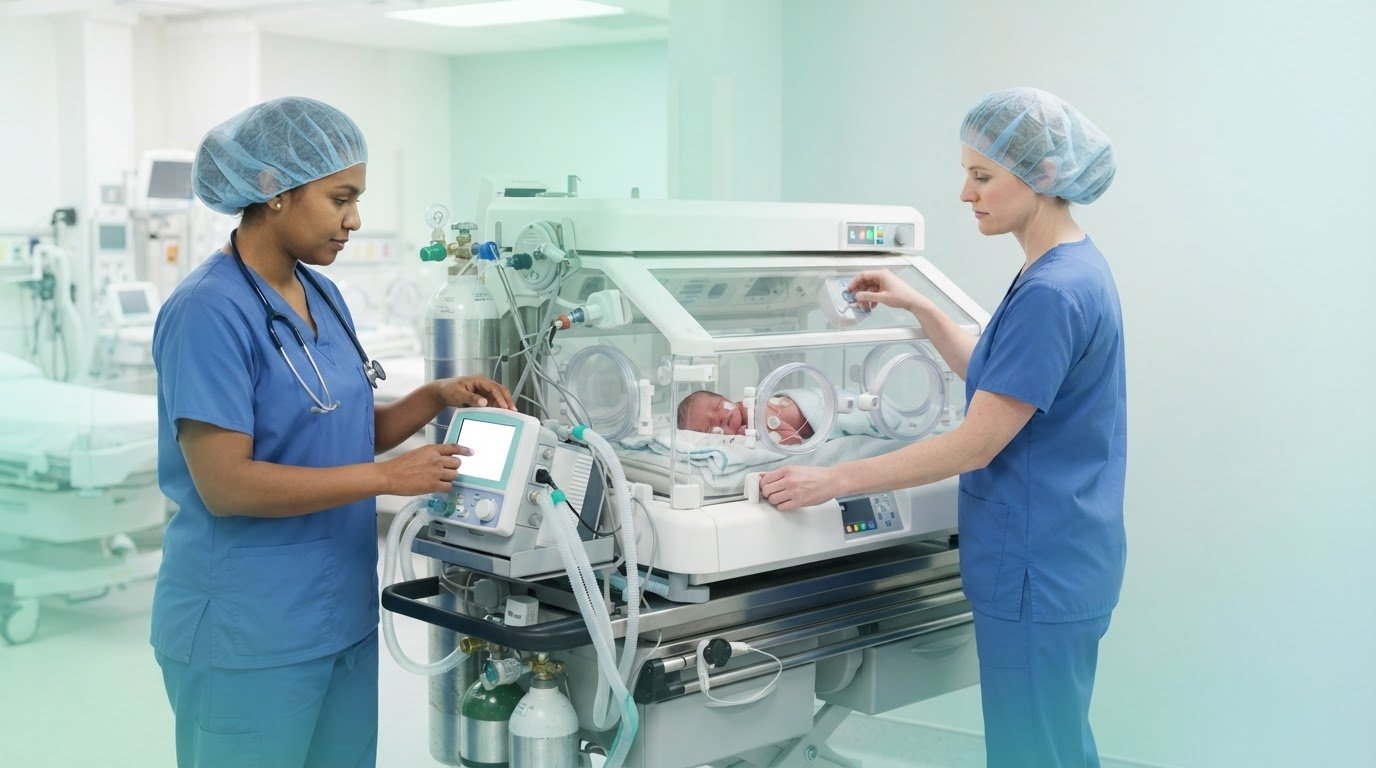
A neonatal transport ventilator must suit the infant’s care plan and the practical demands of transfer between settings. Choosing a device is only one part of readiness: the team also needs to know how it will be configured, monitored and managed in transit.
For Canadian neonatal and transport clinicians, this article offers a practical framework for assessing ventilation support during transfer. It covers invasive and noninvasive approaches, leak compensation, patient synchronization and equipment selection, along with operational questions that shape a transport setup. Use these considerations to guide team discussions, compare equipment with clinical needs and identify what to address before an infant leaves the care environment.
Key Takeaways
- Match invasive or noninvasive ventilation modes to the infant’s clinical needs and the transport team’s care plan.
- Assess how leak compensation and patient synchronization may affect ventilation delivery and bedside monitoring.
- Compare transport equipment by its ventilation capabilities, practical setup requirements and fit with the transport workflow.
- Understand where the EO-150 Ventilator, Monnal™ T60 Advanced and LungFit® PH fit within Novus Medical’s respiratory therapy offerings.
Invasive and noninvasive ventilation
Invasive ventilation delivers support through an endotracheal tube, while noninvasive support uses an interface. The approaches differ in airway access, circuit arrangement and the clinical observations needed during transfer. The care team assesses the infant’s respiratory needs to select the mode and interface. Document the planned approach and rationale in the transport handover so the receiving team understands the plan.
For volume guarantee ventilation, consider how the selected ventilator delivers support and how its configured parameters relate to the intended volume target. Clinicians should understand how the selected ventilator manages this relationship and how its displayed information relates to the chosen settings. A mode name alone does not describe the full setup: consider the configured parameters and how the team will interpret them during transport.
Mandatory Minute Ventilation delivers pressure-limited, volume-targeted mandatory breaths when the minute volume from pressure-supported spontaneous breaths falls below a target minimum. Teams using this mode should understand the target and how the device responds when spontaneous breathing falls short. Include the relevant settings and expected response in the transfer plan to support continuity for the receiving team.
High-frequency oscillatory ventilation has been in clinical use for more than 30 years. It is used to treat neonatal respiratory distress syndrome, pneumonia, meconium aspiration syndrome, persistent pulmonary hypertension of the newborn and lung hypoplasia. Advances in neonatal ventilation have been significant over the 15 to 20 years preceding this article’s discussion. For an infant requiring HFOV, determine whether the planned transport configuration supports the prescribed approach. Confirm the mode, settings and interface before departure, then communicate any changes and relevant observations at handover. The practical takeaway is to plan around the infant’s prescribed mode and the receiving team’s ability to continue it, rather than relying on a mode label alone.
Across the 55 Italian neonatal emergency transport services, 115 ventilators were reported in total. This figure does not identify which devices support each ventilation approach. Teams should confirm the capabilities and configuration of the ventilator assigned to the infant, and ensure that the planned mode and settings are clear to the receiving team.
Leak compensation and patient synchronization
A leak around a noninvasive interface can affect the relationship between ventilator output and the infant’s respiratory effort. Assess mask fit, infant movement and tubing connections. Leak compensation describes a ventilator’s ability to account for leaks while delivering support. Its response depends on device design and settings, so teams should understand the functions available on their transport equipment.
Patient synchronization describes how ventilator support aligns with an infant’s spontaneous breathing. Trigger sensitivity affects when a supported breath begins, while cycling criteria affect when it ends. If assistance starts late or continues after the infant’s effort changes, the support may not align with the breathing pattern. Before departure, review the selected mode and its trigger and cycling controls, using the device instructions and the infant’s observed respiratory pattern.
Before transport, use a consistent check for a noninvasive setup:
- Inspect the interface position and seal, then reassess after repositioning the infant.
- Check the circuit connections and identify whether leaks appear at the mask, tubing or another connection.
- Observe the infant’s respiratory effort alongside ventilator indicators, rather than relying on one display alone.
For example, if a displayed value changes after you adjust a nasal interface, consider whether it reflects a better seal or a change in breathing pattern. Reassess the infant and equipment together. During movement, check the interface and connections again if the infant’s position changes or support appears out of step with spontaneous effort. Record relevant observations and settings for handover so the receiving team can compare the same information.
Before using a neonatal transport ventilator, make sure the transport team can identify its leak-related indicators and synchronization controls. Practise the workflow with the actual interface and circuit configuration used for transport. For transport planning, review respiratory equipment options alongside the team’s setup and handover process.

Transport ventilation equipment
For critically ill infants, choose equipment for the complete transport setup, not just the ventilator modes. Compare support needs with available gas, battery capacity, monitoring and team capabilities.
Ventilator Options and Selection
Hospitals and neonatal transport teams select a ventilator by matching its modes, controls and interfaces to the infant’s planned support. Compare required ventilation modes, low-volume capability, alarms, portability, and compatibility with the transport incubator and circuit. In Canada, review each model’s intended use and operating instructions. A feature list alone does not establish suitability for a particular transfer.
Regulations and Standards
Canadian purchasing and clinical teams should assess the device’s applicable authorization, intended use and manufacturer documentation. Align procurement and operation with facility policies, biomedical engineering review and transport procedures. Requirements depend on the device and its use, so do not assume a general standard applies to every ventilator or transport configuration.
Oxygen, Air, Battery, and Monitoring Needs
Before departure, calculate planned oxygen and air demand from the prescribed settings, route and expected duration. Confirm compatible supply connections, available reserves and battery readiness for the entire journey. Match monitoring to the infant’s care plan, and ensure alarms remain audible and visible in the transport environment. Reassess resource levels during transfer, not just at departure.
Safe Setup and Operation
Follow a repeatable setup: inspect the ventilator, connect the circuit and gas supplies, enter prescribed settings, then test alarms and ventilation before connecting the infant. Secure tubing and power connections for movement, and document settings for handover. Training should cover device controls, alarm response and transport-specific scenarios. Follow manufacturer maintenance instructions and facility procedures. Risks include circuit disconnection, depleted gas or battery, unintended setting changes, and ventilation that no longer matches the infant’s needs. Monitor the infant and equipment throughout transfer, and respond promptly to changes.
Fabian ventilators without high-frequency ventilation accounted for 24 of the 115 ventilators reported by Italian neonatal emergency transport services. This figure describes the reported equipment mix, rather than establishing which model is appropriate for an individual infant or transfer. Selection still needs to reflect the planned support and the transport team’s capabilities.
Which neonatal transport ventilators are available in Canada, and how do they compare?
In Canada, the EO-150 Ventilator and Monnal™ T60 Advanced represent two distinct options to assess for neonatal and transport-related respiratory care. The EO-150 delivers therapy from newborn to adult, while the Monnal™ T60 Advanced is a critical-care transport ventilator. These descriptions identify different intended roles, but don’t establish that either device meets every neonatal transport requirement.
Compare the manufacturer’s documentation against the clinical use your service is evaluating. For the EO-150, confirm how its stated newborn-to-adult scope relates to the intended care setting and patient population. For the Monnal™ T60 Advanced, examine its critical-care transport role and assess whether its documented functions align with your service’s transport protocols. Avoid assuming that a broad patient range or transport designation alone answers every clinical question.
A useful comparison record can show how each device fits the organization’s needs:
- Intended role: Record the manufacturer’s stated patient population and care setting.
- Clinical governance: Document which service would use the device and how its use fits local protocols.
- Staff adoption: Consider whether the relevant teams can establish consistent training and familiarization.
- Procurement review: Keep product documentation and the clinical rationale together for evaluation.
This approach separates stated product roles from assumptions about performance in a particular transport scenario. It also helps purchasing and clinical teams discuss the same intended use, rather than comparing product names alone. The EO-150’s newborn-to-adult description and the Monnal™ T60 Advanced’s transport designation provide a starting point; the complete review should follow the manufacturer’s documentation and the facility’s planned application.
To discuss respiratory equipment options for your clinical setting, contact a respiratory equipment specialist.
Novus Medical: LungFit® PH
LungFit® PH is a distinct system for neonatal and respiratory care teams to consider alongside transport ventilation equipment. It is not a substitute for a ventilator selected to meet an infant’s transport requirements. The system uses patented Plasma Pulse Technology® to generate inhaled nitric oxide from ambient air, a feature teams can consider when assessing respiratory therapy equipment.
Consider it when evaluating respiratory support needs beyond the ventilator itself, and review its intended role alongside the transport team’s clinical workflow. For ventilation equipment, Novus Medical also offers the EO-150 Ventilator and Monnal™ T60 Advanced. Keep the comparison focused on each device’s intended use and the support your team needs; these offerings serve different equipment considerations and should not be treated as interchangeable.
To discuss how LungFit® PH fits your facility’s respiratory therapy needs, contact Novus Medical.
Plan the next step for transport readiness
Use your next equipment review to turn clinical needs into a shared transport plan. Bring respiratory clinicians, neonatal staff, biomedical teams and transport personnel together to define responsibilities, equipment checks and handover information. A clear plan helps the team identify operational gaps before preparing a critically ill infant for transfer.
As you assess a neonatal transport ventilator, keep device selection connected to the complete respiratory care pathway. Novus Medical offers the EO-150 Ventilator and LungFit® PH for distinct respiratory therapy needs. Discussing your facility’s requirements can help focus the next conversation on equipment fit and intended use, without treating different systems as interchangeable.
For a practical discussion about transport ventilation equipment, contact Novus Medical about transport ventilation. A considered review is a useful step toward a coordinated approach for your team and the infants in its care.
Frequently Asked Questions
What is a transport ventilator for newborns, and how does it work?
A neonatal transport ventilator provides respiratory support during an infant’s transfer between care settings. It delivers breaths through a connected circuit according to prescribed settings, while displaying information clinicians use to assess ventilation. For example, during transfer from a referring hospital, the team maintains the planned support and hands over device settings and observations so the receiving unit can continue care.
What features should a transport ventilator have for newborns and preterm infants?
A neonatal transport ventilator should support the infant’s prescribed ventilation approach and allow appropriate adjustment and assessment of respiratory support. Consider controls that are clear during movement, noticeable alarms and circuit compatibility with the planned care. For a preterm infant, assess whether the setup supports close observation and access to controls while keeping the circuit arranged for transfer.
Disclaimer
Disclaimer: Articles on this website are produced with the assistance of automated content tools (AutoSEO) and are intended solely for general informational purposes. This content does not constitute professional advice. While we strive to maintain accurate and up-to-date information, readers should verify key details independently before taking action based on any content found on this site.



Leave a Reply
Your email is safe with us.