

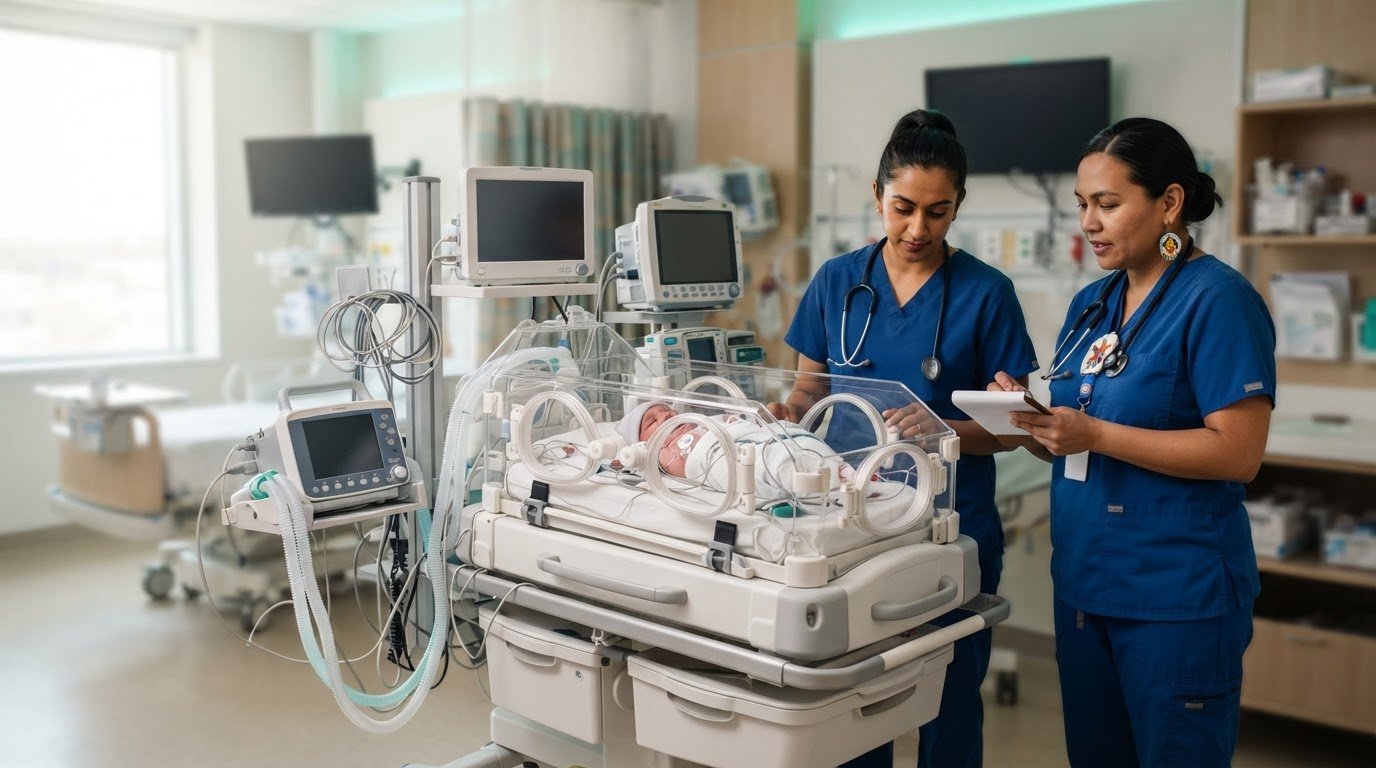
A transport-ready plan starts at the sending site, where clinical teams prepare the newborn’s care and coordinate the transfer. Neonatal transport medical supplies should match the infant’s support needs, the site’s capabilities and the equipment planned for the journey. The priority is a clear, usable setup, not simply a longer inventory.
Equipment choices also shape how teams work together. Staff need to know what is ready, how it fits the transfer plan and what information must accompany the newborn. Clear preparation connects bedside care with transport-team responsibilities and supports an organized handoff.
This guide covers stabilization before departure, then considers isolette, restraint and stretcher design. It explains how a site’s capabilities shape supply planning and outlines the main equipment categories clinical teams may need to coordinate. Use these considerations to review your workflow, identify practical gaps and plan a transport setup suited to your facility and patient-care requirements.
Key Takeaways
- Align pre-transport stabilization and available supplies with your site’s neonatal-care capabilities and the newborn’s needs.
- Assess isolette temperature control, infant securement and stretcher compatibility as connected parts of transport planning.
- Map essential respiratory support, monitoring, infusion and emergency equipment to the transport team’s setup.
- Use the guide’s site-level considerations to identify equipment priorities and prepare a more coordinated transfer.
Stabilization and clinical support while awaiting transport
Clinical teams stabilize a newborn before transport and maintain support while the transport team mobilizes. Preparation should reflect the patient’s current condition and clinical needs.
Pre-transport Stabilization
Start with an assessment of the newborn’s status, then communicate findings to the transport team. For neonatal transport requests at Montreal Children’s Hospital, referring professionals provide recent vital signs, including temperature. SANTS asks four initial referral questions: the baby’s age, gestational age, respiratory support and oxygen status, and main concern. Gather these details early so the referral discussion is focused and the team can share a consistent clinical picture.
While awaiting transfer, maintain the support the newborn needs and observe for changes. If breathing support or the infant’s condition changes, communicate the update promptly. Risks include deterioration before departure or interruption to ongoing support. Timely updates and a coordinated handoff help reduce avoidable gaps in care.
Medications and Emergency Supplies
Medication needs depend on the newborn’s current treatment plan. Prepare prescribed medications with their administration supplies, and ensure the team can identify what is due during transfer. If infusion therapy is required, coordinate the medication and delivery setup with the infusion pump. There is no single medication list for every patient: the clinical plan determines what travels with the newborn.
Emergency supplies should support the care the team may need to continue en route. A neonatal transport system may include vital-sign monitoring and a defibrillator, alongside respiratory and infusion equipment. Keep essential items accessible, assign responsibility for them and explain their role during handoff. This preparation helps the transport team respond to the newborn’s needs without searching through unrelated supplies.
Neonatal transport teams typically stabilize a baby before transport. While the team mobilizes, keep the bedside plan focused on the newborn’s immediate needs and ensure everyone knows which support is continuing. Share meaningful changes as they arise, rather than waiting until departure, and clarify outstanding medication or equipment arrangements during handoff. A concise, current account helps the receiving team understand what has been done and what support remains necessary when responsibility shifts.
Isolette, infant restraint and stretcher design
An isolette, infant restraint system and stretcher form a connected transport setup. Assess the newborn’s positioning, temperature support, staff access and equipment placement together. The design should let the clinical team observe the infant and reach required controls without disrupting the setup.
The Neonate Patient Transport System has a heated isolette and secures the baby with a five-point restraint. When assessing the equipment, check how the restraint fits the infant and whether tubing and lines remain accessible once the baby is secured. Consider whether the isolette’s openings and controls support observation and care during movement between the bedside and transport platform.
Stretcher compatibility is another practical consideration. Review how the isolette and attached equipment sit on the platform, whether staff can reach controls, and how the arrangement moves through the sending facility. In 2017, researchers investigated vibration levels of the Neonate Patient Transport System at CHEO. That work identifies vibration as a design consideration, without establishing a performance result in this context.
Ground and air transport can impose different equipment constraints. SANTS states that STARS aircraft can transport the team and its mobile equipment, but not the isolette or patient. For air transport, plan separately for the patient and isolette. For ground transport, consider vehicle space and secure equipment placement. In either case, coordinate the route and transfer arrangements with the team responsible for transport.
- Review infant fit, restraint access and clinical visibility.
- Assess stretcher compatibility and access to equipment controls.
- Plan for the separate transport of patient and isolette by STARS aircraft.
Document the selected arrangement so staff can prepare the same configuration for the transfer. For respiratory equipment planning, consider how the Monnal™ T60 Advanced fits the clinical requirements of your transport setup.

Neonatal supplies and setup by site level
Match the infant’s transport setup to the sending hospital’s neonatal-care level and available services.
Equipment and Guidelines in Canada
A neonatal transport system commonly includes a mobile intensive-care incubator, ventilator, medical air, infusion pumps, physiological monitors and a defibrillator. Confirm that the operating team can access each device and its required supplies during transfer. The infant’s respiratory support and monitoring needs determine which equipment must be ready at the sending site.
Ontario’s Provincial Council for Maternal Child Health recommended in 2012 that neonatal transport teams at Ontario NICUs meet the same standards and use the same equipment. This recommendation concerns Ontario NICUs. For Canadian teams, distinguish provincial guidance from local site-level capabilities when planning supplies and handoffs.
Essential Medical Supplies
Prepare supplies for the infant’s planned respiratory care, vascular access, monitoring and emergency response. A transport system’s ventilator, medical air, infusion pumps, vital-sign monitors and defibrillator serve different functions. Organize compatible supplies with the relevant equipment.
Infection prevention preparation should include hand hygiene supplies, gloves and products used to clean equipment under the hospital’s procedures. Keep clean supplies separate from used items, and plan to clean equipment between patients. This supports a clear workflow and helps prevent patient-care equipment from being mixed.
Site level helps define which services and supplies are available before transport. At Level 1 sites, SANTS specifies a Panda warmer/resuscitator and neonatal resuscitation supplies per NRP. Level 1 sites also have access to at least two units of O-negative packed red blood cells.
Level 2 sites in Calgary Zone and outside Calgary Zone provide NICU care for infants over 32 weeks’ gestation. Listed capabilities include CPAP, HFNP, UVCs, PIVs and PICCs. Use these distinctions to identify what the sending hospital can provide, what the transport team must bring, and what needs clear coordination before departure.
SANTS identifies delivery of an infant under <28 weeks’ gestation at a Level 2 site as an emergent referral. Level 2 sites outside Calgary Zone have laboratory and x-ray services available 24/7. Include these distinctions in referral coordination so teams can clarify which services are present and what should accompany the infant.
What medical supplies are essential for neonatal transport?
Essential supplies depend on the newborn’s clinical support needs and the equipment selected for transfer. Build the inventory around each device’s function, required accessories and the care the team must continue during transit.
A practical readiness check links each supply to the equipment and task it supports. For example, confirm that respiratory equipment is paired with the required medical air and that infusion supplies match the pump and treatment plan. Keep monitoring accessories organized with the monitor so they are ready for assessment.
- Respiratory support: Match the ventilator and medical air setup to the newborn’s planned support.
- Infusion: Prepare the pump and administration supplies for the prescribed therapy.
- Monitoring: Keep vital-sign monitoring equipment and its accessories ready for use.
- Emergency response: Include the defibrillator within the transport equipment arrangement.
Before departure, check the equipment as a connected system, rather than treating every item as a separate checklist entry. Confirm that staff can reach the controls, supplies are accessible and the setup does not obstruct clinical access to the patient. A clear inventory also helps identify items that need replenishing after use.
During handoff, confirm which equipment and supplies are accompanying the newborn, what support is already in place and what care must continue. For instance, state whether respiratory support and infusion therapy are ongoing, then identify the related devices and supplies. This gives receiving clinicians a concise picture of the transfer setup.
Transport planning also benefits from separating routine-care items from emergency equipment. Keep each group clearly identified and positioned for its intended task, so the team can find supplies without searching through unrelated items. Repeat the check after every transport to restore the equipment arrangement.
For facilities reviewing respiratory equipment options, explore respiratory equipment suited to clinical care needs.
Novus Medical: LungFit® PH
Novus Medical offers LungFit® PH for clinical teams assessing respiratory equipment needs as part of neonatal care planning. The device uses patented Plasma Pulse Technology® to generate inhaled nitric oxide from ambient air. Equipment selection should reflect the intended clinical application and fit within the facility’s care pathways.
For teams reviewing respiratory support equipment, compare the device’s role with the requirements of the patient population, the clinical environment and the planned workflow. The EO-150 Ventilator and Monnal™ T60 Advanced are also part of Novus Medical’s respiratory equipment offerings, each considered in relation to the facility’s specific respiratory-care requirements.
Neonatal transport decisions centre on the infant’s needs and the transport team’s setup. Contact Novus Medical to discuss LungFit® PH and respiratory equipment for your clinical setting.
Plan the next step for your transport team
Turn your equipment review into a site-specific readiness plan. Identify which clinical requirements your current setup meets, where supplies need clearer organization and how the handoff will communicate the newborn’s ongoing care. This gives transport and receiving teams a practical basis for coordinating the transition.
As you refine your neonatal transport medical supplies plan, keep equipment selection tied to clinical use. Novus Medical offers respiratory products including LungFit® PH and the EO-150 Ventilator. Its MagVenture Accelerator Training Program addresses a separate clinician training need. Each offering has a distinct role, so focus product discussions on the respiratory equipment relevant to your facility.
For a conversation about your clinical requirements and respiratory equipment options, contact Novus Medical about neonatal transport. A well-organized plan can help your team approach each transfer with clear roles and purposeful preparation.
Frequently Asked Questions
What neonatal transport supplies should be included in a checklist?
A checklist for neonatal transport medical supplies should cover patient-specific items, equipment accessories, infection prevention supplies and handoff documents. List each item’s location and readiness, assign a team member and reconcile the list before departure. For example, record which supplies travel with the transport equipment and which remain with the sending unit. This helps teams identify omissions and separate clean supplies from used equipment.
How should oxygen, ventilation, and temperature support be managed during neonatal transport?
Plan neonatal transport medical supplies around the newborn’s prescribed support, and monitor the patient throughout transfer. Before departure, confirm that the oxygen and ventilation setup matches the clinical plan, connections are secure and the transport team understands equipment alerts. Keep the isolette’s temperature support operating as planned. During handoff, communicate any change in the newborn’s condition so receiving clinicians have an up-to-date clinical picture and can continue care.
Disclaimer
Disclaimer: Articles on this website are produced with the assistance of automated content tools (AutoSEO) and are intended solely for general informational purposes. This content does not constitute professional advice. While we strive to maintain accurate and up-to-date information, readers should verify key details independently before taking action based on any content found on this site.



Leave a Reply
Your email is safe with us.