

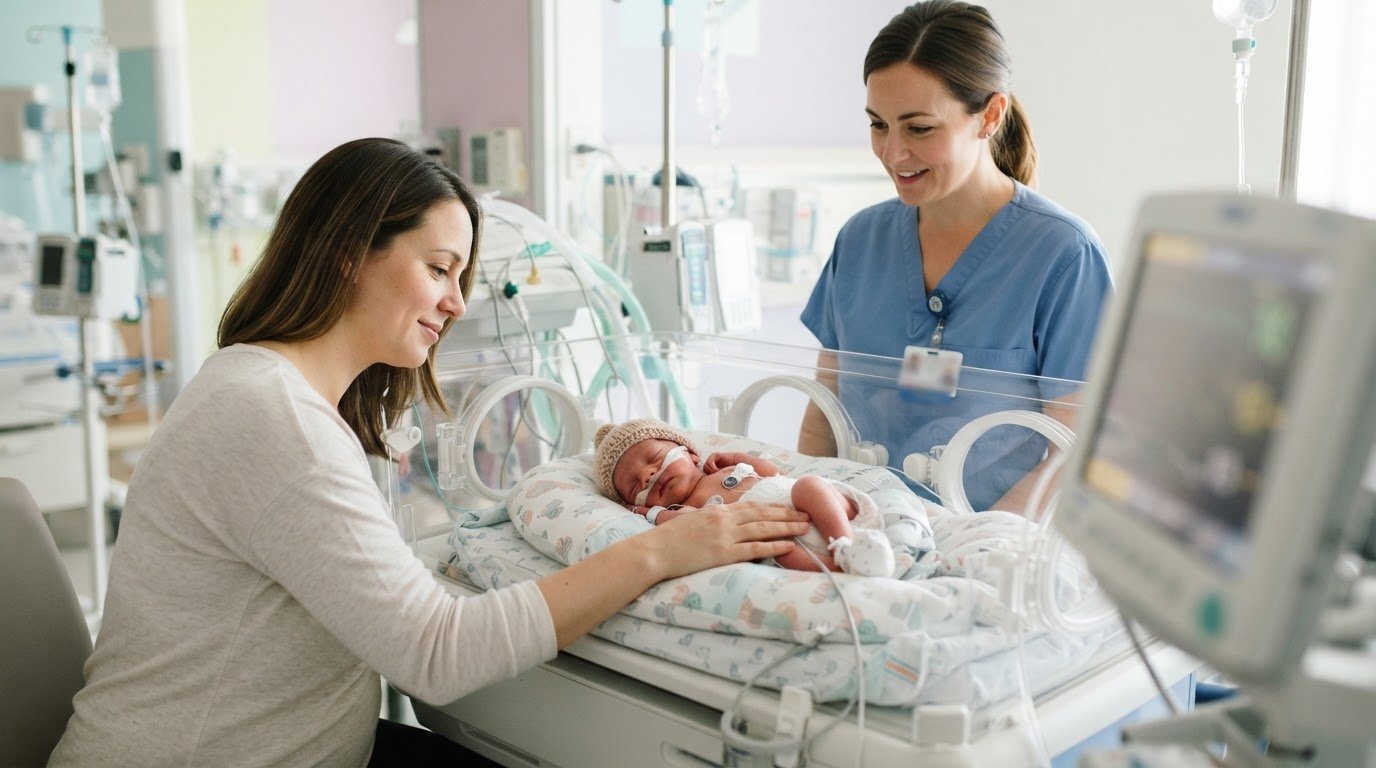
A baby in the NICU is not simply a recipient of care. Infant developmental care treats each infant as an active participant, using their cues to shape handling, positioning, rest and family involvement. The approach adapts care to the baby’s needs and recognizes parents as important partners. It asks care teams to consider routine interactions from the infant’s perspective.
When a baby needs intensive care, medical treatment naturally comes first. Developmental support is another part of the picture: teams can adjust everyday interactions and the care environment to respect an infant’s responses and developmental needs. This approach also gives families a meaningful role, while clinicians guide treatment and coordinate the care plan.
This article explains pro-developmental care and how NICU teams put it into practice. It covers how supportive surroundings, individualized care and attention to infant cues can shape daily routines, and how parents can participate in care and decisions. Together, these elements help create a more responsive approach for each baby and family.
Key Takeaways
- Understand how pro-developmental care treats infants as active participants and parents as partners in care.
- Learn how NICU teams adapt light, sound, positioning and rest to support each baby’s developmental needs.
- See how care teams can tailor routines around infant cues, comfort, sleep and feeding needs.
- Explore how family participation and responsive care can shape everyday NICU practices.
What is pro-developmental care?
Pro-developmental care adapts NICU routines to an infant’s development, responses and family context. It treats a newborn’s behaviour as information that can help shape care.
Infant- and family-centred care
Infant- and family-centred care recognizes each baby as an individual and parents as important caregivers and advocates. NIDCAP describes infants as collaborators in care, supported and nurtured by their parents. In practice, care planning considers the baby’s responses alongside the family’s strengths and needs. Early intervention pathways and eligibility vary between Canadian provinces and territories, so program arrangements are not the same nationwide.
Family participation and shared decisions
Family participation means parents share observations and contribute to discussions about their infant’s care. For example, during rounds, a parent might describe how their baby responds to a familiar voice or routine. Milestones are skills that emerge across movement, communication, learning and social interaction. Since timing varies between infants, clinicians consider a child’s age and overall pattern of development rather than relying on one skill alone.
Emotional and psychological family support
Emotional and psychological support can help parents manage the uncertainty and stress of a newborn’s NICU admission. Practical support may include clear explanations before procedures, time to discuss concerns, and help taking part in daily care. At home, parents can support brain development through responsive interaction, such as talking, holding and following the baby’s attention. Seek a developmental assessment if you have concerns about progress or notice a loss of previously acquired skills. Share specific observations with the healthcare team.
In practice, infant- and family-centred developmental care supports family participation in neonatal care and shared decision-making that considers each family’s strengths and needs. Guidance recommends integrating parents into the care team and treating them as partners in decisions about their infant. Family-centred care also helps parents participate in their premature baby’s care and recognizes them as important, equal partners in creating the best possible conditions for their baby.
NICUs can support this approach by fostering collaboration between families and healthcare providers and training team members in holistic, family-centred care. NIDCAP is described as a comprehensive, family-centred, evidence-based approach to developmental care in newborn and infant intensive care nurseries.
Developmentally supportive NICU environments
Environmental adjustments help make the NICU more responsive to each infant’s needs. Alongside clinical care, teams consider the surroundings, including light, touch and opportunities for family contact.
Positioning and postural support
Positioning and postural support involve adapting an infant’s body alignment to their clinical needs and development. A plan can account for posture, care activities and observed stability instead of applying one position to every baby. Appropriate support can help reduce postural complications and promote physiological or autonomic stability. Care teams can review positioning as needs change and document the reasons, so staff and parents understand the approach. During routine care, gentle touch and supported movement can also make handling measured and responsive.
Sleep and arousal support
Sleep and arousal support means adjusting the environment and timing of care to respect an infant’s periods of rest and alertness. NICU teams can modify lighting to support developing sleep-wake rhythms and reduce high-frequency noise. Recording individual patterns helps staff identify when an infant is settled or ready to engage. Where clinical routines allow, teams can coordinate necessary care around observed rest periods. These observations make adjustments specific to the baby rather than relying on a uniform schedule.
Care for premature infants
Developmental care for premature infants pays particular attention to how external stimulation and handling fit each baby’s needs. Staff can reduce unnecessary sensory input, use gentle touch and support skin-to-skin contact when it fits the infant’s care plan. Parents can share observations about their baby’s responses, helping the NICU team adapt routine interactions. The aim is to make the environment responsive to the infant’s condition and developmental needs, while clinical professionals continue necessary monitoring and treatment.

Minimizing pain and tailoring care to infants’ needs
In neonatal intensive care, developmental support means limiting avoidable stress while meeting clinical needs. Professionals consider each infant’s responses when planning handling, feeding and rest.
Reducing sensory stimulation and stress
Reducing sensory stimulation means limiting avoidable noise and other stressors during an infant’s care. This can make intensive care more responsive to the baby’s state. Teams can reduce high-frequency noise, protect rest periods and observe whether handling disrupts sleep or increases distress. Skin-to-skin contact is another supportive approach when it fits the care plan. Kangaroo Mother Care and skin-to-skin methods can improve short-term cardiorespiratory stress outcomes, reduce cortisol, increase oxytocin and reduce distress in newborns.
Pain management tailored to infants
Individualized pain management means adapting comfort measures to the infant, the procedure and the baby’s observed responses. This matters because premature infants may show stress through changes in behaviour and physiological state. Before a stressful procedure, the team can plan ways to reduce avoidable discomfort and support the baby’s regulation. Parents can be supported to provide non-pharmacologic comfort measures during procedures, participating in care while professionals monitor the infant’s response.
Feeding is another area where developmental needs shape clinical routines. Protocols can account for an infant’s readiness and tolerance instead of relying on a uniform approach. Staff observe the baby’s response during feeding and use those observations to guide care planning. If stress cues arise, the team can reassess the pace or approach within the infant’s care plan. This individualized attention connects feeding support with broader efforts to protect sleep, reduce stress and avoid unnecessary discomfort.
Care planning also considers how necessary interventions fit into the infant’s day. Professionals can coordinate handling and comfort measures around the baby’s cues while keeping clinical priorities central. For families, understanding a procedure’s purpose and the available comfort options can make participation more practical. The team’s observations can then guide later routines and decisions about support for that infant.
Infants as collaborators in care
Even before speech is possible, an infant in intensive care communicates through behaviour. Changes in movement, facial expression, breathing or state can offer clues about comfort and readiness. Treating these responses as meaningful helps the team adapt care to the baby, rather than following routines without considering the infant’s signals.
Collaboration starts with observation. Before handling or feeding, caregivers can notice whether the baby is settled, alert, drowsy or showing signs of stress. During care, they can watch for changes and pause or adjust their approach if the infant’s responses suggest difficulty. For example, hand-to-mouth movements or a settled posture can help staff pace routine interactions.
Parents bring valuable observations because repeated contact helps them learn their baby’s individual patterns. They can share what settles their infant, which cues appear before distress, and how the baby responds to touch or voice. During rounds, these details can connect bedside observations with care decisions. Taking part in daily routines also helps parents become familiar with their infant’s responses.
This approach does not mean infants make clinical decisions. Their cues inform how care is delivered, while clinicians remain responsible for clinical judgement. A practical cycle is to observe the baby, provide care, notice the response and adapt the next interaction. NIDCAP’s view of infants as collaborators places observation at the centre of care. The takeaway for families and professionals is that a baby’s behaviour is useful information, not background noise.
Care teams can strengthen this approach by making observations consistent across caregivers and shifts. Record the infant’s responses in the care plan, then share relevant patterns with parents and team members. To support infant-led care practices, explore resources for developmental care.
Novus Medical: LungFit® PH
LungFit® PH is an inhaled nitric oxide generator for clinical teams evaluating respiratory support technology. Its patented Plasma Pulse Technology® is a product feature; it does not replace developmental care practices such as observing infant cues, adapting handling or supporting family participation.
For neonatal and critical-care teams, the relevant next step is to assess whether an inhaled nitric oxide system fits their clinical workflows and respiratory-care requirements. Novus Medical offers LungFit® PH alongside other respiratory equipment, including the EO-150 Ventilator and Monnal™ T60 Advanced. These products address respiratory care needs, while developmental care remains individualized to each infant and family.
For information about LungFit® PH and its role in clinical respiratory care, contact Novus Medical or visit novusmedical.ca.
Keep developmental priorities in view
As your team reviews NICU practices, consider how equipment decisions fit alongside individualized care. Technology can support clinical workflows, but attentive observation and family participation remain central to infant developmental care. Identifying your facility’s respiratory-care requirements can help focus discussions about equipment and implementation.
Novus Medical offers LungFit® PH and the EO-150 Ventilator for respiratory care, as well as the MagVenture Accelerator Training Program for clinicians. These offerings serve different clinical and educational needs, so align any product discussion with your facility’s intended use and care setting.
To discuss respiratory equipment or clinician training with Novus Medical, contact the team. Thoughtful planning can help your team keep each infant’s needs at the centre of care.
Frequently Asked Questions
What is infant developmental care?
Infant developmental care adapts care to a baby’s developmental stage, responses and medical needs. For example, caregivers can pause an interaction when a baby shows signs of fatigue, then observe whether a quieter approach helps. The approach also gives parents room to share what their baby tolerates and responds to during daily routines.
What are evidence-based infant developmental care practices in Canada?
Canadian NICU teams can use practices such as individualized positioning, documenting infant activity patterns, and aligning feeding protocols with developmental needs. The 2022 consensus panel’s standards and recommendations address infant- and family-centred care. Teams can apply infant developmental care by recording how a baby responds to routine activities, then using those observations to inform care planning and parent discussions.
What are the risks of overstimulation and how can caregivers avoid it?
Excessive stimulation can disrupt rest and contribute to stress or distress. Caregivers can limit avoidable sensory input by lowering background noise, reducing unnecessary handling and allowing quiet periods between interactions. At home, pause play or conversation if the baby seems unsettled or tired. In a NICU, follow the established care plan and observe the infant’s response to changes in sound, light and activity.
Disclaimer
Disclaimer: Articles on this website are produced with the assistance of automated content tools (AutoSEO) and are intended solely for general informational purposes. This content does not constitute professional advice. While we strive to maintain accurate and up-to-date information, readers should verify key details independently before taking action based on any content found on this site.



Leave a Reply
Your email is safe with us.