

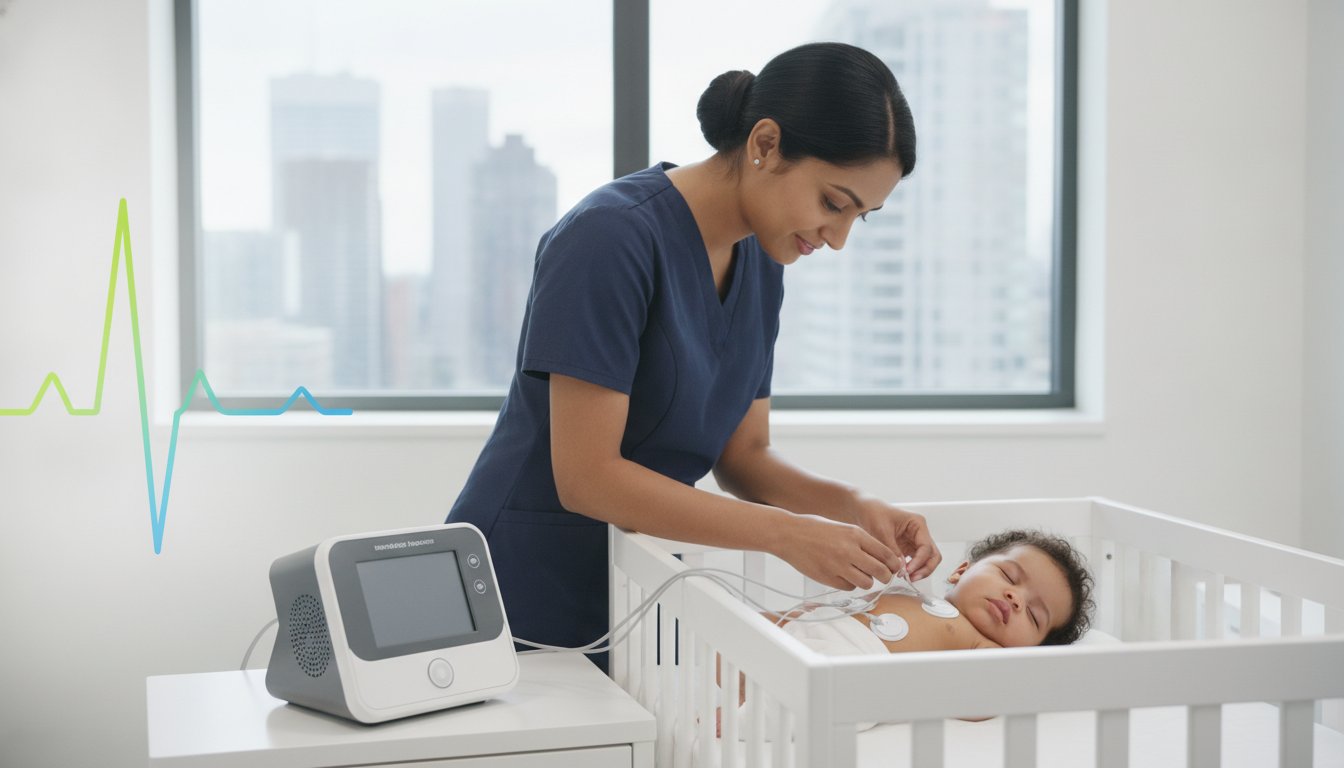
In Canadian pediatric care, apnea monitoring for pediatric patients detects central, obstructive, or mixed infant apnea (pediatric apnea) events lasting longer than 20 seconds, or those accompanied by bradycardia or color change. Selecting calibrated, clinically validated equipment ensures reliable alarm triggers while preventing alarm fatigue in hospital and home environments. Modern home monitor (apnea monitoring) systems track continuous heart and respiratory rates so you can optimize outpatient care plans across Canada. The decisions that follow centre on three questions: which risk profile applies, which device features and alarm limits fit that profile, and when monitoring should stop or never start.
Key Takeaways: Pediatric apnea monitoring is medically indicated for events lasting over 20 seconds or those involving bradycardia, typically for premature infants or those with tracheostomies.
- Central and obstructive apnea require different monitoring focuses on either neural drive or airway patency.
- Monitoring is unnecessary for healthy full-term infants except when documented airway anomalies or hypoventilation exist.
- Obtain equipment through specialized durable medical equipment suppliers rather than pharmacies to ensure insurance coverage.
- Calibrate baseline heart rate thresholds using 24-hour trend data to reduce home alarm fatigue.
3 Clinical Scenarios for Pediatric Respiratory Care
Selecting proper monitoring pathways requires matching patient risk profiles to specific diagnostic configurations. Three situations recur in Canadian practice: a neonate leaving intensive care who still needs continuous respiratory tracking (pair discharge with a recording-capable home monitor); a stable outpatient family that must run the device without constant clinician presence (choose a simple interface and fast software review); and a critically ill child coming off ventilatory support who needs bedside effort assessment during in-hospital transport (use a dedicated signal-capture system at the bedside). Structured oversight in these pathways reduces readmission risk and improves outpatient safety.
First, premature infants evaluated for infant apnea need specialized recording setups during initial discharge planning. The ApneaTrak system delivers smart recording capabilities to track compliance and physiological events accurately. Continuous monitoring fits high-risk discharge cases best.
Second, stable pediatric patients using a home monitor require simple interfaces that support family operation without false alarms. Easy software analysis helps Canadian clinicians adjust care plans quickly.
Third, critically ill children weaning from intensive care ventilation need dedicated bedside systems to evaluate respiratory effort. Reliable signal capture protects the patient throughout transport within the hospital.
Each scenario demands deliberate device selection based on acuity. Request a quote today to equip your facility with dependable physiological systems.
Classifying Pediatric Apnea Clarifies the Right Risk Pathway
Identify the specific form of infant apnea early so you can select appropriate monitoring and treatment strategies.
Central, obstructive, and mixed conditions present distinct diagnostic profiles requiring precise clinical evaluation. According to Wikipedia’s Obstructive Sleep Apnea entry (2025), obstructive events involve physical airway blockage despite ongoing respiratory effort. Conversely, central events stem from a temporary lack of neural signal to breathe. Choosing accurate home monitor equipment depends on whether physical blockages or neurological pauses drive these incidents.
| Apnea Type | Primary Mechanism | Recommended Focus |
|---|---|---|
| Central | Absence of respiratory effort | Neural drive monitoring |
| Obstructive | Upper airway blockage | Airway patency management |
| Mixed | Combined central and obstructive factors | Comprehensive ventilatory support |
Your clinical team must evaluate specific risk profiles to determine whether low-flow support or an advanced breathing machine (intensive care ventilator) is required. To review complete equipment specifications for specialized pediatric respiratory care, consult Novus Medical, Excellence Through Experience for nationwide support in Canada. Select dedicated monitoring tools tailored to your patient’s exact physiological risk.
Custom Alarm Limits Reduce Delayed Detection in High-Risk Infants
Customizing threshold settings on a home monitor prevents critical delays in detecting infant apnea. Establishing tailored parameters from objective physiological baselines is the safe approach for home care. Obtaining unserviced medical equipment via informal channels creates serious hazards for patients and major liabilities for providers. Healthcare providers should source devices through verified distributors like About Novus to ensure proper safety testing.
Follow this clinical protocol to configure baseline parameters safely:
- Analyze trend data: Review 24-hour physiological recordings before patient discharge.
- Establish heart rate limits: Set low cardiac thresholds relative to sleeping baselines.
- Configure oxygen parameters: Define precise desaturation alarm triggers.
- Verify delay intervals: Adjust duration settings to filter false events.
For advanced respiratory support, the LungFit PH System utilizes patented technology to produce inhaled nitric oxide directly from ambient room air. Caregivers running complex ventilatory support still need calibrated safety systems around the monitor itself. Custom configurations fit high-risk neonates who require tight physiological windows, while standard limits suit stable recovering infants.
Tip: To optimize accuracy without unnecessary alarm fatigue, calibrate baseline heart rate thresholds using 24-hour trend data before discharge.

Device Features That Support Safe Home Monitoring
Obtaining a home monitor for infant apnea requires clear coordination between hospital discharge planners and medical equipment providers.
Navigating durable medical equipment claims early prevents dangerous delays in infant care. Securing proper coverage early ensures that equipment arrives before discharge. During work on the Baby Pod project with Advanced Healthcare Technology Ltd. (AHT), safe neonatal infant transport in vehicles was the core problem. A lightweight transport device with a crash-survivable design and carbon fibre construction was implemented, producing a safe, lightweight solution for moving vulnerable infants.
Selecting equipment with verified sensors guarantees dependable tracking during sleep. For specialized diagnostic needs, consult our guide on pulmonary testing options to evaluate testing capabilities.
Policy shifts frequently force families to secure essential home monitoring gear through a dedicated medical supply company rather than a neighbourhood pharmacy.
A commenter in the forum.breakthrought1d.org thread "Medical supply company recommendations":
"Due to a change in insurance last year, my CGM supplies are no longer a ‘pharmacy’ item and instead are a ‘durable medical equipment’ item- that requires I order through a medical supply company." (source)
Insurance reclassifications often shift home respiratory gear into durable medical equipment categories, requiring specialized equipment suppliers. Working with an experienced medical device vendor simplifies this administrative process for clinicians and caregivers.
When Apnea Monitoring for Pediatric Patients Is Unnecessary
Prescribing a home monitor for healthy full-term infants without clinical indications creates unnecessary parental anxiety and frequent false alarms.
Sound diagnostic boundaries protect families from chronic sleep disruption and alarm fatigue. Unwarranted telemetry often leads to repeated, non-urgent emergency visits that yield no real therapeutic outcome. Monitoring infant apnea is unnecessary for asymptomatic, healthy infants who lack underlying cardiorespiratory risks. Deploying monitoring equipment like a passive safety blanket on a healthy baby introduces stress without changing clinical outcomes. Clinical guidelines restrict these devices to infants with documented tracheostomies, severe airway anomalies, or active central hypoventilation. Prescribing a monitor solely for benign periodic breathing or parental reassurance is improper practice. Reserve home monitoring for clear pathophysiological risks. Contact our team to review appropriate patient selection criteria.
Caregiver Training and Support That Sustain Home Programs
Infant apnea monitoring programs typically last until the infant experiences no events for a defined period, and structured family education drives strong completion rates. This continuous oversight supports safe transitions from hospital care.
Local medical supply shops frequently feature steeper prices and fewer options than dedicated distributors, which heightens the need for expert remote setup guidance. In work with Freeman Ellis Staley and his parents, Will and Misti, managing complex home therapies and gravity syringe feeds had become overwhelming. Hands-on support guided them through daily challenges, which resulted in a smoother feeding process and reduced stress at home.
The customer service provided in ordering, configuring, training and following up on any queries regarding the Elite Platinum DL RTD has been the best customer service we have ever experienced. End-to-end customer service means families receive ongoing assistance for their home monitor equipment long after initial setup.
Among Novus Medical’s Google reviews, Farzad (5★) wrote:
"Excellent organization with highly qualified staff. I used to order equipment and supplies from them while working with my previous employer. Highly recommend."
Comprehensive caregiver instruction and technical support help families operate home monitoring equipment with confidence.
In the reviews.birdeye.com post titled "Eco Medical Equipment, Healthcare in Edmonton, AB, Birdeye", a reviewer stated:
"The staff at Eco Medical in Edmonton did a terrific job helping me order my Q’Straint retractors and seatbelt extension. They were professional, helpful and made the whole process easy from start to finish." (source)
Expert guidance from knowledgeable representatives makes sourcing home monitoring equipment reliable from order through follow-up.
Frequently asked questions
What is infant apnea?
Infant apnea is a respiratory condition characterized by a pause in breathing that lasts longer than twenty seconds. Shorter breath pauses accompanied by slow heart rates or cyanosis also indicate this condition. Canadian clinical teams monitor vulnerable neonates closely to prevent severe secondary oxygen deprivation. Advanced bedside equipment alerts caregivers immediately when breathing stops.
When is a home monitor needed?
A home monitor is needed when an infant leaves the hospital with ongoing risks of dangerous respiratory pauses. Clinicians prescribe these devices for premature infants, infants requiring home oxygen therapy, or those with neuromuscular disorders. Reliable alarm settings ensure that parents and home care providers receive rapid alerts during critical events. You can contact a specialist to review portable monitoring equipment for discharge planning.
What defines apnea in children?
Pediatric apnea is defined as an abnormal cessation of airflow lasting longer than twenty seconds, or a shorter pause associated with oxygen desaturation. Medical standards classify these events into obstructive, central, or mixed types. Diagnostic systems accurately log airflow drops and effort signals to determine the exact pattern. Precise monitoring helps respiratory clinicians select appropriate ventilatory support or diagnostic protocols.
What are the common causes of pediatric apnea?
Pediatric apnea stems from underdeveloped central nervous system control, physical airway obstructions, or underlying medical conditions like gastroesophageal reflux. Neuromuscular weaknesses and severe respiratory infections can also impair normal breathing regulation in young patients. Identifying the root mechanism allows clinical teams to apply targeted treatments. Modern monitoring devices assist in tracking how well infants respond to therapeutic interventions.
How prevalent is obstructive sleep apnea in children?
Clinically Proven Respiratory Support
Reliable infant apnea monitoring for pediatric patients demands dependable clinical technology and continuous operational oversight. The same decision arc you started with (risk profile, device and alarm fit, and whether monitoring is indicated at all) still governs safe practice when care moves from the unit to the home. In 2026, healthcare facilities across Canada rely on specialized monitoring and ventilation systems designed to protect vulnerable patients. Integrating advanced devices with home monitor tools supports care transitions from intensive care units to outpatient environments.
VP of Novus Medical Robert Simms and President Murray Beaton oversee a dedicated team focused on end-to-end customer service. Healthcare teams gain technical assistance, customized equipment setups, and staff training so you can strengthen patient safety while streamlining daily clinical workflows.
Contact our clinical team today to request a quote or product demonstration.
Disclaimer
Disclaimer: Articles on this website are produced with the assistance of automated content tools (AutoSEO) and are intended solely for general informational purposes. This content does not constitute professional advice. While we strive to maintain accurate and up-to-date information, readers should verify key details independently before taking action based on any content found on this site.
Leave a Reply
Your email is safe with us.