

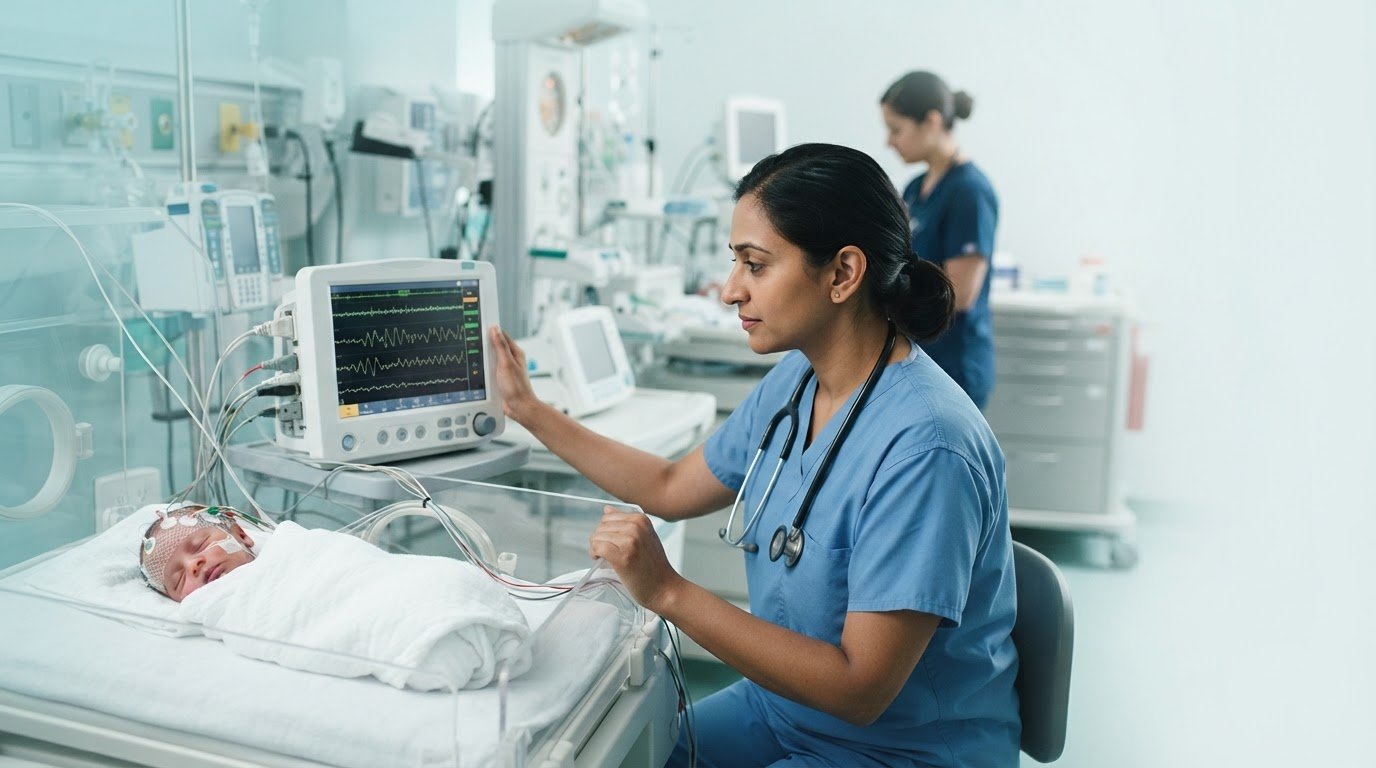
A neonatal cerebral function monitor displays trends in an infant’s cerebral electrical activity, but it does not provide a complete neurological assessment. For NICU teams, its value depends on matching the recording to a clear clinical question, checking signal quality and interpreting the trace alongside the infant’s condition and other assessments.
This guide explains what cerebral function monitoring may contribute, how amplitude-integrated EEG differs from conventional EEG, and what to plan before introducing monitoring into a unit’s workflow. It also covers practical considerations for recording, review and communication, so teams can set clear expectations for what a bedside trace can and cannot show.
For teams evaluating equipment, this guide also introduces the ANT Neuro NEO cerebral function monitor. Novus Medical supplies the monitor and provides Canadian technical support for medical devices.
Key Takeaways
- Understand what a neonatal cerebral function monitor displays and how its information differs from conventional EEG.
- Use the trace as one source of information, not as a standalone diagnosis or prediction of outcome.
- Plan monitoring around a defined clinical question, signal-quality checks, qualified review and documented decisions.
- Evaluate the ANT Neuro NEO cerebral function monitor against your NICU’s clinical needs and workflow.
What does a neonatal cerebral function monitor measure?
A neonatal cerebral function monitor records electrical activity from the brain through scalp electrodes and displays it in a bedside format for observing patterns over time. In neonatal care, cerebral function monitoring (CFM) commonly refers to amplitude-integrated electroencephalography (aEEG). The displayed trace is a processed, compressed representation of EEG activity. It is not a direct measure of brain structure, oxygenation or neurological function as a whole.
Clinicians may review the trend for features of the background pattern and possible seizure activity. Interpretation depends on the infant’s clinical presentation, the recording quality and other relevant assessments. The trace cannot, by itself, establish a diagnosis or predict an individual infant’s outcome.
How do cerebral function monitoring and EEG relate?
aEEG is derived from EEG, but it is not equivalent to conventional EEG. It compresses electrical activity into a trend that can support bedside observation. Conventional EEG retains more detailed, multi-channel information, which can help clinicians assess and localize seizure activity. For an overview of the processing and display approach, see Amplitude-integrated electroencephalography (aEEG).
This difference matters when reviewing a recording. A simplified trend can make changes in background activity easier to follow, but it may not show the full detail of the underlying EEG. Some seizure patterns may be difficult to identify on aEEG alone. A concerning or uncertain trace therefore requires clinical interpretation and may prompt review using conventional EEG, depending on the clinical question and local practice. A neonatal cerebral function monitor is a monitoring tool, not a standalone diagnostic verdict.
What can neonatal cerebral function monitoring tell clinicians, and what can it not?
A cerebral function trace can help clinicians follow changes in recorded brain electrical activity over time. Depending on the recording and the clinical question, the pattern may contribute information about background activity or raise concern for possible seizure activity. It remains one source of clinical information, not a complete account of an infant’s neurological status.
A neonatal cerebral function monitor cannot independently establish a diagnosis, determine the cause of an abnormal pattern or predict an individual infant’s outcome. A trace considered in isolation should not dictate management. Clinical judgement and other investigations remain necessary when indicated.
Why should a monitor trace be interpreted in clinical context?
Interpretation depends on both the infant and the recording. The care team considers the infant’s condition and the reason monitoring was initiated, as well as the trace’s continuity and technical quality. Electrode contact, movement or interference can affect the signal. Gaps or changes in the recording can also limit what can be concluded. A change on the display needs assessment, not automatic attribution to a neurological event.
Possible seizure activity or an atypical background pattern should be reviewed by a qualified neonatal specialist. If the trace is unclear or the clinical concern requires more detail, the team can consider whether further assessment, including conventional EEG, is appropriate. The decision depends on the clinical question and local practice, not on a single display feature.
For broader context, clinicians can consult paediatric research and professional guidance, including resources from the American Academy of Pediatrics. These resources complement, rather than replace, specialist interpretation of an individual infant’s findings.
When assessing equipment, consider how signal review and escalation will fit existing clinical workflows. Novus Medical provides the ANT Neuro NEO cerebral function monitor and Canadian technical support for medical devices.

How can a NICU team plan cerebral function monitoring in practice?
Build the workflow around the clinical question: decide how the recording will be obtained, reviewed and incorporated into care. Before introducing a neonatal cerebral function monitor, identify who will operate the equipment, check the recording and arrange qualified interpretation. Also decide how the team will respond to technical concerns or interruptions. Clear responsibilities help integrate monitoring into bedside care.
Which workflow questions should a neonatal team address?
Use a practical sequence that reflects local clinical processes:
- Define the question. Clarify what the team expects the recording to contribute and how it relates to the infant’s broader assessment.
- Plan the recording. Assign responsibility for setup and signal checks. Decide where recording fits into bedside routines and how staff will handle interruptions or technical concerns.
- Arrange review and communication. Establish who reviews the signal, who provides clinical interpretation and how relevant findings reach the care team. Align responsibilities with local roles and expertise.
- Document the decision-making. Record the clinical question, relevant recording context, interpretation and resulting decisions in the appropriate clinical documentation.
Training should cover operation of the system and recognition of recording concerns. Clinical interpretation remains the responsibility of appropriately qualified professionals. During equipment evaluation, consider staff access to that expertise, how findings will be communicated across the team and whether review fits the unit’s usual workflow. A display or alert alone does not define the next clinical step.
Equipment planning also benefits from considering how neurodiagnostic tools fit the wider care environment. Novus Medical’s Canadian neurodiagnostic equipment overview provides broader context for those discussions. To discuss the ANT Neuro NEO cerebral function monitor and Canadian technical support, connect with Novus Medical.
How does the ANT Neuro NEO cerebral function monitor fit a Canadian NICU?
The ANT Neuro NEO cerebral function monitor is available to Canadian NICU teams evaluating neonatal cerebral monitoring equipment. Assess its fit against the clinical use case and the facility’s established care and interpretation processes. Novus Medical distributes the monitor and provides Canadian medical-device sales and technical support.
Keep the evaluation specific to the unit’s needs. Review the product’s intended use and specifications, then consider how they align with the team’s workflow. This helps distinguish the device’s documented functions from the broader clinical processes required to use monitoring information.
What should a facility establish before evaluating a monitor?
Start by defining the clinical use case and identifying the people involved in operating, reviewing and acting on monitoring information. Then assess operational requirements, including where the equipment will be used, how staff will be trained and how technical support fits into the facility’s planning. These steps help teams assess practical fit without expecting a device alone to resolve workflow or interpretation needs.
- Clinical need: Identify the questions the team expects monitoring to inform.
- User roles: Clarify who will handle recording, review and communication within local processes.
- Product information: Review intended use and specifications in current product materials, and base the evaluation on documented details.
- Operational fit: Consider training, access to qualified interpretation and the relationship to existing NICU equipment.
Where broader equipment planning is relevant, the neonatal respiratory therapy guide offers additional NICU context. For a focused product discussion, Canadian healthcare teams can explore the NEO cerebral function monitor through Novus Medical. Reviewing the clinical use case, product information and support needs together gives the facility a practical basis for evaluation.
Set a clear path for your next evaluation
Keep equipment evaluation connected to current clinical practice. As a unit’s priorities change, teams can revisit the questions they expect a neonatal cerebral function monitor to help address and how bedside monitoring fits into existing assessment and review processes.
Bring product information into that discussion. Reviewing the ANT Neuro NEO cerebral function monitor can help your team assess its fit with the facility’s clinical use case, workflow and support requirements.
Explore the ANT Neuro NEO cerebral function monitor with Novus Medical and discuss your NICU’s evaluation needs with our team.
Frequently Asked Questions
Is a neonatal cerebral function monitor the same as an EEG?
No. The terms are related, but they do not always refer to the same recording approach. Specify whether a request is for aEEG/CFM or conventional EEG, and use the modality named in the report when discussing results. This reduces ambiguity in handovers and referrals. Follow current neonatal neurophysiology guidance and local documentation conventions.
Can a cerebral function monitor diagnose neonatal seizures on its own?
No. A trace alone cannot establish neonatal seizures. Treat a displayed event as a finding for clinical review, not a conclusion. The care team determines whether another assessment is warranted. For handover, note the time of the event and relevant clinical observations so the team can compare the display with what was happening. The next step depends on the infant and current practice.
How long is cerebral function monitoring used for a newborn?
There is no universal duration. The team’s plan should specify the clinical question the recording is intended to address and when its ongoing value will be reassessed. If the newborn’s status or monitoring purpose changes, the responsible clinicians can revisit the plan. Follow institutional guidance and the device’s approved instructions rather than adopting a fixed period from another setting.
Who should interpret a neonatal cerebral function monitor recording?
Interpretation should be carried out by clinicians whose responsibilities and competencies are established by the unit. Facilities can clarify in their workflow who receives a completed review and how the interpretation is communicated to the treating team. Include relevant clinical information with the recording so its review can inform ongoing assessment rather than being treated as a standalone report.
Disclaimer
Disclaimer: Articles on this website are produced with the assistance of automated content tools (AutoSEO) and are intended solely for general informational purposes. This content does not constitute professional advice. While we strive to maintain accurate and up-to-date information, readers should verify key details independently before taking action based on any content found on this site.

Leave a Reply
Your email is safe with us.