
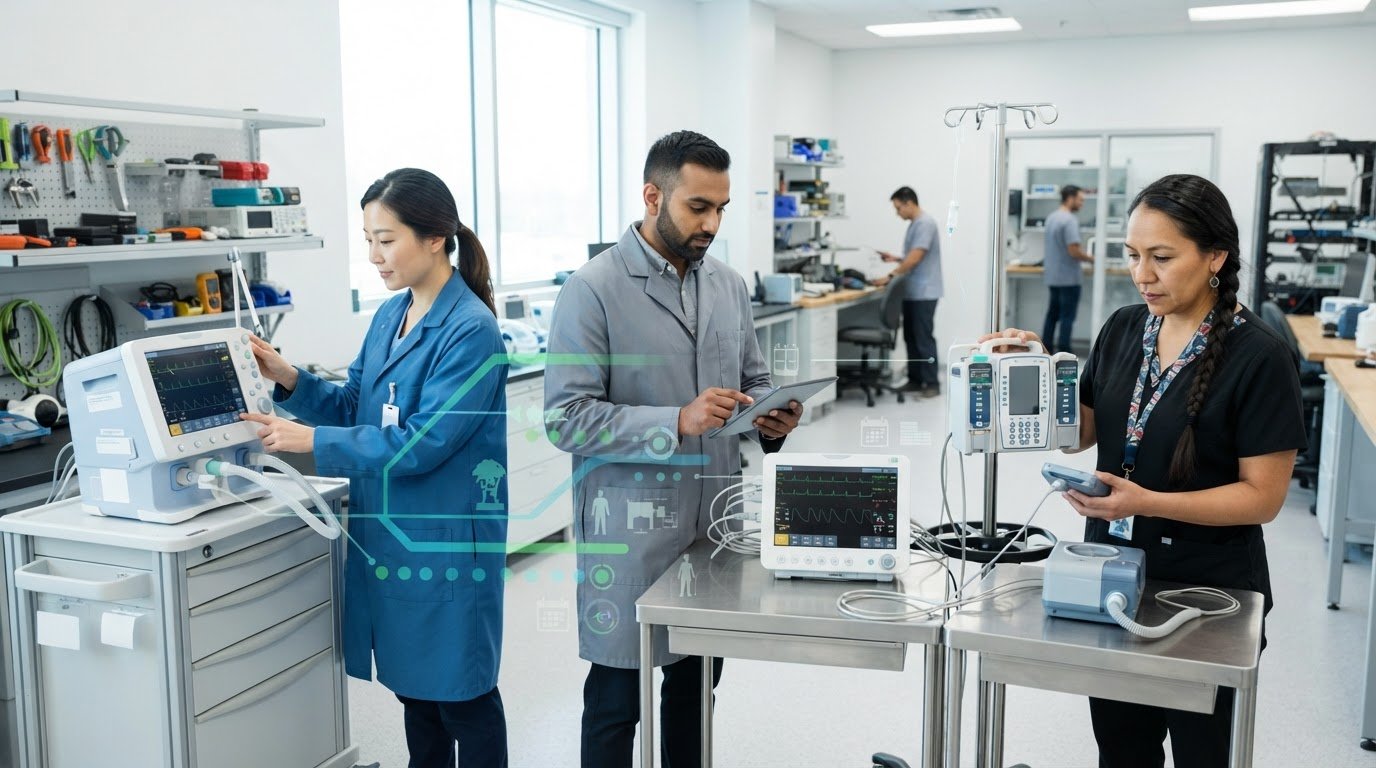
What if the most useful starting point for hospital equipment maintenance planning isn’t a broad estimate, but a closer look at each asset’s clinical role, condition and service history? Equipment needs differ across an inventory, and an unexpected failure can disrupt workflows or leave teams managing availability without a clear maintenance record.
Healthcare teams already know that reliable equipment depends on more than responding when something stops working. Planning is harder when service records are scattered and maintenance requirements vary between devices. This article explains the key factors that shape maintenance planning for Canadian hospitals in 2026, without relying on generic estimates. You’ll learn how preventive, corrective and condition-informed approaches differ, which asset and operational details to track, and how organized service histories can support practical resource planning. The result is a clearer foundation for aligning maintenance activity with equipment needs and clinical workflows.
Key Takeaways
- Hospital equipment maintenance needs depend on each device’s age, use, operating environment and service history, so broad estimates can miss important differences.
- Learn how preventive, corrective and condition-informed maintenance approaches differ, and when each can guide planning.
- Use a consistent inventory workflow to organize asset details, service events, observed issues and coverage information.
- Build a repeatable review process that connects equipment needs with warranty support, service agreements and technical assistance.
What Shapes the Cost of Hospital Equipment Maintenance?
Maintenance needs differ because hospital inventories include devices with different clinical roles, technical complexity and operating demands. Equipment used frequently in a critical care environment may need a different service plan from an asset used intermittently in a controlled setting. Planning should reflect the equipment mix and how each device is used, rather than applying one assumption to an entire facility.
Age, usage intensity, operating conditions and service history all help define an asset’s maintenance profile. Documented repairs, recurring issues and completed inspections can indicate where closer review may be appropriate. A Medical equipment overview provides general context on the range and classification of devices used in care.
For a visual introduction to equipment servicing and repair, watch this video:
Which hospital equipment characteristics shape maintenance needs?
Consider clinical criticality alongside technical complexity and frequency of use. A device central to a care workflow may have different availability considerations from one used less often. Complex systems may require specialized technical support or parts, while operating conditions and wear can affect the attention an asset needs. These distinctions help teams set priorities without assuming identical requirements for every device.
Separate the work into four activities: scheduled inspections, corrective repairs after an issue is identified, replacement parts, and technical support. Each has a different trigger and resource requirement. Records of service events and observed issues can help teams distinguish routine activity from unplanned needs and support clearer coordination.
Generic figures cannot represent every Canadian facility or equipment inventory. Before setting planning assumptions, review each asset’s role, age, use, environment and available service documentation. Where records are incomplete, note the gaps. Without a clear history, it is harder to understand prior work or identify patterns. An asset-level review gives teams a more practical basis for planning across different devices and clinical environments.
Preventive, Corrective, and Condition-Informed Maintenance Explained
Hospitals can distinguish maintenance activities by what triggers them. Preventive maintenance is planned in advance according to documented requirements. Corrective maintenance responds to an identified fault or service need. Condition-informed maintenance uses available observations and service records to inform when review or intervention is appropriate. These approaches can coexist across an equipment inventory; none guarantees that failures will be eliminated or savings achieved.
When does each maintenance approach fit a hospital asset?
Match the method to the asset’s documented requirements, clinical role and available information. Schedule preventive work within planned service windows, with attention to workflow and availability. Start corrective work when a fault, performance concern or other service need is identified. Condition-informed decisions depend on meaningful observations and records; without them, there is less evidence to guide a change in timing.
| Approach | Trigger | Purpose | Planning consideration |
|---|---|---|---|
| Preventive | Documented schedule or requirement | Complete planned inspection or maintenance tasks | Coordinate service windows and follow device documentation |
| Corrective | Identified fault or service need | Assess and address the reported issue | Record the issue, response and resulting service activity |
| Condition-informed | Equipment observations or service history | Inform review or intervention based on available evidence | Use consistent records; note gaps or uncertainty |
For Canadian facilities, manufacturer documentation and established facility procedures should guide maintenance decisions. The linked CMS guidance on hospital equipment maintenance is a United States reference, not a substitute for Canadian requirements or local procedures.
Record the reason for each task and its outcome. This makes it easier to distinguish scheduled work from fault response and to assess whether the current plan reflects the asset’s service history. That evidence supports a more grounded view of the cost of hospital equipment maintenance without relying on a single method for every device.
For Canadian facilities planning equipment support, Novus Medical’s technical support is available by phone, internet and remote connection.

How to Track Maintenance Needs Across a Hospital Equipment Inventory
A consistent recordkeeping workflow helps biomedical engineering and clinical teams work from the same asset history. It also makes maintenance planning easier to revisit as equipment moves between departments, staff roles change or service needs emerge. Use a process that can be maintained across the inventory, rather than relying on scattered notes.
- Identify assets. Record device identifiers and enough information to distinguish each item in the inventory.
- Gather records. Bring together available service reports, maintenance history, and warranty or service agreement details.
- Classify needs. Note documented maintenance requirements, relevant service history and any known issues that may affect planning.
- Assign review. Clarify who will maintain the record and how clinical teams can report observations to biomedical engineering.
- Revisit plans. Review entries after service events or changes in equipment use, and update the plan when new information emerges.
Clinical teams can contribute information about observed issues and changes in equipment use; biomedical engineering can connect those observations with service documentation and maintenance history. Clear handoffs help ensure that relevant details follow the asset, rather than remaining with one department or staff member.
What records help teams plan equipment maintenance?
Pair an asset register with service reports and a usable maintenance history. Record identifiers, service events, observed issues, and warranty or contract details in a consistent way. The format can vary; the essential point is that teams can locate and interpret the information when equipment or personnel change. Avoid treating an undocumented gap as evidence that no service need exists.
For contract-focused considerations that relate to equipment support planning, consult this Canadian medical equipment service contract guide. Keep contract details with the relevant asset record so they can be considered alongside service history, not in isolation.
For support with medical equipment service and warranty needs, connect with Novus Medical, a Canadian distributor providing technical support by phone, internet and remote connection.
Building a Practical Hospital Maintenance Plan with Canadian Support
A workable plan connects each asset’s clinical role and current condition with its records and service requirements. This gives teams a repeatable way to set priorities, coordinate planned work and respond when needs change. Review the plan as part of equipment stewardship, rather than treating it as a one-time exercise.
- Review the asset’s role. Note how the equipment supports care and the operational implications of limited availability.
- Assess condition and history. Consider observed issues alongside documented service events and maintenance records.
- Identify service needs. Use manufacturer documentation and facility procedures to determine planned work and response requirements.
- Check coverage. Keep warranty coverage and service agreement details accessible, and understand how they relate to the asset’s service needs.
- Set ownership and review. Assign responsibility for coordinating requirements and updating the plan when equipment use or condition changes.
How can Canadian facilities make maintenance planning more consistent?
Assign clear ownership for reviewing asset records and coordinating service requirements. Biomedical engineering can maintain the service overview, while clinical teams report changes in use or observed concerns through an agreed process. Schedule regular internal reviews so that updates are captured and plans reflect the equipment’s current role and condition.
Warranty coverage, service agreements and technical support are distinct planning resources. Record the applicable coverage alongside the asset’s service history, and account for technical assistance when coordinating service activity. Novus Medical provides Canadian-based technical support by phone, internet and remote connection, as well as warranty and service support. These resources can help healthcare teams coordinate equipment support while maintaining a clear record of service needs.
A consistent review process gives facilities a more informed basis for managing the cost of hospital equipment maintenance, without assuming that one plan fits every asset. For support with medical equipment service and warranty needs, connect with Novus Medical.
Make Your Next Equipment Review Count
Use the next planning cycle to turn maintenance information into a clear operational decision. Select an equipment group, identify any unresolved record gaps, and assign responsibility for reviewing them. Then set a point to reassess whether service needs or clinical use have changed. This creates a practical step between keeping records and acting on them, helping teams make decisions about the cost of hospital equipment maintenance with asset-specific information rather than assumptions.
Consistency matters more than creating a complex process. A review that fits existing biomedical engineering and clinical workflows is easier to sustain, and it gives teams a reliable starting point as equipment needs evolve. Keep the focus on informed decisions that support dependable access to equipment and continuity of care.
For a discussion about technical support for your facility, connect with Novus Medical. A considered next step can help your team move forward with greater clarity and confidence.
Frequently Asked Questions
What factors affect the cost of hospital equipment maintenance?
The cost of hospital equipment maintenance depends on the asset and the work it requires. Equipment type, clinical role, usage, condition, service history, parts needs and service scope all shape planning. For example, two devices in the same department may have different service histories or operating demands. Facility-specific records help teams understand those differences; a generic estimate cannot reflect every inventory or care environment.
What is the difference between preventive and corrective maintenance?
Preventive maintenance is planned work guided by the equipment’s documentation and applicable facility procedures. Corrective maintenance is action taken in response to an identified fault or service need. A device may have scheduled preventive tasks and still require corrective attention if an issue arises between them. Both approaches can be part of an asset plan, but neither ensures that every failure will be avoided.
How often should hospital equipment be maintained?
There is no single maintenance interval that applies to every hospital device. Use the manufacturer’s documentation and applicable facility procedures to plan for each asset. If a device changes departments or its use increases, review whether the existing plan still fits its role and condition. Service history can also inform that review, but it should not replace equipment-specific documentation or facility guidance.
Which records should a hospital keep for equipment maintenance?
Keep an asset register alongside service reports, maintenance history and notes about observed issues. Include relevant warranty or service-agreement information so staff can understand the support context for each device. If equipment is transferred between departments, its record should remain accessible to the team receiving it. Consistent documentation helps staff identify prior work and plan follow-up without relying on individual memory.
Can maintenance history help a hospital plan future service needs?
Yes. Service history can help teams see recurring issues, prior repairs and changes noted in an asset’s condition. For example, repeated reports of the same concern may signal a need for a focused review. Consider those records alongside clinical use and manufacturer documentation when planning. Historical patterns can inform decisions, but they cannot predict exactly when a future repair or service event will occur.
Disclaimer
Disclaimer: Articles on this website are produced with the assistance of automated content tools (AutoSEO) and are intended solely for general informational purposes. This content does not constitute professional advice. While we strive to maintain accurate and up-to-date information, readers should verify key details independently before taking action based on any content found on this site.



Leave a Reply
Your email is safe with us.