

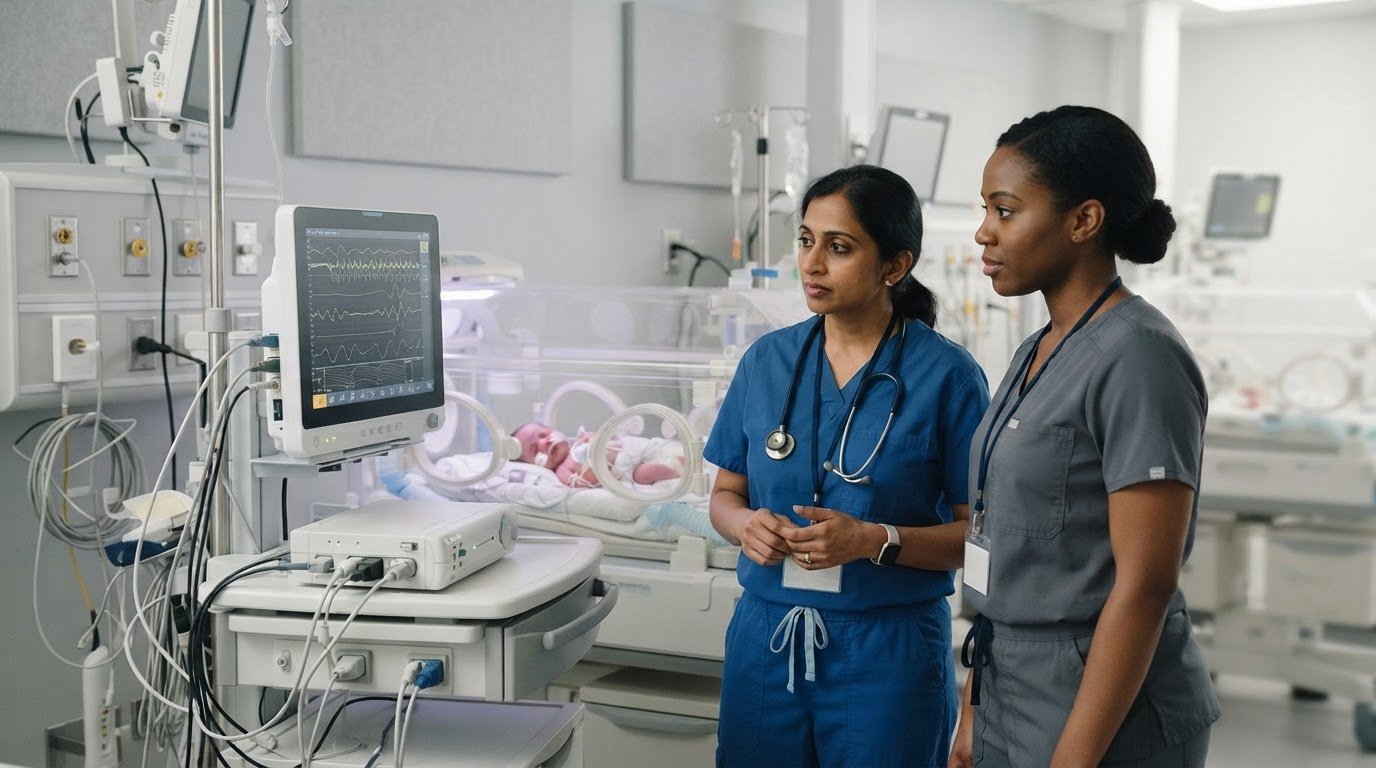
An infant who appears clinically settled may still have electrographic seizures that bedside observation cannot reveal. For Canadian NICU teams, this can complicate assessment, particularly when sedation limits visible signs or therapeutic hypothermia calls for ongoing neurological evaluation. Cerebral function monitoring in NICU, using amplitude-integrated EEG (aEEG), can add bedside information to clinical decision-making.
Early recognition of seizures and hypoxic-ischaemic encephalopathy (HIE) matters, yet access to specialist EEG interpretation around the clock may be limited. aEEG supports ongoing observation, but its limitations and the role of conventional EEG should also be considered.
This guide explains how bedside aEEG can support monitoring, what clinicians may consider during cooling, and how to plan consistent workflows across the NICU. Monitoring information can inform timely assessment and follow-up, but aEEG does not replace clinical judgement or full EEG when indicated.
Key Takeaways
- Learn how cerebral function monitoring in NICU can provide bedside aEEG trends, and where conventional EEG offers additional detail.
- Consider aEEG as part of neurological assessment for infants with suspected HIE or severe respiratory distress, including during therapeutic hypothermia.
- Set clear electrode placement and skin assessment procedures, and organize bedside connections to support safe care.
- When evaluating monitoring systems, review Health Canada licensing, clinical workflow requirements and whether the ANT Neuro NEO suits your NICU.
The Role of Cerebral Function Monitoring (CFM) in Neonatal Neuro-Protection
Neurological changes in the NICU may not be visible at the bedside. Cerebral function monitoring in NICU uses amplitude-integrated EEG (aEEG) to display trends in cerebral electrical activity over time, helping clinicians identify changes that may warrant assessment. This can be particularly relevant when seizures have no clear physical signs, including in sedated infants.
CFM provides an accessible bedside view over time. Conventional multi-channel EEG records activity across more electrodes and offers greater detail for specialist interpretation. aEEG supports continuous trend observation, but it does not replace conventional EEG when detailed seizure assessment is needed. Its role is to add timely information to clinical evaluation and neuro-protective decision-making.
The video below introduces neonatal cerebral function monitoring and its bedside context.
Continuous Trends vs. Intermittent Diagnostics
A spot-check EEG samples activity during a limited recording period, so an event outside that window may not be captured. Continuous aEEG trends give the care team an ongoing bedside view and can help flag changes for review. Earlier recognition may support timely clinical assessment and treatment decisions, but aEEG findings need to be interpreted in the context of the infant’s condition.
AEEG Technology and Signal Processing
aEEG software filters and compresses the EEG signal, then displays it as a time-compressed trend that is easier to follow at the bedside than raw EEG alone. Staff can observe changes over time, while clinicians interpret the trace alongside the infant’s condition and other available findings.
A semi-logarithmic scale expands the display of lower-amplitude activity relative to higher-amplitude activity, making subtle changes easier to see.
The ANT Neuro NEO cerebral function monitor is a bedside aEEG option available through Novus Medical. When considering it for a Canadian NICU, assess the device alongside your unit’s clinical needs, workflow and support requirements.
Clinical Indicators for aEEG Monitoring in the NICU
aEEG can add continuous information about brain activity when an infant’s clinical risk warrants neurological monitoring. For suspected hypoxic-ischaemic encephalopathy (HIE), clinicians may use CFM to assess background activity alongside the infant’s examination and other investigations. It can inform assessment during therapeutic hypothermia, but it does not determine cooling eligibility on its own. Follow the unit’s clinical protocol.
Respiratory and neurological status can also intersect. Severe respiratory distress and associated clinical instability may prompt closer assessment of cerebral function as part of the overall care plan. For context on respiratory care in Canadian NICUs, see this guide to neonatal respiratory therapy in Canada.
Monitoring During Therapeutic Hypothermia
During cooling and rewarming, aEEG trends can help clinicians follow background activity and identify changes that warrant review. Background pattern recovery over time may contribute to prognostic assessment, but it is not a standalone prediction of neurodevelopmental outcome. Interpret findings alongside the neurological examination, clinical course and other relevant investigations.
Seizure Management and Medication Response
Neonatal seizures may be electrographic-only, with no observable movements. Clinical observation alone can therefore miss ongoing seizure activity, including status epilepticus. Continuous aEEG can help identify suspicious changes and track trends after anti-seizure medication. Conventional EEG may be needed for detailed assessment and confirmation. Follow local escalation and interpretation pathways when the trace or the infant’s condition changes.
Other situations may also prompt cerebral function monitoring in NICU, including neurological concerns in preterm infants at risk of intraventricular haemorrhage (IVH), or assessment after cardiac arrest or major surgery. aEEG monitors brain activity; it does not diagnose IVH itself, which requires appropriate imaging and clinical assessment. To discuss whether the ANT Neuro NEO cerebral function monitor fits your unit’s needs, contact Novus Medical’s neuro-diagnostics team.

Implementing CFM Technology: Optimizing Bedside Workflows
Effective cerebral function monitoring in NICU depends on more than the monitor. Clear bedside procedures help teams obtain usable traces while protecting fragile neonatal skin and keeping care activities organized.
Define electrode placement and skin assessment steps in unit procedures. Follow the device and electrode instructions, prepare the skin appropriately, and check electrode contact and the infant’s skin during monitoring and routine care. A remote input box can bring electrode connections to a designated bedside interface, helping organize leads and reduce cable clutter. Route cables so necessary movement and care can continue without pulling on electrodes or creating entanglement risks.
Build trace review into daily rounds so nursing, medical and neurodiagnostic team members can consider trends alongside the infant’s examination and clinical course. Staff education should cover setup, common background patterns, artefacts and when to escalate a finding for specialist review.
Hardware Integration and Patient Safety
Confirm the electrical setup with your biomedical engineering team and follow the monitor’s instructions. Where specified for the equipment, an isolation transformer reduces leakage current and distributes power to connected equipment. Plan cable routing and secure excess slack to reduce the chance of dislodging electrodes during routine handling. Keep access to the infant clear and avoid pressure or restriction.
Data Management and Remote Review
Depending on system capability and local configuration, networked review may allow neurologists to access traces from a central station. Before implementation, confirm who can view recordings, how access is controlled and how data handling aligns with facility policies. For wider context, read this guide to the evolution of neurodiagnostic equipment in Canada.
Include bedside setup, staff training and support needs in your CFM workflow plan. Discuss the ANT Neuro NEO cerebral function monitor with Novus Medical as part of your implementation planning.
Selecting Cerebral Function Monitoring Solutions in Canada
Evaluate a system against your unit’s clinical, technical and support requirements. For cerebral function monitoring in NICU, verify the Health Canada licensing status of the specific device and request documentation relevant to its intended use. Assess its suitability for your setting using available performance information and references, rather than relying on broad claims.
The ANT Neuro NEO cerebral function monitor is available in Canada through Novus Medical. During evaluation, confirm which functions and views are available in the configuration being considered. Check that they meet your team’s clinical and review needs, and assess whether the interface suits your bedside workflow and staff experience. Have the clinicians who will set up and review recordings participate in the evaluation.
Technical Specifications for NICU Environments
Ask the supplier how the system performs in your intended environment, including during high-frequency ventilation. Review amplifier specifications and ask what factors may affect trace quality. Confirm whether the system supports both aEEG trends and raw EEG viewing, and whether those views meet your team’s clinical and review needs. Check connectivity, accessories, maintenance requirements and compatibility with local workflows before procurement.
Canadian Support and Clinical Readiness
Technical support matters when teams need help with setup or troubleshooting. Before purchase, confirm available support channels and how technical issues are handled. Ask what product-specific education is available, how staff can learn about common patterns and artefacts, and what resources can support protocol implementation. Training should match the roles of bedside clinicians and neurodiagnostic reviewers.
Novus Medical provides sales, technical support and warranty services to hospitals and healthcare providers across Canada. If your facility is assessing the ANT Neuro NEO, discuss its capabilities, implementation requirements and support arrangements with Novus Medical. This helps your team evaluate the operational fit as well as the monitor’s features.
Build a Consistent Neuro-Monitoring Approach
Effective cerebral function monitoring in NICU combines continuous aEEG trends with clinical assessment, clear interpretation pathways and workflows that protect fragile skin and support bedside care. For infants with suspected HIE or seizure concerns, monitoring can inform timely review. Conventional EEG and other investigations remain important when more detailed assessment is needed.
Choose equipment and support based on your unit’s clinical requirements, staff training needs and implementation plan. Novus Medical offers the ANT Neuro NEO cerebral function monitor, along with a range of medical devices and healthcare products for hospitals and healthcare providers across Canada.
Contact Novus Medical to discuss neuro-diagnostic solutions for your NICU and assess how a bedside aEEG system may fit your team’s monitoring protocols. With careful implementation and ongoing clinical review, your NICU can build a consistent approach to neonatal brain monitoring and neuro-protective care.
Frequently Asked Questions
What is the difference between CFM and a standard EEG in the NICU?
CFM typically displays a filtered, compressed aEEG trend for ongoing bedside review, while conventional EEG records more detailed electrical activity across multiple channels. aEEG can help the care team follow changes over time, but it has limitations in identifying some seizures and focal abnormalities. For cerebral function monitoring in NICU, clinicians may use aEEG alongside conventional EEG when detailed assessment is required.
How many electrodes are typically required for cerebral function monitoring?
The number depends on the monitor, montage and number of channels being recorded. A single-channel aEEG setup commonly uses a pair of recording electrodes; additional electrodes may be needed for reference, grounding or multichannel configurations. Follow the device instructions and unit protocol for placement. Check electrode contact and the infant’s skin regularly, since neonatal skin is delicate and requires careful monitoring.
Can CFM be used while an infant is undergoing therapeutic hypothermia?
Yes. CFM may be used to follow brain activity trends during therapeutic hypothermia, including the cooling and rewarming phases, when clinically appropriate and supported by the device instructions and local protocol. Changes in background activity can inform ongoing assessment, but aEEG should not determine cooling eligibility or prognosis by itself. Interpret the trace alongside the infant’s examination and other relevant clinical findings.
Is specialized training required for NICU nurses to interpret aEEG traces?
NICU nurses should receive device-specific education and unit-based guidance before using aEEG to inform care. Training can cover electrode setup, common background patterns, artefacts, documentation and when to escalate a change for specialist review. Basic pattern recognition supports bedside observation, but it does not replace interpretation by appropriately qualified clinicians or conventional EEG when more detailed assessment is needed.
What are the common background patterns seen in neonatal CFM?
Commonly described aEEG backgrounds include continuous normal voltage, discontinuous normal voltage, burst suppression, continuous low voltage and a flat trace. Sleep-wake cycling may also appear as the infant’s brain activity matures. Pattern interpretation depends on gestational and postnatal age, clinical context, recording quality and the time course. Review unfamiliar or concerning traces through your unit’s escalation and specialist interpretation pathways.
Disclaimer
Disclaimer: Articles on this website are produced with the assistance of automated content tools (AutoSEO) and are intended solely for general informational purposes. This content does not constitute professional advice. While we strive to maintain accurate and up-to-date information, readers should verify key details independently before taking action based on any content found on this site.


Leave a Reply
Your email is safe with us.