

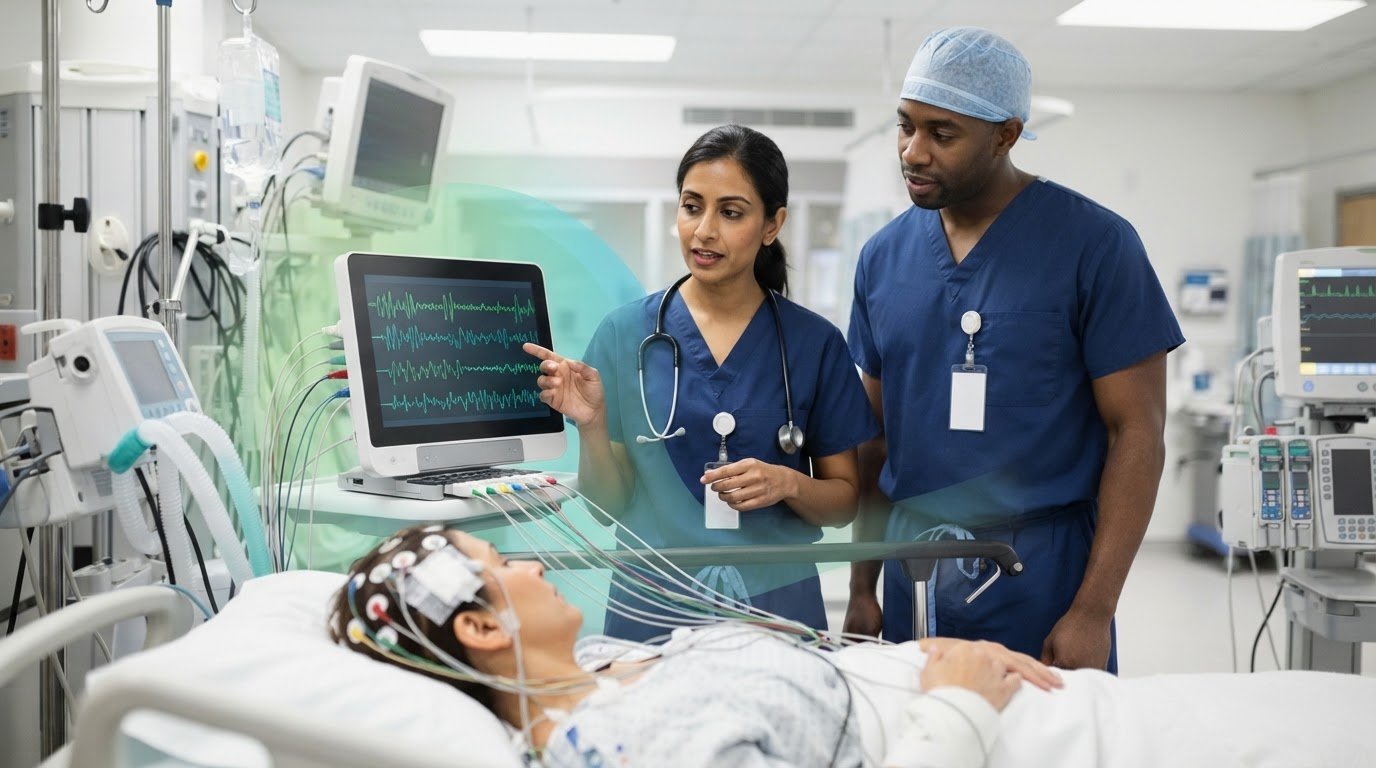
What if a critically ill patient is having seizures that bedside observation cannot reveal? Nonconvulsive seizures may occur without obvious motor signs, leaving important questions unanswered by clinical examination alone. Continuous EEG monitoring in critical care records cerebral electrical activity over time, giving the clinical team more information to assess alongside the patient’s condition and clinical course.
For ICU teams, useful monitoring depends on more than recording time. Signal quality, timely review and clinical interpretation all matter. EEG findings can inform assessment, but they do not establish the cause of a patient’s condition or replace clinical judgement. This article explains when continuous EEG may help, what its results can and cannot show, and how to plan the technical and interpretive workflow. It also introduces Cadwell Arc EEG, available through Novus Medical in Canada.
Key Takeaways
- Identify clinical situations where continuous EEG monitoring in critical care may add information beyond bedside observation.
- Interpret EEG findings in the context of the patient’s presentation, recognizing what monitoring can and cannot establish.
- Plan the recording workflow around a clear clinical question, patient needs, technical setup and interpretation pathway.
- Assess EEG capability and technical support as separate requirements when planning a Canadian critical-care program.
What continuous EEG monitoring in critical care can reveal
Continuous electroencephalography (cEEG) records cerebral electrical activity over an extended period using electrodes placed on the scalp. A routine EEG samples activity during a limited recording window; cEEG can show how patterns change over time. A short recording may suit an initial assessment, while prolonged monitoring may be considered when the clinical question involves intermittent events or evolving activity.
Bedside observation remains essential, but it cannot reveal every change in electrical brain activity. A seizure may have no clear outward signs, and patterns can change between examinations. The patient’s presentation, the clinical question and other available information guide whether continuous EEG monitoring in critical care is appropriate. Monitoring is not automatic for every patient.
Which critical-care questions can cEEG help assess?
Teams may consider cEEG when nonconvulsive seizures or status epilepticus are suspected, including when a patient’s responsiveness raises concern but there are no obvious convulsions. In coma or encephalopathy, a recording can add information about brain activity and how patterns change during observation. It supports assessment, but does not establish a diagnosis or determine the cause of altered consciousness on its own.
Amplitude-integrated electroencephalography (aEEG) is a related method used to monitor brain activity in intensive care. It differs from conventional EEG recording, so the method should match the clinical question. Amplitude-integrated electroencephalography (aEEG) provides an overview of this technique.
What cEEG does not establish on its own
A scalp recording may not capture every seizure source, and an EEG change does not necessarily explain clinical deterioration. Results require interpretation alongside the neurological examination, medical history, treatment and other relevant findings. Before starting, define the question: what event or pattern is the team assessing, and how could the result inform the broader clinical picture? This helps prevent the recording from being treated as a standalone answer.
How continuous EEG informs seizure detection and neurological assessment
Seizures in critically ill patients may be intermittent or have subtle clinical signs. Continuous recording can capture electrical events between bedside assessments and help clinicians evaluate whether seizure activity persists, recurs or changes during care. When status epilepticus is suspected, EEG can support assessment for ongoing electrographic seizure activity, including after visible convulsions have stopped if the patient has not regained consciousness. Interpretation should use standardized EEG terminology and remain anchored to the patient’s presentation.
EEG can detect recorded seizure activity, but it cannot predict an individual patient’s outcome on its own.
From EEG patterns to clinical interpretation
A pattern’s significance depends on the patient’s neurological state, medications, examination and the timing of the recording. The ictal-interictal continuum (IIC), as described in American Clinical Neurophysiology Society critical-care EEG terminology, refers to patterns that are not classified as definite seizures but may warrant clinical consideration. IIC is a descriptive category, not a diagnosis or treatment instruction.
Serial EEG review may help the team assess whether patterns change alongside neurological deterioration or after treatment. For neuroprognostication, EEG is one part of a broader assessment. Findings should be considered with the clinical course and other relevant evidence, not treated as a standalone forecast.
Why EEG findings must be interpreted cautiously
Scalp EEG has technical and anatomical limits and may not capture all seizure activity. A detected pattern also does not establish why a patient’s condition changed. Clinicians should relate the tracing to the neurological examination, history, treatment and other available investigations before making care decisions. A result can inform assessment without determining treatment or prognosis by itself.
For teams considering continuous EEG monitoring in critical care, a clear clinical question helps focus recording and review. Novus Medical supplies Cadwell Arc EEG and provides Canadian-based technical support. Review the Cadwell Arc EEG system as part of your neurodiagnostic program planning.

Planning continuous EEG monitoring in critical-care workflows
Effective continuous EEG monitoring in critical care starts with a defined clinical question, not simply the decision to attach electrodes. Clarify what the team needs to assess, which changes in the patient’s neurological state are relevant, and how findings will reach the clinicians responsible for care. This gives bedside staff, EEG technologists and qualified interpreters a shared purpose for the recording.
Set responsibilities before recording begins. Bedside staff communicate clinical events and changes; EEG technologists apply and maintain the recording setup and address technical concerns; qualified clinical interpreters review the tracing and communicate findings through the agreed pathway. Local protocols should specify who receives routine updates and how urgent concerns are escalated.
A practical sequence for starting a recording
- Prepare: Confirm the clinical question, relevant patient context and communication plan. Explain the process to the care team and coordinate electrode placement with bedside care.
- Apply electrodes: The EEG technologist positions scalp electrodes according to the recording protocol, taking account of patient-care needs and access to the head.
- Verify the signal: Review signal quality at setup and address poor electrode contact or other technical problems. Document the recording start and relevant clinical context.
- Handoff: Establish how staff will report recording concerns, notable clinical events and significant changes to the appropriate technical and clinical contacts.
Managing workload and technical limitations
Monitoring requires coordinated setup, attention to recording quality and access to qualified interpretation. Movement, equipment interference or electrode problems can create artifact that complicates assessment or obscures parts of the tracing. Recognizing and documenting these issues helps interpreters distinguish recording limitations from patterns that may warrant clinical review. A recording’s value depends on signal quality and a clear review pathway.
Plan roles and escalation processes around local capacity rather than assuming a particular monitoring duration or staffing ratio. Clear responsibilities and documentation support continuity as care needs change.
Selecting EEG capability and support for a Canadian critical-care program
Begin equipment evaluation with the clinical service’s intended use and workflow. Define the questions the program needs to address, who will manage each stage of recording, and how findings will be communicated to the care team. These requirements give decision-makers a practical basis for comparing system information with the needs of their service.
Connecting clinical requirements with EEG equipment
Assess the recording workflow, team requirements, service continuity and technical support separately. Map how a recording moves from preparation to review, identify who is responsible at each step, and establish how interruptions will be managed. This helps teams compare equipment information against the work their service needs to perform.
- Intended use: Define the clinical questions and care settings the program aims to support.
- Recording process: Consider how recordings will be prepared, checked and incorporated into existing workflows.
- Team responsibilities: Clarify who manages recording tasks, interpretation and communication of findings.
- Continuity: Plan how the service will respond to technical concerns and maintain clear handoffs.
Canadian technical support and next steps
Separate the service’s clinical requirements from the capabilities described for a specific system. Use approved product information to assess system functions, then consider those details alongside the program’s workflow, staffing and service-continuity plans. This keeps purchasing decisions grounded in the care team’s needs rather than assumptions about equipment.
A defined evaluation framework helps your team identify priorities for its neurodiagnostic program. Explore Novus Medical’s neurodiagnostic equipment as you assess options for your critical-care service.
Turn clinical priorities into a practical next step
Use your program’s clinical priorities to guide its next planning discussion. Bring neurocritical-care clinicians, EEG technologists and decision-makers together to identify what the service needs to support, where responsibilities sit, and how findings will inform care. This shared perspective helps your team assess equipment and support needs against intended practice, rather than starting with features alone.
Continuous EEG monitoring in critical care is most useful as part of a considered clinical and operational plan. Explore Novus Medical’s Cadwell Arc EEG and neurodiagnostic support to take the next step in planning for your critical-care service.
Frequently Asked Questions
When is continuous EEG monitoring used in critical care?
It may be considered when clinicians need to assess a specific concern that remains unresolved, such as a patient who does not regain expected responsiveness after convulsive seizures have stopped. The care team can define what event or change prompted the request and what information would affect assessment. That focused question helps guide the decision to monitor and the review plan.
Can continuous EEG detect seizures without visible symptoms?
Yes. EEG may record seizure activity without obvious signs at the bedside. If staff notice a brief change, such as an unexplained pause in responsiveness, they can document its timing and describe what they observed for comparison with the recording. This information may help the interpreting clinician assess whether the electrical activity corresponds to the reported event.
How does continuous EEG differ from a routine EEG?
The key practical difference is the time window being assessed. A routine EEG can provide an initial sample, while a clinician may consider longer monitoring if the clinical concern remains unresolved or events are suspected to occur at intervals. The choice depends on the question being asked. A longer recording is not automatically required simply because a patient is in critical care.
What are the limitations of continuous EEG monitoring?
A recording can be affected by technical interruptions, so teams should document periods when electrodes are disturbed or the signal is unavailable. Medication changes and care events should also be recorded with their timing, since they may help explain changes in the tracing. A technically incomplete or difficult-to-interpret record may leave the clinical question unresolved and require cautious review.
Does continuous EEG monitoring determine a patient’s prognosis?
No. Prognosis requires a broader clinical assessment, and EEG is not a stand-alone prediction tool. Interpretation should take account of when the recording occurred and relevant factors that can affect brain activity, including sedative exposure and the underlying illness. Clinicians may consider EEG alongside serial examinations and other investigations appropriate to the patient, then communicate uncertainty as well as findings.
Disclaimer
Disclaimer: Articles on this website are produced with the assistance of automated content tools (AutoSEO) and are intended solely for general informational purposes. This content does not constitute professional advice. While we strive to maintain accurate and up-to-date information, readers should verify key details independently before taking action based on any content found on this site.

Leave a Reply
Your email is safe with us.