
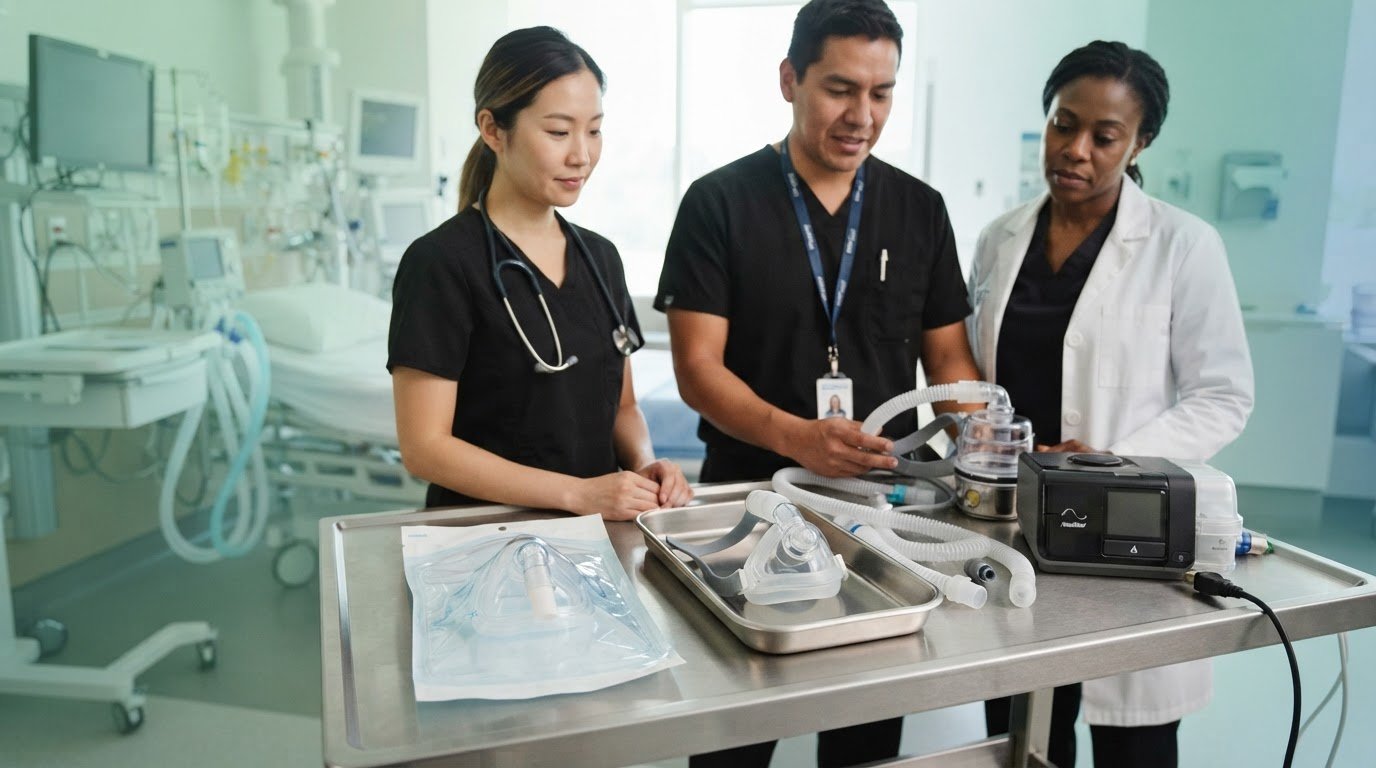
The best NIV mask choice isn’t determined by single-use or reusable status alone. When comparing disposable vs reusable NIV masks, care teams also need to consider patient fit, ventilation setup and the infection-prevention workflow the facility can reliably support.
Each handling pathway has different workflow requirements. A single-patient-use mask needs clear patient assignment and handling steps. A reusable mask requires staff to follow its product-specific reprocessing instructions. Vented and non-vented designs also serve different circuit configurations, so match the interface to the prescribed setup. Fit and patient tolerance remain important considerations for the clinical team.
This comparison outlines how disposable and reusable masks differ across fit, infection-prevention procedures, reprocessing and procurement planning. It also covers NIV mask options distributed by Novus Medical, including the Respireo Hospital F2 Vented Disposable, Respireo Hospital F2 Non Vented Disposable with anti-asphyxia valve, Respireo Primo P Vented and Respireo SOFT Nasal Mask. Use the criteria below to structure product discussions around your facility’s clinical requirements and procedures.
Key Takeaways
- Compare disposable vs reusable NIV masks by handling pathway, patient needs and facility workflow, rather than assuming one category is universally preferable.
- Use a consistent selection framework that considers clinical use, patient fit, circuit configuration, handling requirements and staff procedures.
- Keep vented and non-vented designs distinct when matching a mask to the prescribed ventilation setup and applicable product instructions.
- Assess options such as Respireo Hospital F2 Vented Disposable and Respireo Hospital F2 Non Vented Disposable with anti-asphyxia valve against your clinical requirements.
Disposable vs. reusable NIV masks: what is being compared?
An NIV mask is a patient interface used with non-invasive ventilation equipment to deliver respiratory support without an invasive airway. “Disposable” and “reusable” describe how the interface is handled after use, not its clinical suitability. The appropriate option depends on the patient’s care needs, equipment setup and the procedures the facility can consistently follow.
NIV interfaces differ from public-health masks and respirators, which are intended for source control or wearer protection rather than connection to NIV equipment. This overview of respirator types and reusability describes protective equipment, but its categories shouldn’t be applied directly to NIV masks. In clinical use, consider the interface’s fit, ventilation configuration and intended handling pathway.
What does disposable mean for an NIV mask?
For an NIV mask, disposable generally refers to a product labelled for single-patient use. Follow the product labelling and instructions for use to determine its handling requirements and when it should be removed from service. Disposable designs can differ in fit characteristics and vented or non-vented configuration, so confirm these details for the specific product rather than relying on the category name.
What does reusable mean for an NIV mask?
A reusable NIV mask may be used again only in keeping with its instructions for use and the facility’s applicable reprocessing procedures. Requirements can vary by product, so there is no universal cleaning method, reuse limit or replacement interval for every mask. Before adding an interface to routine use, align its instructions with the facility’s reprocessing and storage processes.
In practice, comparing disposable vs reusable NIV masks means looking at more than the interface. Consider how it fits the planned patient care, connects with the ventilation setup and moves through the facility’s handling workflow. Keeping these factors separate also prevents confusion between protective equipment and interfaces intended for ventilatory support.
How disposable and reusable NIV masks differ in clinical workflows
Workflow differences arise during setup and after use. A single-patient-use option requires a clear process for assigning the interface to a patient and handling it during that patient’s care. A reusable option adds product-specific reprocessing and storage steps before another use. Neither pathway is inherently safer or more effective. Follow facility infection-prevention procedures and the manufacturer’s instructions for use.
| Workflow stage | Disposable, single-patient use | Reusable |
|---|---|---|
| Setup | Confirm the product, configuration and patient assignment. | Confirm the product and that it has completed the required reprocessing pathway. |
| Between uses | Follow labelling and instructions for handling during the assigned patient’s care, then removal from service. | Follow instructions for cleaning, disinfection and storage, where specified, before another use. |
| Workflow planning | Plan supply, identification and disposal according to facility procedures. | Plan staff steps, reprocessing resources and storage according to facility procedures. |
How do reprocessing and infection-prevention procedures affect the choice?
For a reusable mask, map the product’s instructions to the facility’s established procedures. Keep cleaning, disinfection and storage requirements separate when the manufacturer specifies distinct steps; don’t replace product-specific directions with a general routine. For a single-patient-use interface, follow its labelled handling pathway rather than treating it as reusable for another patient. Clear written steps help staff follow the same process during handoffs across shifts.
How do vented and non-vented configurations affect workflow?
Configuration is a separate decision from handling pathway. Match the mask to the prescribed NIV setup and compatible breathing circuit; vented and non-vented designs aren’t interchangeable. The Respireo Hospital F2 Vented Disposable and Respireo Hospital F2 Non Vented Disposable with anti-asphyxia valve are distinct options. Confirm that the configuration aligns with the intended setup and product instructions before use. Review NIV mask options alongside your clinical and workflow requirements.

How to select an NIV mask for patient needs and facility procedures
Use a consistent review to compare interfaces. The choice between disposable vs reusable NIV masks should reflect the intended clinical use, prescribed ventilation setup and facility’s ability to follow the product’s handling instructions.
- Clinical use: Define the care context and prescribed NIV approach with the responsible clinical team.
- Patient fit: Assess facial fit, seal and patient tolerance as part of interface selection.
- Circuit configuration: Match a vented or non-vented design to the prescribed setup and compatible breathing circuit. Consider an anti-asphyxia valve where required by the clinical setup.
- Handling pathway: Follow product labelling and instructions for use for single-patient-use handling or reprocessing.
- Staff workflow: Map setup, handling and storage steps to facility procedures and staff responsibilities.
What should clinicians assess about fit and interface suitability?
Assess the interface on the patient rather than relying on a category-level assumption. The clinical team should evaluate facial fit and seal, then consider patient tolerance in the context of care and the prescribed setup. A mask category alone can’t establish suitability for every patient. Follow the applicable product instructions and keep fit and interface decisions within the responsible clinical team’s assessment.
How should facilities assess reprocessing capacity and staff workflow?
For a reusable interface, map each product-specific handling step to the facility’s established procedures and staff workflow. Account for separate cleaning, disinfection and storage requirements where the instructions specify them. For a single-patient-use option, plan handling according to its labelling. This respiratory therapy equipment procurement guide provides broader context for equipment planning.
Review circuit and ventilator requirements alongside interface selection. A critical care ventilator buyer’s guide can provide wider equipment-selection context. Explore NIV mask options with Novus Medical as part of your team’s product review.
NIV mask options from Novus Medical: matching products to clinical requirements
Novus Medical distributes NIV masks to healthcare providers in Canada. Named products can give clinical and procurement teams a starting point for comparison, but selection still depends on the patient, prescribed ventilation setup, product instructions and facility procedures. Assess each interface against those requirements rather than assuming that its disposable or reusable category determines suitability.
How can named NIV mask options support clinical evaluation?
The Respireo Hospital F2 Vented Disposable and Respireo Hospital F2 Non Vented Disposable with anti-asphyxia valve are named disposable options with different configuration descriptions. Assess each against the prescribed circuit and clinical setup. Respireo Primo P Vented and Respireo SOFT Nasal Mask are additional named options; their names alone don’t establish handling status or other specifications. Review product instructions alongside the care team’s assessment of fit, configuration and intended use.
For each product under consideration, record the clinical requirement, relevant interface configuration, handling pathway and applicable instructions. This gives clinical and procurement teams a shared basis for evaluation, while keeping product names distinct from assumptions about materials, reuse or performance.
What support can Canadian healthcare teams access?
Novus Medical provides Canadian-based technical support by phone, internet and remote connection. For broader planning that includes respiratory equipment requirements and procurement considerations, refer to the respiratory therapy equipment procurement guide.
Use your team’s clinical criteria and facility procedures to guide the review, then explore Novus Medical NIV mask options for further consideration. Keep patient needs, interface configuration and operational requirements central to the product discussion.
Put your NIV mask review into practice
Turn your disposable vs reusable NIV masks assessment into a consistent review process for your care team. Document how interface selection relates to facility clinical criteria, equipment setup and handling procedures. A shared reference helps clinicians and procurement staff apply the same criteria while keeping patient-specific decisions with the responsible clinical team.
Novus Medical brings more than 40 years of experience selling and supporting medical devices in Canada. Use your established criteria to guide product consideration and support a clear discussion between clinical and procurement teams.
Explore Novus Medical NIV mask options and identify products for your team’s clinical review.
Frequently Asked Questions
Can disposable NIV masks be reused?
No. A mask labelled for single-patient use shouldn’t be reassigned to another patient or treated as reusable because it appears intact. Keep its intended-use information visible and separate from reusable stock. If the labelling doesn’t resolve a handling question, pause use of that item and follow your facility’s established escalation process rather than making an assumption.
How often should reusable NIV masks be replaced?
There’s no single replacement interval that applies to every reusable NIV mask. Follow product-specific directions and document inspection findings and the reason an interface is removed from service. This creates a traceable record for equipment review and helps staff apply the same decision process across shifts instead of relying on memory or an assumed number of uses.
Are disposable NIV masks more effective at preventing infection?
Disposability alone doesn’t establish greater infection-prevention effectiveness. Separate the product-choice question from the process question: assess whether the facility’s selected handling pathway is being followed consistently. Local process reviews or audits can help teams identify workflow gaps without treating the disposable or reusable label as a measure of infection outcomes.
What should staff do if an NIV mask develops a leak during therapy?
Follow the care setting’s response pathway and prioritize assessment of the patient. Staff should avoid changing prescribed ventilation settings to compensate for a leak unless that action is within their role and clinical direction. Record when the leak was identified, the actions taken and the patient’s response, then escalate unresolved concerns through the established clinical pathway.
Disclaimer
Disclaimer: Articles on this website are produced with the assistance of automated content tools (AutoSEO) and are intended solely for general informational purposes. This content does not constitute professional advice. While we strive to maintain accurate and up-to-date information, readers should verify key details independently before taking action based on any content found on this site.


Leave a Reply
Your email is safe with us.