

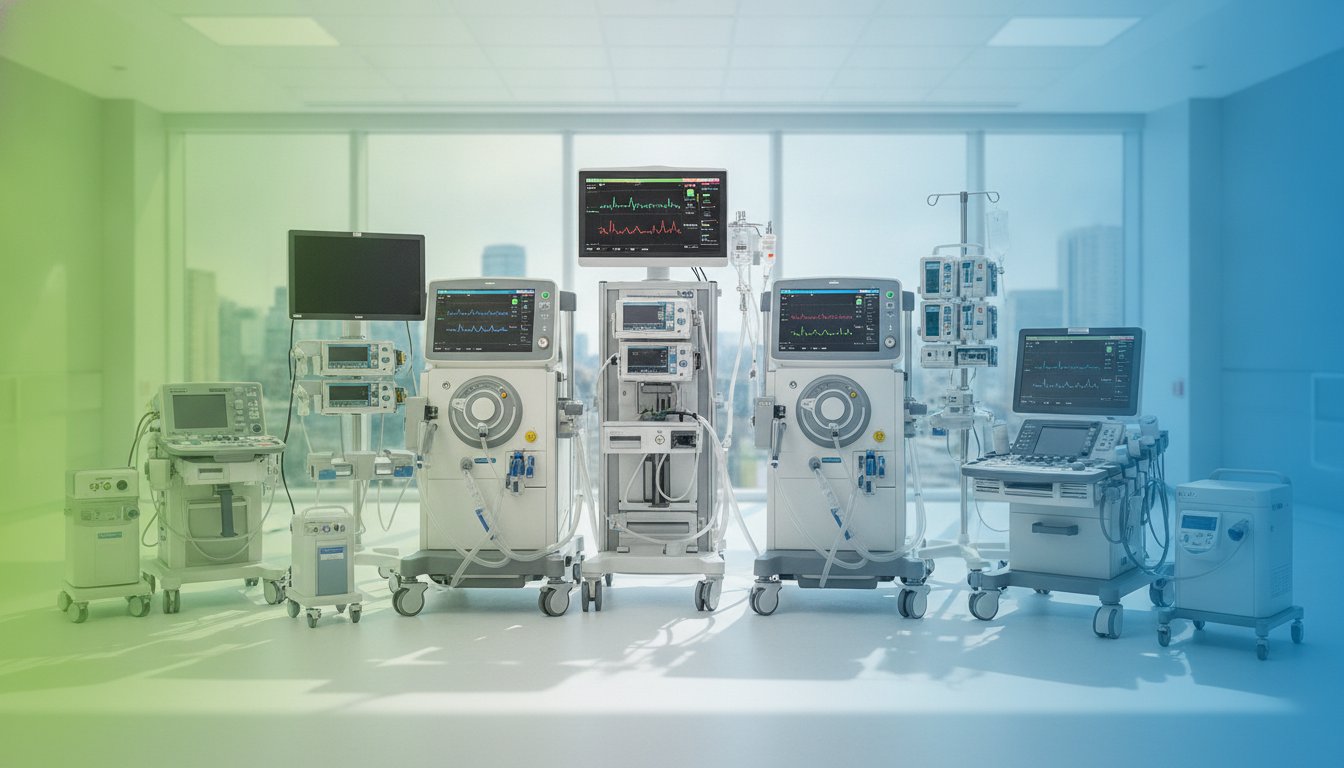
You separate capital expenditures from operating expenses, then test each purchase against clinical demand, service coverage, and your facility’s funding cycle before you lock a quote.
Key Takeaways: Budget for capital medical equipment by classifying assets in the C$8,000–C$76,000 range as multi-year investments while mapping total lifecycle costs beyond the sticker price.
- Median market prices for capital devices sit at C$30,000 based on 33 industry samples.
- Avoid direct purchases unless you can justify the opportunity cost of locking into technology.
- Prioritize specialized distributors for Canadian facilities to ensure technical support and safety compliance.
- The LungFit PH case shows how technology can convert cylinder logistics into capital savings.
Match your procurement profile to the facility you actually run
Your capital process depends on operational scale and clinical mandate. Clinical teams often select devices without aligning procurement with regional support infrastructure; a vendor with nationwide technical support keeps continuity across provinces.
Three situations you will recognize in Canadian healthcare, each with a concrete next step:
- Tertiary academic hospital: you need advanced diagnostics, complex integrations, and deep service contracts: shortlist vendors that document multi-province coverage before clinical evaluation.
- Regional community centre: you need reliable multi-departmental tools such as the Monnal T60 Advanced breathing machine (intensive care ventilator): right-size to shared ICU use rather than over-specifying research-grade options.
- Outpatient diagnostic clinic: you need testing efficiency from a dedicated lung health assessment (pulmonary function system): prioritise throughput and calibration support over broad inpatient feature sets.
Matching profile to hardware prevents over-specification. Identify your primary archetype, then streamline clinical evaluation. For guidance backed by 40 years of Canadian device distribution, consult Novus Medical, Excellence Through Experience.
Capital equipment is a fixed asset, not a daily supply
Capital assets are items that exceed your organization’s capitalization threshold and last more than one year. Canadian hospitals record these acquisitions as fixed assets rather than daily operating expenses, under CRA rules and your board’s own capitalization policy.
Think of operating expenses like continuous rental fuel, while a capital purchase is buying the engine outright. Review lifespan metrics and your local capital limits when you classify inventory. You can explore About Novus to review Canadian clinical supply history.
That financial distinction changes how patient devices are procured. Reclassifying clinical items as capital assets or durable medical equipment shifts buyers from routine pharmacy channels to specialized medical supply channels, for facilities and for patients:
"Due to a change in insurance last year, my CGM supplies are no longer a ‘pharmacy’ item and instead are a ‘durable medical equipment’ item- that requires I order through a medical supply company." (source)
A commenter in the forum.breakthrought1d.org thread "Medical supply company recommendations" described exactly that route change. While dedicated retailers like USA Medical and Surgical Supplies handle standard clinical inventory and daily surgical supplies, once an item is classified as durable or capital, ordering, approval paths, and budget lines all move with it.
5 Steps that turn clinical demand into a fundable capital budget
A structured sequence keeps financial allocations tied to devices clinicians will actually use and stops scope creep before tender.
- Audit current inventory: Evaluate device operational age, maintenance logs, and clinical safety compliance across departments.
- Prioritize clinical demands: Identify immediate diagnostic replacements and capacity gaps in high-volume services.
- Analyze lifecycle costs: Account for service contracts, consumables, staff training, and software integration.
- Compare technical specifications: Select configurations, such as advanced equipment for cardio-pulmonary diagnostics, that fit your diagnostic workflow.
- Finalize procurement timing: Set phased multi-year schedules that match facility funding cycles.
Build secretion-management and related performance features into the clinical checklist early so you are not redesigning workflows after install. This workflow gives Canadian facilities a predictable path from need list to funded purchase. Contact a specialist to review technical specifications and request a quote for your capital plan.
Total cost of ownership exposes the costs quotes leave out
Total cost of ownership means life-cycle overhead, not the line on the acquisition quote.
In clinical distribution work, plans fail when buyers ignore installation and continuous calibration. Operational costs overtake the sticker price when facility modifications are left out. Local medical supply shops often charge higher prices and offer less selection than specialized suppliers, which inflates your run-rate. Compare quotes against the market band of C$8,000–C$76,000 drawn from 33 industry samples so you can see whether a bid sits inside normal range before you add hidden volume beneath the surface: install, training, accessories, and service.
Purchasing through a dedicated provider such as Löwenstein Medical supports long-term efficiency when the service network matches your sites. Ask for a quote that itemizes those life-cycle lines up front.
Tip: Always calculate annual maintenance and accessory overhead into your initial capital allocation rather than relying on future operational budgets.

Software and templates keep multi-year capital numbers consistent
Dedicated software and pre-built templates remove manual spreadsheet errors when you model expensive assets such as an intensive care ventilator or a full pulmonary function system. Scenario models stop costly misallocations that manual entry tends to hide across departments.
| Option | Primary Benefit | Workflow Focus |
|---|---|---|
| Downloadable Templates | Standardizes data collection | Rapid initial setup |
| Planning Software | Automates model comparison | Long-term tracking |
Comparing capital leases with equipment loans needs consistent cash-flow projections. Software shows how maintenance contracts move net cost over time, so you can adopt the model before the first tender rather than after. Request a personalized quote so your acquisition strategy sits on the same operational templates your finance team already trusts.
Skip direct purchase when ownership locks you into the wrong asset
Direct purchases fail when rapid technology cycles or unpredictable transport needs outrun the value of long-term ownership. Committed capital budgets often lock facilities into rigid assets they cannot redeploy.
Administrators rarely price the opportunity cost: buying dedicated transport hardware outright can consume funds you still need for specialized clinical staff.
Situation: standard transport incubators created financial and logistical strain for neonatal vehicle transfer.
Action: Advanced Healthcare Technology Ltd. developed the Baby Pod Infant Transport Device with carbon fibre construction and close-proximity harnessing.
Result: a lightweight, safe neonatal transport option that lowered operational burden versus legacy incubator workflows.
Unserviced devices sold through informal online channels carry patient safety risks and legal liabilities for Canadian facilities. Verify safety certifications before any purchase.
An individual posting in the ebme.co.uk thread "Medical Equipment on eBay, Forums" noted:
"There is an Alaris Asena CC Mark III on sale. The seller is a tedcigar of Newport, and he seems to have quite a few random medical devices among rather a lot of random tat, religious badges and second-hand watches!" (source)
Informal secondary listings often feature uncalibrated devices that put safety and compliance at risk. Professional procurement channels keep transport devices inside strict Canadian safety standards.
Score vendors on workflow fit and safety, not list price alone
When you read vendor estimates, translate clinical design into risk metrics you can defend at committee: fewer consumable dependencies, clearer service paths, and less disruption to existing workflows.
Measure how directly a device removes recurring supply-chain overhead. The LungFit PH system is a practical benchmark: patented Plasma Pulse Technology generates inhaled nitric oxide from room air, so you avoid cylinder logistics and convert an unpredictable operating expense into a planned capital line. That is the standard to hold other vendors to when you score workflow fit and safety evidence side by side.
Request a quote when your shortlist is ready, and ask each bidder to show consumable and service cost over the same horizon. For comprehensive checklists on structuring clinical procurement and evaluating technical requirements, visit Synergy Medical Inc.
GPOs cut equipment cost when paired with single-source support
Group purchasing organizations (GPOs) lower lifecycle spend by aggregating regional facility demand into discounted national supply contracts.
Combining those price agreements with centralized distributor support reduces long-term operating expense and removes duplicate administrative work on capital buys. Novus Medical provides end-to-end customer service across ordering, configuration, training, and follow-up, so single-source deployment keeps maintenance consistent when you stack vendor support on a GPO contract.
Among Google reviews for that distributor support model, a client specialist (5★) wrote:
"Excellent organization with highly qualified staff. I used to order equipment and supplies from them while working with my previous employer. Highly recommend."
Dedicated personnel and qualified staff shorten deployment time for clinical teams when GPO pricing and distributor execution run on the same thread.
Frequently asked questions
What counts as capital equipment?
Capital devices are long-term healthcare assets, such as an intensive care ventilator (breathing machine), that your policy capitalizes because they exceed threshold value and useful life of one year.
How much do typical medical devices cost?
Acquisition expenses vary with technical configuration; request a personalized quote from distributors for exact figures on the configuration you will run.
How to calculate total cost of ownership?
Sum direct acquisition fees with recurring operating expense, maintenance contracts, essential accessories, and staff clinical training over the device’s useful life.
What financing options are available for capital equipment?
Facilities fund major outlays through direct purchase, structured operating leases, monthly equipment rentals, or customized multi-year distribution service agreements.
How should a medical equipment budget be created?
Review patient volume, assess software licensing terms, and consult specialized distributors for system configurations that match your clinical pathways and funding cycle.
Strategic Budgeting for Capital Medical Equipment
A durable capital strategy still answers the same questions you opened with: is the device a true fixed asset, what is its full life-cycle cost, and does ownership (versus lease or managed service) fit your transport, technology, and staffing reality. Align procurement timing with patient volume so you do not buy capacity you cannot staff.
Facilities often under-weight long-term technical service when they guard financial reserves; price maintenance early so the balance sheet stays protected after install.
Under President Murray Beaton and Vice-President Robert Simms, the team supplies specialized devices and end-to-end customer service with technical assessments shaped for Canadian sites.
Contact clinical specialists to request a customized procurement quote today. More on this: Contact Novus.
Disclaimer
Disclaimer: Articles on this website are produced with the assistance of automated content tools (AutoSEO) and are intended solely for general informational purposes. This content does not constitute professional advice. While we strive to maintain accurate and up-to-date information, readers should verify key details independently before taking action based on any content found on this site.



Leave a Reply
Your email is safe with us.