
What happens when a device is due for service, but its service history is stored separately from its inspection record? In a clinical setting, that gap can make it harder to confirm equipment status and coordinate next steps. A biomedical equipment maintenance plan should do more than assign calendar dates. It should connect each device’s risk, manufacturer guidance, service history, and escalation procedures.
Maintenance tasks and records can be spread across departments and tracking systems. A single schedule may also overlook differences in clinical use, device condition, or manufacturer recommendations. This guide explains how to build a practical, risk-aware framework for Canadian healthcare facilities. You’ll learn how to organize an equipment inventory, document inspections and service history, assign follow-up actions, and define who removes equipment from use, who is notified, and when technical support is engaged. These steps help teams keep records organized and respond to equipment issues with clearer handoffs.
Key Takeaways
- Build a biomedical equipment maintenance plan around device risk and manufacturer guidance, rather than relying on one generic schedule.
- Organize asset records so teams can quickly find each device’s identity, location, status, service history, and responsible team.
- Define a fault-response pathway that covers reporting, equipment status, service arrangements, and documented closure.
- Review overdue tasks, recurring faults, and open follow-ups regularly, with clear escalation contacts for consistent handoffs.
What a Biomedical Equipment Maintenance Plan Should Protect
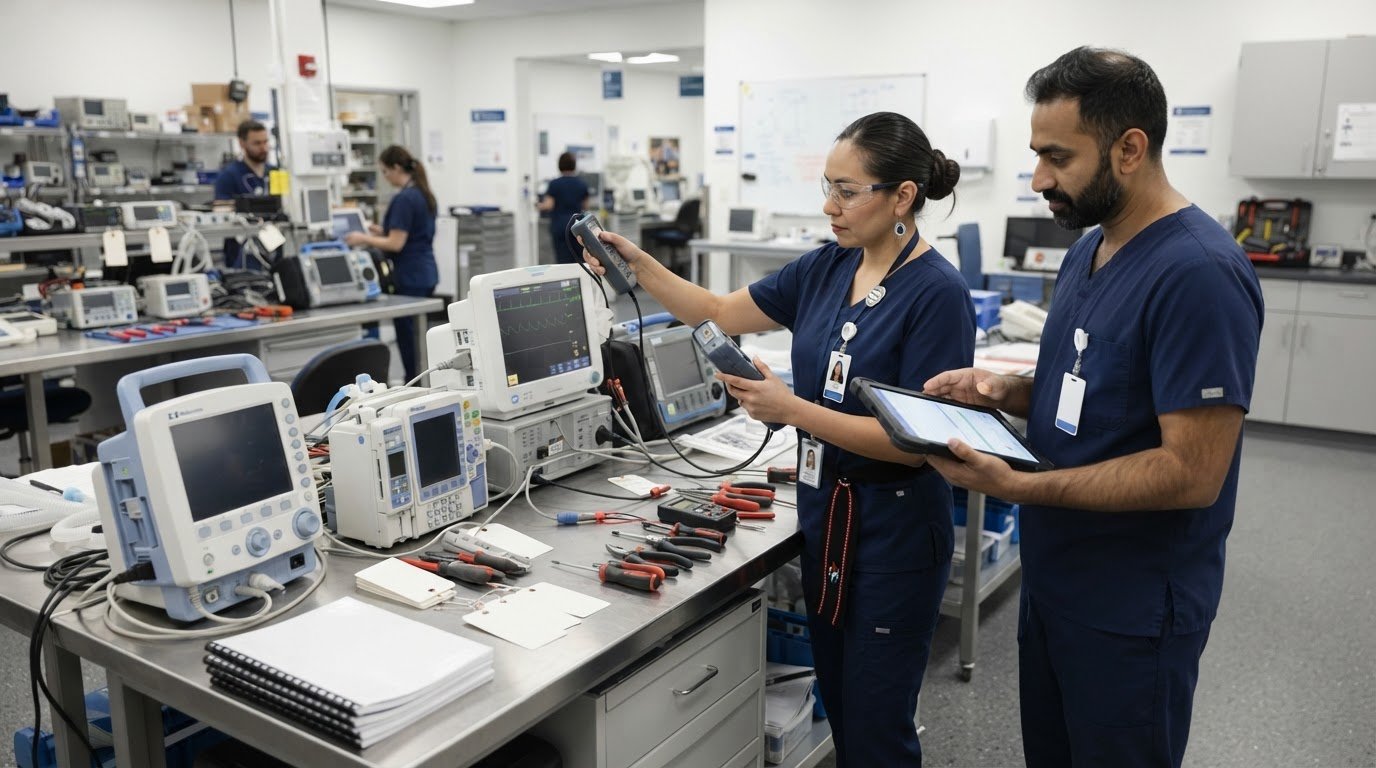
A biomedical equipment maintenance plan documents inspection, preventive maintenance, corrective maintenance, and follow-up. Its purpose is practical: clarify responsibilities, required work, and recorded outcomes so teams can support equipment readiness and continuity in clinical workflows.
Maintenance needs vary by device. Connect each activity to the device’s function, clinical use, and applicable documentation. Clinical engineering provides context for the professional role involved in managing medical technology, including equipment oversight and technical support.
For a visual overview, watch this introduction to preventive maintenance for medical equipment:
How preventive, corrective, and inspection tasks differ
Preventive maintenance is planned work guided by device documentation and facility procedures. Corrective maintenance follows a reported fault or performance concern and addresses the identified issue. Inspections are separate activities. The World Health Organization’s framework distinguishes performance inspections, which assess operation, from safety inspections, which assess risks to patients and operators. Record each activity and its outcome. Do not treat one as a substitute for another or apply a test protocol that is not relevant to the device.
Why one schedule does not fit every device
Set task frequency according to the device’s clinical use, function, manufacturer instructions, and facility risk assessment. Equipment used in a critical workflow may need different oversight from equipment used in another context, but the appropriate tasks and intervals depend on device documentation and qualified technical review. Avoid applying one calendar interval across all device categories. Review the schedule when use, guidance, or equipment condition changes, and record the reason for any adjustment.
Build a Biomedical Equipment Maintenance Plan Around Risk and Records
A facility-ready plan moves from objectives to inventory, risk assessment, task assignment, work records, and review. This sequence turns maintenance policy into a usable register, showing what work is due, who owns it, and what remains unresolved. The WHO medical equipment maintenance programme provides a framework for organizing inspection, preventive maintenance, and corrective action.
- 1. Set objectives: Define what the plan must support, such as safe operation, equipment readiness, and traceable maintenance decisions.
- 2. Inventory assets: Create a record for each device and assign it a unique identifier.
- 3. Assess risk: Consider clinical use, equipment function and condition, and applicable device guidance.
- 4. Assign tasks: Set responsibility and timing according to manufacturer documentation and qualified technical review.
- 5. Record work: Document the task, findings, completion date, personnel, and any required follow-up.
- 6. Review results: Check records for overdue work, recurring concerns, and open actions.
What to capture in the equipment inventory
For each asset, record its device type, model, serial number, clinical location, current operational status, and responsible team. Add relevant service history, warranty information, device documentation, and the next planned maintenance action. A computerized maintenance management system (CMMS) can support this process, but a controlled register may fit better with the facility’s established workflow. The essential requirement is a consistent record that authorized staff can retrieve and update.
How to assign maintenance responsibilities
Name who schedules work, performs it, reviews the result, and updates the record. Distinguish tasks assigned to qualified internal staff from servicing that requires technical support. Link every task to applicable manufacturer documentation and a traceable completion record. External service arrangements can complement the facility’s inventory and records. See this Canadian medical equipment service contract guide. Novus Medical provides Canadian-based technical support by phone, internet, and remote connection. Learn more about medical equipment support.

Set Clear Procedures for Faults, Incidents, and Equipment Recalls
A defined response process helps staff report concerns, communicate equipment status, and record the steps taken. The World Health Organization’s medical equipment maintenance programme places corrective maintenance alongside inspection and preventive maintenance. In a facility plan, clear handoffs ensure that a fault report leads to an assigned action and documented closure.
What happens when equipment is reported as faulty?
Identify who receives reports, creates the service record, coordinates triage, and communicates status to affected teams. Clinical staff should follow facility procedures for removing equipment from use or restricting its use. The plan should direct them to the appropriate clinical and technical decision-makers without prescribing clinical decisions.
A traceable fault-response pathway takes a reported issue through triage, an equipment status decision, service action, findings, follow-up, and documented resolution.
- Record the device identifier, location, reporter, reported concern, and date.
- Document the status decision, notifications, service actions, findings, and any outstanding follow-up.
- Record who authorized return to service under facility procedures and when the status was communicated.
Keep incident documentation factual and connected to the device’s service history. If an investigation identifies a performance concern or further action, assign an owner and track the action to closure.
How to manage recalls and service notices
Assign a role to review manufacturer notices and coordinate the response. Use the equipment inventory to identify affected devices by relevant identifiers, then document who was notified, what action was required, and which assets were addressed. Track completion evidence and unresolved items. Close the response only after the designated reviewer records that required actions are complete under facility and manufacturer procedures.
Include escalation contacts in the biomedical equipment maintenance plan so staff know where to direct technical questions. Novus Medical provides Canadian-based technical support by phone, internet, or remote connection through Novus Medical technical support.
Keep the Maintenance Plan Active With Technical Support and Review
A biomedical equipment maintenance plan needs scheduled review as equipment, service needs, and team responsibilities change. Set a review cadence through facility procedures. Check overdue tasks, recurring faults, service records, and unresolved follow-up actions. The goal is to find gaps in the maintenance process and assign practical corrections, rather than infer clinical or financial outcomes from service data.
Use maintenance records to improve the plan
Check whether work is recorded consistently and whether completed tasks include clear findings and closure details. Look for repeated faults on the same asset, missing service documentation, and actions left open after a repair. Assign an owner and due date to each improvement, then retain a resolution record. This creates a traceable link from a review finding to a process change.
Coordinate facility teams with technical support
Make escalation contacts and handoff steps easy to find. Staff should know who receives a technical concern, what device and service information to provide, and who communicates updates to relevant teams. Training and clear handoffs help staff apply procedures consistently, especially when responsibility moves between clinical users, equipment coordinators, and technical personnel.
Use the facility’s established support channels for technical questions, particularly when an issue requires qualified service input or manufacturer guidance. Novus Medical provides Canadian-based technical support by phone, internet, and remote connection to support service coordination alongside a facility’s own inventory and maintenance records. Service agreements can also clarify how external support fits into internal processes. See the Canadian medical equipment service contract guide.
After each review, update task ownership, escalation contacts, and procedures where needed, then communicate changes to the teams responsible for applying them.
Put Your Maintenance Framework Into Practice
A practical biomedical equipment maintenance plan connects device risk and manufacturer guidance with clear records, assigned responsibilities, and defined response steps. Keep the framework active by reviewing overdue tasks, service histories, recurring faults, and outstanding follow-ups. When equipment concerns arise, documented escalation and handoffs help teams coordinate service and communicate equipment status in line with facility procedures.
Maintenance is a shared process. Internal teams manage inventory, scheduling, and records, while qualified technical support can assist with equipment questions and service coordination. Novus Medical brings more than 40 years of experience selling and supporting medical devices in Canada, with Canadian-based technical support by phone, internet, and remote connection, as well as warranty and service contract support.
Strengthen your facility’s maintenance and technical support process with Novus Medical’s medical equipment support. Connect with Novus Medical to discuss technical support and service coordination for your facility.
Frequently Asked Questions
What should a biomedical equipment maintenance plan include?
A biomedical equipment maintenance plan should identify equipment, set maintenance objectives, assign task ownership, and document service activity. Include manufacturer guidance, inspection and preventive maintenance tasks, corrective work, service history, and follow-up actions. The plan should also explain how staff report faults, communicate equipment status, respond to recalls, and review whether scheduled work and records are complete. Clear responsibilities make these steps easier to coordinate.
How often should biomedical equipment be maintained?
There is no single maintenance interval that applies to every device. Set task timing based on manufacturer instructions, device function, clinical use, and facility procedures. Qualified technical personnel should document why the schedule is appropriate for each device or device group. Review it when equipment use, service history, or applicable guidance changes, and record any schedule adjustments so teams can follow current requirements.
Who is responsible for medical equipment maintenance in a hospital?
Responsibility is shared among the teams designated in the hospital’s maintenance procedures. Clinical users report faults and follow local equipment procedures, while maintenance personnel or other qualified technical staff perform assigned work. Programme owners oversee schedules, records, and escalation processes. The written plan should name who receives reports, communicates equipment status, reviews completed work, and refers technical issues for support.
How should a healthcare facility document equipment maintenance?
Maintain a traceable record for each device, including its identifier, model, serial number, clinical location, maintenance tasks, dates, findings, and follow-up actions. Record who performed or reviewed the work and whether further action remains. Keep service history and status in the facility’s approved system, such as a controlled register or maintenance management system, so authorized staff can locate and review the information.
Disclaimer
Disclaimer: Articles on this website are produced with the assistance of automated content tools (AutoSEO) and are intended solely for general informational purposes. This content does not constitute professional advice. While we strive to maintain accurate and up-to-date information, readers should verify key details independently before taking action based on any content found on this site.
Leave a Reply
Your email is safe with us.