
The most sophisticated ventilator in your ICU is only as effective as the clinician’s ability to harmonize its algorithms with the patient’s unique respiratory drive. You likely recognize the daily friction of managing persistent asynchrony, where escalating sedation often becomes the default response to a patient struggling against the circuit. This tension not only complicates the clinical workflow but also increases the risk of long-term complications. This 2026 Canadian ICU guide provides clarity by having advanced ventilator modes explained 2026, ensuring you can confidently utilize dual-control and adaptive technologies to prioritize lung protection and patient comfort. We’ll examine how leading systems like the Monnal™ T60 Advanced employ closed-loop logic to automate adjustments, which helps to mitigate the pressure of setting up complex modes during critical events. By the end of this guide, you’ll have the technical depth required to reduce ventilator days and minimize the incidence of ventilator-induced lung injury (VILI) through precise, evidence-based settings that adapt to the patient’s changing needs.
Key Takeaways
- Transition from clinician-driven settings to patient-centred adaptive responses by understanding how modern closed-loop logic improves real-time breath delivery.
- Master the nuances of dual-control ventilation, with advanced ventilator modes explained 2026, to consistently achieve target tidal volumes using the lowest possible airway pressures.
- Reduce the physiological cost of patient-ventilator asynchrony and the need for heavy sedation by implementing innovative neural and adaptive triggering strategies.
- Optimize clinical workflows and patient safety by pairing sophisticated hardware like the Monnal™ T60 Advanced with rigorous professional clinical training.
The Evolution of Mechanical Ventilation: Why Advanced Modes are Essential in 2026
In 2026, the paradigm of respiratory support has shifted from simply maintaining oxygenation to achieving biological harmony. Advanced ventilator modes use closed-loop logic to adjust breath delivery based on real-time patient feedback, moving away from static clinician-centred settings. As a national distributor, we recognize that Canadian hospitals require these global innovations to address the complexities of modern critical care. Understanding these modes of mechanical ventilation is now a prerequisite for reducing bedside complications and improving outcomes.
Beyond Assist/Control: The Limitations of Traditional Modes
Conventional assist/control modes often fail to account for the asynchrony gap. When volume or pressure targets are too rigid, the result is frequently breath stacking or diaphragmatic atrophy. These mismatches between the ventilator and the patient’s neural drive lead to increased sedation needs and prolonged ICU stays. When clinicians seek to have advanced ventilator modes explained 2026, they often find that adaptive algorithms offer the most reliable path to bridging this gap by responding to patient effort rather than forcing a fixed pattern.
The 2026 Clinical Standard for Lung Protection
Modern lung protection relies on integrating real-time compliance monitoring directly into breath-by-breath delivery. Precision is the primary tool for reducing Ventilator-Induced Lung Injury (VILI) in 2026. Lung-protective ventilation is defined as a strategy that limits tidal volumes and transpulmonary pressures to prevent alveolar overdistension and cyclical collapse while maintaining gas exchange. This level of precision is exactly what technologies like the Monnal™ T60 Advanced provide, ensuring that every adjustment is data-driven and patient-specific.
Dual-Control and Adaptive Ventilation: Bridging Pressure and Volume
Dual-control ventilation represents a sophisticated evolution in critical care, effectively merging the benefits of volume-targeted safety with the decelerating flow and comfort of pressure-regulated breaths. Pressure Regulated Volume Control (PRVC) has evolved significantly in its 2026 iterations, utilizing refined optimal targeting schemes in adaptive ventilation to minimize peak inspiratory pressures. This section of our guide ensures you have advanced ventilator modes explained 2026, focusing on how these algorithms maintain a target tidal volume while adjusting pressure breath-by-breath. By having advanced ventilator modes explained 2026, clinical teams can better manage the transition from fully controlled ventilation to spontaneous breathing, as the system intelligently adapts to increasing patient effort.
Comparing PRVC, APV, and Volume Support
Different manufacturers implement dual-control logic through varying proprietary algorithms, such as Adaptive Pressure Ventilation (APV) or Volume Support. While the fundamental goal remains consistent, the speed at which the ventilator responds to sudden drops in lung compliance differs across platforms. PRVC typically adjusts pressure in small increments over several breaths, whereas newer adaptive modes may recalibrate more aggressively to protect against barotrauma during acute changes. Understanding these nuances helps clinicians select the right mode for patients with rapidly shifting pulmonary mechanics.
Automated Weaning: Reducing the Work of Breathing
Modern ventilators now integrate machine learning to analyze breathing patterns and predict weaning readiness with higher accuracy than traditional weaning indices. For clinicians managing the high-stakes transition from the ICU to transport, the Monnal™ T60 Advanced provides a seamless experience, maintaining these sophisticated support levels without interruption. This continuity is vital for preventing setbacks in patients who are borderline for extubation. If you’re looking to enhance your unit’s technical capabilities, exploring advanced respiratory solutions can provide the necessary technical edge and support.

Enhancing Patient-Ventilator Synchrony with Advanced Triggering
Patient-ventilator asynchrony is a significant clinical burden that drives the need for higher sedation doses and extends the duration of mechanical ventilation. By having advanced ventilator modes explained 2026, clinicians can move beyond basic flow and pressure sensors which often fail in the presence of circuit leaks or auto-PEEP. The EO-150 ventilator offers exceptional versatility here, providing sensitive triggering for both invasive and non-invasive applications to ensure the device responds to the slightest patient effort. Reducing this asynchrony is vital to prevent patient distress and the associated inflammatory responses that complicate recovery.
Proportional Assist Ventilation (PAV) and NAVA
Proportional Assist Ventilation (PAV) and Neurally Adjusted Ventilatory Assist (NAVA) represent a strategic shift toward “shadowing” the patient’s own respiratory drive. Instead of delivering a fixed support level, these modes provide pressure proportional to the instantaneous effort detected. This is particularly beneficial in complex COPD cases where ineffective triggering is common, or in neonatal care where neural triggers bypass the mechanical delays associated with pneumatic sensors. Such effort-based support ensures the ventilator works in harmony with the patient’s biological demands.
Visualizing Synchrony: The Clinician’s Interface
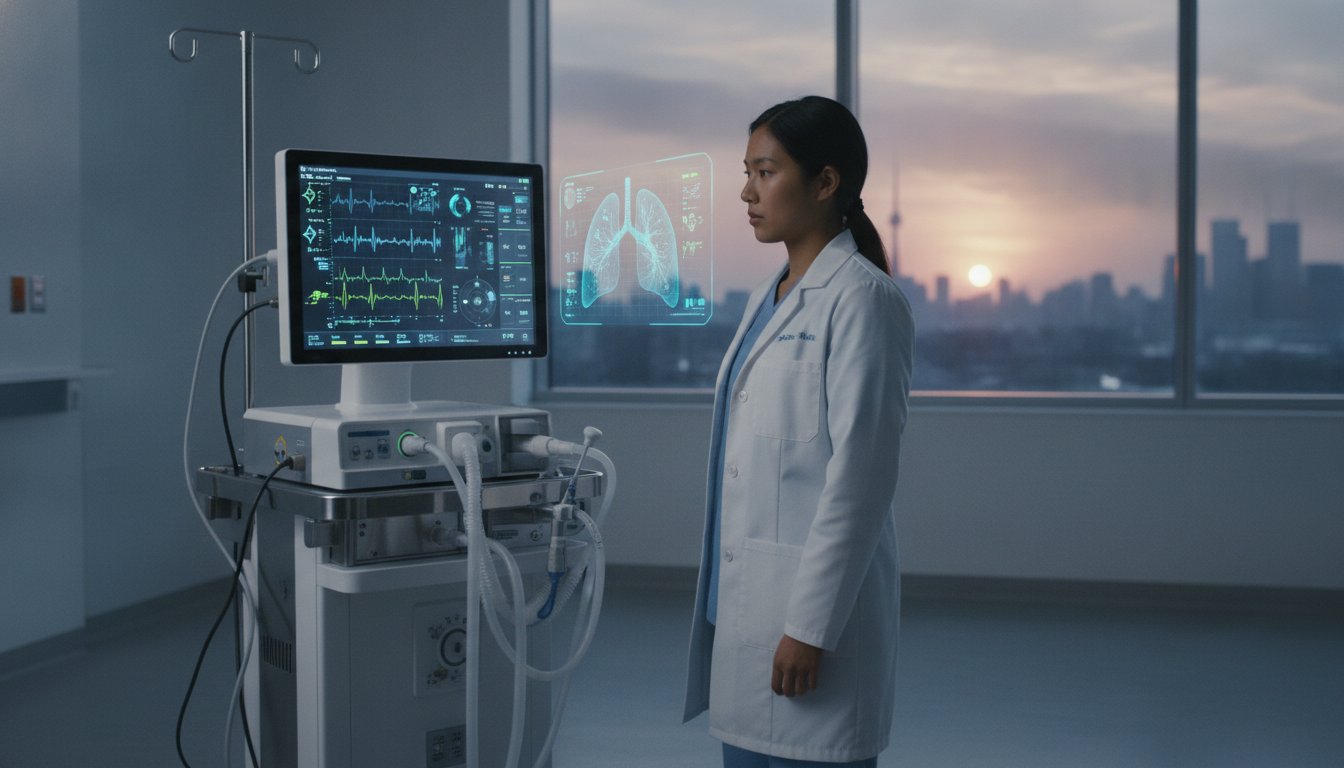
Modern interfaces in 2026 allow clinicians to organize and visualize synchrony data through high-resolution lung modelling. These displays make it possible to identify missed triggers or auto-PEEP at a glance, rather than relying on manual interpretation of subtle waveform changes. This immediate visual feedback loop is essential for optimizing support and preventing the “fighting the ventilator” phenomenon. High-resolution modelling at the bedside provides a real-time window into pulmonary mechanics, allowing for faster, more accurate setting adjustments. To see how these tools can be integrated into your clinical workflow, explore the EO-150 and our full respiratory portfolio.
Implementing Advanced Strategies with Modern Canadian Technology
Successfully deploying sophisticated ventilation requires a synergy between high-performance hardware and a highly trained clinical team. In the Canadian context, the Monnal™ T60 Advanced has emerged as a benchmark for versatility. It provides the continuity of care necessary for high-acuity patients moving from the ER to the ICU or during inter-facility transport. Continuity is essential. Having advanced ventilator modes explained 2026 is only the first step; the true value is realized when these modes are implemented seamlessly across care settings. As a national distributor, we ensure that these global innovations are accessible to local healthcare providers, moving beyond theoretical research to practical bedside application.
The Monnal™ T60 Advanced: Versatility in Action
Engineered for high-stakes environments, the Monnal™ T60 Advanced provides ICU-standard ventilation in a portable, turbine-based format. Its adaptive modes simplify complex respiratory management for transport teams who often work under extreme pressure. By automating pressure adjustments to maintain tidal volume, it allows clinicians to focus on the patient’s overall stability during critical transitions. Precision matters. This device ensures that the level of lung protection established in the ICU is not compromised during movement, providing a consistent clinical experience for both the patient and the provider.
The Critical Link: Training and Technical Support
Professional clinical training is the critical link between possessing technology and achieving superior patient outcomes. Novus Medical supports Canadian healthcare providers through comprehensive technical maintenance and hands-on education. A robust medical equipment service contract is vital for maintaining the calibration and reliability of these high-acuity devices. We act as a steady guide, helping your unit leverage its full technological potential to reduce ventilator days and improve synchrony. Our clinical training programs ensure that advanced ventilator modes explained 2026 are translated into practical, bedside skills. This ongoing commitment involves providing the support needed to master these complexities safely and effectively.
Elevating Respiratory Excellence in the Modern Canadian ICU
Mastering the shift from clinician-centred settings to patient-centred adaptive responses is no longer optional; it’s the foundation of modern lung protection. By integrating closed-loop logic and neural triggering, you can effectively bridge the asynchrony gap and reduce the physiological burden on your most vulnerable patients. We’ve provided advanced ventilator modes explained 2026 to help you navigate these complexities, but the final step involves pairing this knowledge with high-performance technology. As the exclusive Canadian distributor for the Monnal™ T60 Advanced, Novus Medical specializes in high-acuity respiratory therapy equipment that maintains ICU standards across all care settings. Our commitment to your success includes national clinical training and comprehensive technical support to ensure your team operates with total confidence. Explore the Monnal™ T60 and Advanced Ventilation Solutions at Novus Medical to enhance your unit’s capabilities. Together, we can realize better patient outcomes through technical precision and professional dedication.
Frequently Asked Questions
What are the main advantages of dual-control ventilator modes in 2026?
Dual-control modes bridge the gap between volume and pressure ventilation by using closed-loop logic to maintain tidal volume at the lowest possible pressure. This approach prioritizes patient safety through volume limits while ensuring the comfort of decelerating flow. In 2026, these modes are essential for reducing clinician workload and automating breath-by-breath adjustments. It’s a core part of having advanced ventilator modes explained 2026 for modern Canadian ICUs.
How does the Monnal™ T60 Advanced handle patient-ventilator asynchrony?
The Monnal™ T60 Advanced utilizes highly sensitive triggering and adaptive algorithms to synchronize breath delivery with the patient’s spontaneous efforts. By responding to real-time changes in respiratory drive, the device minimizes the “fighting the ventilator” phenomenon common in high-acuity settings. This technical precision reduces the need for heavy sedation and helps prevent complications like diaphragmatic atrophy. It ensures the patient remains comfortably supported from the ER through to the ICU.
Is specialized training required to use adaptive ventilation modes safely?
Yes, professional clinical training’s essential to safely and effectively implement adaptive ventilation. While these modes automate many adjustments, clinicians must still understand the underlying logic to set appropriate safety boundaries and interpret data correctly. Novus Medical provides national clinical training programs and technical support to help Canadian healthcare providers master these technologies. This hands-on education ensures that teams can utilize the full potential of advanced ventilator modes explained 2026.
Can advanced ventilator modes be used during intra-hospital transport?
Advanced modes are now fully integrated into portable systems like the Monnal™ T60 Advanced, allowing for ICU-standard care during transport. This continuity’s vital because it prevents the physiological setbacks often seen when switching to simpler transport ventilators. Whether moving a patient to medical imaging or another unit, maintaining adaptive support ensures consistent lung protection and synchrony throughout the entire journey. It’s a significant advancement in 2026 critical care.
How do modern ventilators help prevent ventilator-induced lung injury (VILI)?
Modern ventilators prevent VILI by integrating real-time compliance monitoring and automated pressure adjustments to limit alveolar overdistension. By maintaining a target tidal volume at the lowest required pressure, these devices minimize cyclical collapse and barotrauma. Systems like the EO-150 and Monnal™ T60 Advanced use precise sensors to ensure that ventilation remains within lung-protective parameters, even as a patient’s pulmonary mechanics change during an acute respiratory distress syndrome episode.
Disclaimer
Disclaimer: Articles on this website are produced with the assistance of automated content tools (AutoSEO) and are intended solely for general informational purposes. This content does not constitute professional advice. While we strive to maintain accurate and up-to-date information, readers should verify key details independently before taking action based on any content found on this site.