The traditional model of passive mechanical support is no longer sufficient for the complexities of modern Canadian acute care. As a clinician, you’re likely navigating the dual pressures of increasing patient acuity and the persistent instability of medical gas supply chains. It’s frustrating to manage difficult-to-clear secretions that stall weaning progress and keep patients in the intensive care centre longer than necessary. You’ve likely felt that technology should be a partner in your workflow rather than a source of complexity.
This clinical reference explores advanced respiratory care techniques designed to shift the focus toward proactive, physiologically-integrated management. By adopting evidence-based strategies in ventilation and cylinder-free gas therapy, you can optimize patient outcomes and reduce hospital stay durations. We’ll examine the latest innovations in secretion management and smarter equipment interfaces that streamline clinical workflows and help mitigate the factors leading to professional burnout at the bedside.
Key Takeaways
- Understand the clinical shift toward early non-invasive intervention and how modern advanced respiratory care techniques stabilize patients while minimizing invasive risks.
- Explore how cylinder-free inhaled nitric oxide generation eliminates traditional supply chain risks and simplifies the logistical management of medical gases.
- Identify proactive secretion management protocols that utilize Mechanical Insufflation-Exsufflation to reduce the risk of pneumonia and improve patient outcomes.
- Gain insights into the critical role of hands-on clinical training and national technical support in maintaining high standards of care across Canadian medical centres.
The Evolution of Advanced Respiratory Care Techniques
Modern advanced respiratory care techniques represent a transition from simple mechanical support to a holistic, multi-modal approach to pulmonary stabilization. In Canadian acute care centres, clinicians are increasingly moving away from early invasive ventilation in favour of non-invasive intervention (NIV). This shift aims to reduce the complications associated with intubation while maintaining gas exchange. High-acuity environments now utilize “smart” ventilation systems that automate weaning processes. These systems use closed-loop algorithms to adjust support based on patient effort, allowing for faster liberation from the ventilator and streamlined clinical workflows.
Lung-Protective Ventilation Strategies
Reducing Ventilator-Induced Lung Injury (VILI) remains a primary objective in the modern ICU. Implementing lung-protective ventilation (LPV) involves strict low tidal volume protocols, typically targeting 6 mL/kg of predicted body weight to minimize alveolar overdistension. Clinicians also focus on PEEP optimization to prevent repetitive opening and closing of alveoli, known as atelectrauma. By monitoring driving pressure at the bedside, teams can better assess the stress placed on lung tissue during each breath. This precise monitoring allows for a more personalized approach to mechanical support, ensuring the lungs are protected throughout the recovery phase.
Advancements in Non-Invasive Interface Design
The success of NIV often hinges on the patient’s tolerance of the interface. Advanced mask designs prioritize a superior seal and enhanced comfort to reduce patient-ventilator asynchrony. Specialized NIV masks are engineered to preserve skin integrity, which is vital for long-term compliance and therapy success. While these interfaces focus on ventilation, they also complement broader Airway Clearance Techniques by ensuring the patient remains stable and comfortable enough to participate in proactive secretion management. This integrated approach ensures that technological sophistication translates directly into improved bedside care, ultimately reducing the duration of hospital stays across the country.
Innovative Gas Exchange: Moving Beyond Traditional iNO
Inhaled Nitric Oxide (iNO) remains a cornerstone in treating Persistent Pulmonary Hypertension of the Newborn (PPHN) and acute pulmonary hypertension. However, traditional delivery relies on high-pressure cylinders that present significant supply chain risks and logistical challenges. These cylinders are heavy, require specialized storage, and are subject to delivery delays that can jeopardize patient safety. Cylinder-free generation systems utilize electrochemical technology to extract nitric oxide directly from the surrounding air, effectively removing the logistical burden of heavy gas cylinders from the clinical environment. This shift is a key component of advanced respiratory care techniques aimed at stabilizing the most vulnerable patients.
The LungFit® PH Framework
The LungFit® PH system represents a paradigm shift by generating iNO at the bedside. This approach improves clinical workflows by eliminating the need for manual cylinder changes and complex inventory tracking. It ensures precise, consistent dosage delivery regardless of ventilator settings or patient breath patterns. By integrating such technology, hospitals can mirror the excellence seen in programs like the University of Chicago Medicine’s Advanced Respiratory Care Program, where technical precision directly correlates to better outcomes.
Reducing Hospital Supply Chain Vulnerability
Medical gas logistics involve hidden costs, including delivery fees, storage space, and hazardous waste disposal. On-site generation provides a fail-safe for critical care units, ensuring that life-saving therapy is always available. Moving to a cylinder-free model reduces a facility’s reliance on external vendors and protects against market fluctuations. To learn more about modernizing your facility’s gas delivery, you can explore our specialized respiratory solutions. Implementing these advanced respiratory care techniques ensures that Canadian ICUs remain resilient against global supply chain instability while maintaining the highest standards of bedside care.

Advanced Airway Clearance and Secretion Management
Proactive secretion management is a critical pillar of advanced respiratory care techniques. While manual suctioning has long been the standard, it’s often reactive and can cause mucosal trauma. Ventilator-Associated Pneumonia (VAP) remains a significant risk in the ICU, often driven by pooled secretions in the subglottic space. The EO-70 Secretion Management Device addresses this by utilizing Mechanical Insufflation-Exsufflation (MI-E). This technology clears deep bronchial secretions by mimicking the flow of a natural cough through rapid pressure shifts.
Mechanical Insufflation-Exsufflation (MI-E) Techniques
Effective cough simulation requires the careful optimization of inspiratory and expiratory pressures. The EO-70 allows clinicians to fine-tune these parameters to ensure maximal clearance without compromising patient comfort. High-frequency vibration and oscillation are integrated into the cycle to help mobilize tenacious secretions that are otherwise difficult to dislodge. These features are essential for patients with neuromuscular disorders or those who are difficult to wean from mechanical support.
Integrating Secretion Management into ICU Protocols
Standardizing the frequency of airway clearance can significantly reduce the need for invasive suctioning and its associated risks. Training clinicians on the EO-70 interface ensures that these protocols are applied consistently across both acute and long-term care centres. This seamless transition is vital for maintaining patient stability during the weaning process. Integrating these advanced respiratory care techniques into daily rounds helps clinicians manage complex cases with greater precision.
You can view our full range of secretion management technology to see how these tools integrate into your clinical workflow.
Implementing Advanced Care: Training and Technical Excellence
Sophisticated hardware is only as effective as the clinician operating it. In high-pressure environments, bedside mastery of advanced respiratory care techniques is essential for patient safety. Canadian hospitals prioritize partnerships with distributors that offer more than just a product delivery; they require ongoing clinical education and technical stability. Hardware alone doesn’t improve outcomes; it’s the professional skill-building that ensures technology translates into superior patient care. Novus Medical supports this landscape by acting as a steady guide between global innovation and local bedside implementation.
Clinical Training and Professional Development
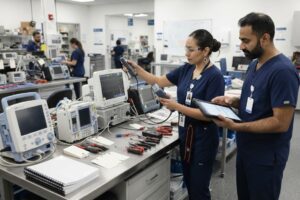
Bridging the gap between device acquisition and bedside mastery is a core focus for modern healthcare centres. Professional development programs ensure that staff are proficient in advanced ventilator modes, such as those found on the Monnal™ T60. Hands-on workshops allow respiratory therapists to simulate complex scenarios, maximizing the return on investment for ICU equipment by ensuring it’s used to its full potential. These educational initiatives empower clinicians to manage complex cases with confidence, reducing the errors that can occur during high-stress workflows.
Technical Reliability and Maintenance Contracts
ICU equipment must remain operational 24/7 to ensure patient safety. Authorized service and comprehensive warranty contracts are vital to extending the lifespan of critical care devices. Navigating the Canadian procurement process requires a partner who understands national standards and can provide immediate technical support across the country. Reliable maintenance reduces the risk of equipment failure and ensures that advanced respiratory care techniques are always available when needed. Learn more about our comprehensive respiratory care solutions and how we support technical excellence in Canadian healthcare.
Advancing Clinical Excellence in Canadian Respiratory Care
The shift toward proactive, physiologically-integrated management is redefining the standards of acute care across the country. By moving away from the logistical risks of traditional cylinders toward bedside generation and adopting automated secretion management, clinical teams can significantly reduce patient weaning times and hospital stay durations. These advanced respiratory care techniques are most effective when supported by robust technical reliability and continuous professional development. Novus Medical stands as a dedicated partner in this transition, serving as the exclusive Canadian distributor for LungFit® PH and providing national technical support and warranty fulfillment to ensure your equipment remains mission-ready.
Our commitment extends beyond distribution to include specialized clinical training for ICU staff, bridging the gap between innovative technology and bedside mastery. If you’re ready to modernize your department’s workflow and improve patient safety, Consult with a Novus Medical Specialist for your Respiratory Care Needs. Together, we can elevate the quality of respiratory support and empower your team to achieve superior clinical outcomes with confidence and precision.
Frequently Asked Questions
What are the primary benefits of using generated nitric oxide over cylinder-based systems?
Generated nitric oxide systems like LungFit® PH eliminate the logistical burden and safety hazards associated with high-pressure gas cylinders. By extracting nitric oxide directly from ambient air, these advanced respiratory care techniques remove supply chain vulnerabilities and the need for specialized storage. This electrochemical approach ensures a constant, fail-safe supply of inhaled nitric oxide (iNO) at the bedside, simplifying clinical workflows and reducing the total cost of gas therapy.
How does mechanical insufflation-exsufflation (MI-E) differ from standard suctioning?
Unlike standard suctioning, which is an invasive and often reactive procedure, MI-E provides a non-invasive solution for airway clearance. Systems like the EO-70 utilize rapid pressure shifts to mimic the flow of a natural cough, effectively mobilizing deep bronchial secretions. This method reduces the risk of mucosal trauma and Ventilator-Associated Pneumonia (VAP). It’s particularly beneficial for patients who lack the muscular strength to clear secretions independently during the weaning process.
Can advanced ventilators like the Monnal™ T60 be used for intra-hospital transport?
Yes, the Monnal™ T60 Advanced is specifically engineered for high-performance intra-hospital transport. Its compact, autonomous design allows clinicians to maintain critical care standards while moving patients from the ICU to diagnostic centres or operating rooms. The device provides consistent ventilation regardless of the environment, ensuring that advanced respiratory care techniques aren’t interrupted during transit. Its long battery life and versatile mounting options make it a reliable choice for complex transport scenarios.
What is the role of non-invasive ventilation in treating acute respiratory distress?
Non-invasive ventilation (NIV) serves as an early intervention strategy to stabilize patients and prevent the need for endotracheal intubation. By providing pressure support through specialized NIV masks, clinicians can improve oxygenation and reduce the work of breathing in acute distress cases. This approach maintains gas exchange while minimizing the complications associated with invasive mechanical ventilation. It’s a vital component of modern protocols aimed at shortening hospital stays and improving patient comfort.
How does Novus Medical support respiratory therapy training across Canada?
Novus Medical provides comprehensive national support through specialized clinical training and technical expertise. We offer hands-on workshops and professional development programs to ensure clinicians are proficient with sophisticated ICU equipment like the EO-150 and Monnal™ T60. Our team manages national technical support and warranty fulfillment from a centralized framework, ensuring that healthcare providers across Canada have access to reliable service and the training necessary to maximize patient outcomes in acute settings.
Disclaimer
Disclaimer: Articles on this website are produced with the assistance of automated content tools (AutoSEO) and are intended solely for general informational purposes. This content does not constitute professional advice. While we strive to maintain accurate and up-to-date information, readers should verify key details independently before taking action based on any content found on this site.