

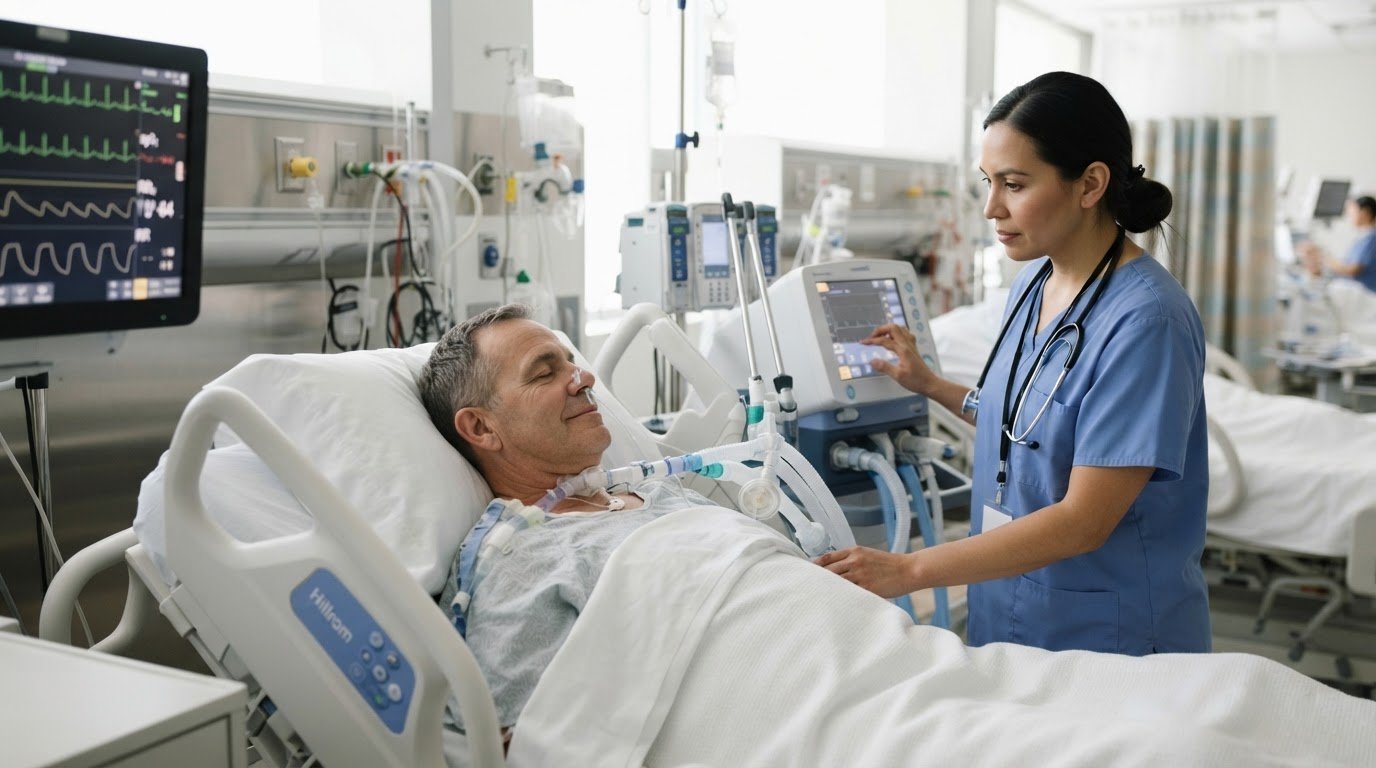
Decreasing risk of ventilator-associated pneumonia involves several elements of care, including positioning. Ventilator-associated pneumonia is a lung infection that develops while a patient is on a ventilator. The Institute for Healthcare Improvement’s ventilator bundle guide recommends raising the head of the bed between 30 and 45 degrees for ventilated patients.
Bed position is one practical part of prevention, alongside infection-control practices and careful respiratory and oral care. Patient factors also matter, so prevention should reflect each person’s clinical needs and care setting.
This article explains ventilator-associated pneumonia, factors that can affect a patient’s risk, and how head-of-bed elevation may help. It also explores the infection’s effects on hospital stays, costs and mortality, offering critical-care teams and families context for prevention in Canadian hospitals.
Key Takeaways
- Recognize that ventilator-associated pneumonia is a lung infection that develops during ventilator use, and consider patient-related factors when assessing risk.
- For ventilated patients, the Institute for Healthcare Improvement guide recommends elevating the head of the bed between 30 and 45 degrees as part of prevention.
- Understand that this infection can add to hospital stays and is associated with mortality, making prevention a key part of critical care.
- Explore how host risks, bed position and prevention practices fit together to support care decisions for ventilated patients.
Host-related VAP risk factors
Patient characteristics can affect vulnerability to ventilator-associated pneumonia and the course of critical illness. Age over 65 years is identified as a host-related risk factor. A gastric pH greater than 3.5 may predispose patients to bacterial colonization of the lower respiratory tract. A plan for decreasing risk of ventilator-associated pneumonia should account for these host factors.
In paediatric patients, fluid overload is associated with increased risk of prolonged mechanical ventilation lasting more than 48 hours. Smoking is also linked with greater infection risk; patients preparing for surgery can seek information about quitting. These factors help teams consider individual needs when planning care.
This OPENPediatrics video reviews how VAP develops and ways to prevent it, including patient positioning:
Reduce sedation when clinically appropriate, and assess whether the patient is ready for spontaneous awakening and breathing trials. Regularly review readiness to breathe without ventilator support. Avoiding unnecessary ventilation can reduce exposure to VAP risk, while reintubation after accidental extubation is associated with increased risk.
For patients likely to need intubation beyond 72 hours, guidelines recommend endotracheal tubes with subglottic secretion drainage ports to limit secretion pooling above the cuff. Selective digestive tract decontamination was associated with lower VAP risk (RR 0.439; 95% CI 0.362-0.532). Both approaches may be considered within prevention planning.
Prevention measures can also carry risks. Lateral Trendelenburg positioning is not generally recommended to prevent VAP because it has been associated with oxygen desaturation and hemodynamic instability. Studies found that silver-coated tubes and tracheal saline instillation reduced VAP rates, but also showed a trend toward higher mortality.
Bundles combine preventive practices, and compliance matters. The Institute for Healthcare Improvement guide reports VAP-rate reductions of 22% with unchanged compliance, 40% with compliance below 95%, and 61% with compliance above 95%. It measures ICU VAP rates per 1,000 ventilator days. Tracking these figures helps teams assess prevention efforts and support decreasing risk of ventilator-associated pneumonia.
Raising the head of the bed
Bed elevation is a practical part of ventilator care, alongside infection-control and oral-care measures. The Institute for Healthcare Improvement (IHI) patient-and-family guide describes raising the bed head between 30 and 40 degrees to help prevent VAP. This positioning may limit aspiration of refluxed stomach contents into the airway. The angle should suit the patient’s clinical needs and the care team’s protocol.
For mechanically ventilated adults, evidence-based prevention can combine positioning with regular mouth care, infection-control practices and review of ongoing ventilator need. The IHI guide recommends including a 0.12% chlorhexidine oral rinse in an oral-care process for ventilated patients. Mouth care helps manage oral secretions and bacterial burden, which can contribute to lower respiratory tract infection. Care teams should apply oral-care procedures as directed by their unit protocols.
A ventilator-care bundle brings practices together so staff can apply them consistently. Elements may include bed positioning, oral care, hand hygiene and assessment of readiness for spontaneous breathing trials. The bundle should reflect the patient’s clinical status and the hospital’s established procedures. Assigning clear roles during each shift can help teams complete and document care reliably.
Patients and caregivers can ask whether the bed head can be raised and how often mouth care is provided. For staff, the IHI guide suggests recording the head-of-bed angle on an ICU flow sheet every 4-6 hours as one way to monitor adherence. Documentation makes positioning visible during handovers and helps identify when the patient’s position needs review. If a patient cannot tolerate elevation, the care team can reassess positioning while maintaining other prevention measures.

VAP-associated hospital stays and mortality
Ventilator-associated pneumonia is associated with longer hospital stays and increased mortality. For someone in intensive care, an infection can complicate recovery and extend the need for clinical monitoring. The added time may affect discharge planning, rehabilitation and coordination with the next care setting. These outcomes matter to patients, families and hospital teams considering the full course of critical illness.
Length of stay varies according to the patient’s underlying condition, infection severity and response to treatment. Someone with VAP may need continued respiratory support while clinicians treat the infection and reassess progress. Each extra hospital day can also affect bed availability and the timing of care for other patients. Reviewing patient outcomes alongside ICU capacity helps teams understand operational effects without reducing the issue to a single measure.
Mortality figures require careful interpretation. Patients who develop VAP are often seriously ill, and the condition that led to ventilation can also affect survival. An association between VAP and mortality does not, by itself, show that pneumonia caused an individual death. Clinicians interpret outcomes in light of the patient’s overall illness, treatment course and other complications.
A meta-analysis found ventilator bundles reduced mortality among ICU patients by approximately 10%. This finding supports coordinated prevention as part of routine critical care, while not establishing the same result for every hospital or patient group. Prevention measures can be reviewed alongside infection incidence, length of stay and patient outcomes. Considering these indicators together helps teams assess whether local processes are being applied consistently and where care pathways may need attention.
Hospital teams can compare patterns across patient groups and care settings. Reported VAP rates, additional hospital stays and mortality differ between high-income and low- and middle-income countries. This context is important when interpreting published findings or comparing local results. In Canadian facilities, tracking local outcomes over time can support informed quality reviews and keep patient impact central to prevention planning.
What ventilator-associated pneumonia is
Ventilator-associated pneumonia (VAP) is a lung infection that develops while a person receives ventilator support. It occurs when bacteria enter the lungs and cause infection. A ventilator supports breathing, and an endotracheal tube provides an airway for invasive ventilation. The tube can also create a route for secretions and microorganisms to reach the lower respiratory tract. VAP describes infection in this ventilated-patient context, not simply the presence of bacteria.
Invasive ventilation provides breathing support through an endotracheal tube. The tube passes through the mouth or nose into the airway, bypassing some of the body’s normal protective mechanisms. Secretions can collect above the tube’s cuff and then move towards the lungs. Aspiration of contaminated secretions is one way infection may develop. This helps explain why secretion management, oral care and positioning feature in prevention practices.
VAP is different from colonization. Bacteria may be present in the airway without causing a lung infection; infection involves the lungs. VAP can complicate the illness that led to ventilation and affect ongoing care. Clinicians assess the overall clinical picture, including respiratory changes and other findings, rather than treating a positive culture alone as proof of pneumonia. This distinction matters when interpreting tests and planning treatment.
Research on VAP prevention often examines critically ill adults and children in intensive care who required invasive mechanical ventilation for at least 48 hours. That context helps explain the focus on reducing exposure to invasive ventilation and applying consistent prevention measures. VAP is generally treated with antibiotics, with selection depending on the bacteria causing the infection. The practical takeaway is that VAP is an infection linked to ventilator care, and prevention focuses on limiting routes for bacteria and secretions to enter the lungs.
Novus Medical: LungFit® PH
LungFit® PH is an inhaled nitric oxide system offered by Novus Medical to healthcare facilities assessing respiratory therapy equipment. Its patented Plasma Pulse Technology® is a product feature, not a VAP-prevention measure. VAP prevention relies on clinical practices such as infection control, oral care, appropriate positioning and regular review of the need for ventilation. Consider the system in relation to a facility’s respiratory care requirements, not as a substitute for prevention protocols.
For respiratory care teams evaluating equipment, consider how LungFit® PH fits the clinical workflow and intended care setting. Keep equipment decisions separate from infection-risk reduction measures, and follow established clinical protocols for ventilated patients.
To discuss LungFit® PH for your facility, contact Novus Medical.
Carry prevention into ongoing care planning
A deliberate approach to decreasing risk of ventilator-associated pneumonia also involves reviewing care processes over time. Use routine team discussions to identify workflow barriers, clarify responsibility for follow-up and connect prevention practices to daily critical-care work. This makes education a practical part of ongoing quality improvement.
For equipment planning, Novus Medical offers LungFit® PH and the EO-150 Ventilator, as well as the MagVenture Accelerator Training Program. These offerings serve distinct clinical and training needs; equipment selection is separate from infection-prevention protocols. Consider the intended care setting, patient population and clinical workflow when discussing respiratory equipment with your team.
Set a clear next step for your facility, such as bringing a workflow question to the next care-team review or discussing equipment needs with Novus Medical. Contact Novus Medical to discuss care and continue building informed, coordinated respiratory care practices.
Frequently Asked Questions
What is ventilator-associated pneumonia (VAP), and how is it diagnosed?
VAP is a lung infection associated with invasive mechanical ventilation, and clinicians diagnose it by assessing the patient’s overall clinical picture. A positive airway culture alone does not establish pneumonia, since bacteria may be present without lung infection. The care team considers respiratory changes alongside other clinical findings and interprets test results in context. This distinction helps prevent colonization from being mistaken for infection.
What are the main risk factors for ventilator-associated pneumonia?
Risk depends on a patient’s health and care circumstances, so teams should reassess it as these change. During routine care discussions, review the ventilation plan, readiness for breathing trials and whether the current approach remains necessary. Patients and caregivers can also ask how hand hygiene and mouth care are included in daily care, helping clarify which prevention practices are being followed.
What do Canadian guidelines recommend for preventing ventilator-associated pneumonia?
The IHI ventilator bundle guide recommends elevating the head of the bed between 30 and 45 degrees. Prevention also includes regular mouth care, infection-control practices, and assessing whether the patient can breathe without ventilator support.
Disclaimer
Disclaimer: Articles on this website are produced with the assistance of automated content tools (AutoSEO) and are intended solely for general informational purposes. This content does not constitute professional advice. While we strive to maintain accurate and up-to-date information, readers should verify key details independently before taking action based on any content found on this site.



Leave a Reply
Your email is safe with us.