

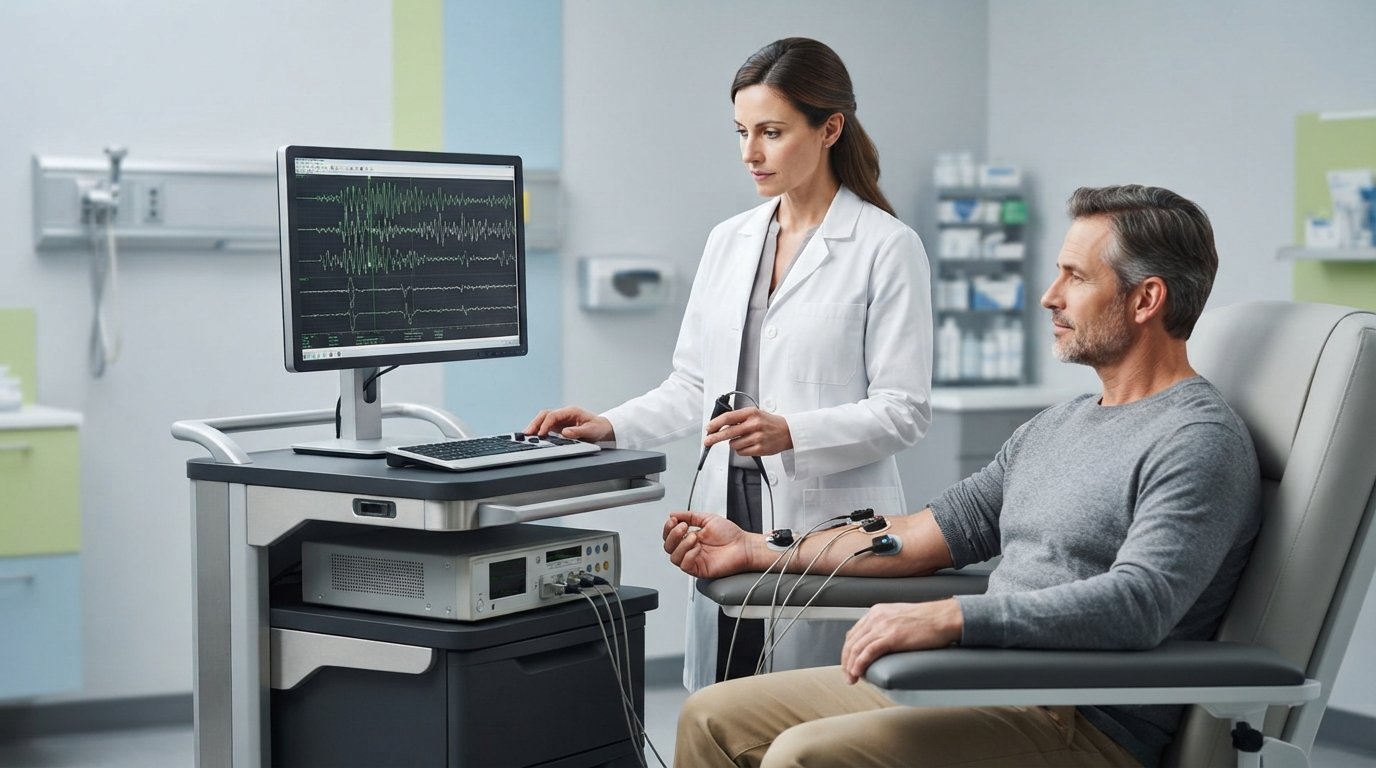
The most sophisticated electrodiagnostic amplifier is practically useless if ambient electrical artifact obscures subtle fibrillation potentials, or if a sudden hardware fault halts your schedule while waiting weeks for international repairs. When choosing an EMG machine for a clinic, diagnostic precision depends just as much on low-noise hardware engineering and domestic technical service as it does on advanced software capabilities.
You already understand the daily disruption caused by high contact impedance, complicated reporting menus that slow patient throughput, and unresponsive manufacturer service channels. This clinical buyer’s guide provides the exact criteria you need to evaluate amplifier fidelity, software workflow, Health Canada compliance, and dedicated support infrastructure. We examine the hardware benchmarks that ensure clean waveforms, review modern electronic medical record integration options, and explain how reliable Canadian technical assistance keeps your neurophysiology practice running on schedule.
Key Takeaways
- When choosing an EMG machine for a clinic, align your amplifier channel configuration with routine nerve conduction volume and prospective needs for evoked potentials.
- Prioritize hardware with high common mode rejection ratios and low noise floors to reliably distinguish low-amplitude fibrillation potentials from ambient clinic interference.
- Select software platforms featuring automated peak tracking and direct electronic medical record integration to eliminate charting bottlenecks and accelerate patient turnaround.
- Confirm active Health Canada Class II medical device licensing and manufacturer-backed Canadian technical support to avoid operational downtime and cross-border repair delays.
Define Clinical Workload and Core Diagnostic Capabilities
Diagnostic volume and testing complexity dictate your equipment footprint. When choosing an EMG machine for a clinic, matching amplifier architecture to daily case volume ensures you avoid clinical bottlenecks and prevent premature hardware obsolescence. Evaluating physiological testing demands across diverse electromyography procedures and diagnostic capabilities allows practices to establish precise baselines for routine nerve conduction studies (NCS), needle electromyography, and evoked potentials. High-volume practices also demand rugged input interfaces that resist mechanical wear during repeated patient changeovers.
Channel Configuration for General and Specialized Clinics
Standard community clinics evaluating peripheral neuropathies, radiculopathies, and focal entrapments operate efficiently on high-fidelity 2-channel amplifiers. In contrast, academic hospital laboratories performing multi-modality assessments, such as blink reflexes, repetitive nerve stimulation, and somatosensory evoked potentials, require 6-channel to 12-channel platforms. When choosing an EMG machine for a clinic, selecting an expandable architecture protects your capital investment, letting teams add hardware channels as subspecialty referral patterns expand. This flexibility ensures you don’t face a complete platform replacement when adding advanced electrodiagnostic protocols.
Portable Systems Versus Stationary Clinical Consoles
Your physical facility layout determines the balance between mobility and integrated storage:
- Portable laptop systems: These lightweight packages support traveling specialists and bedside hospital consultations, packing neatly into protective transit cases without compromising digital processing fidelity.
- Stationary console workstations: Dedicated outpatient neurophysiology suites benefit from heavy-duty carts that house medical-grade isolation transformers, articulating arm mounts, secure accessory drawers, and industrial input connectors rated for over 100,000 insertions to withstand heavy daily operation.
Signal Fidelity, Noise Reduction, and Hardware Architecture
High signal fidelity separates true neurogenic abnormalities from ambient clinic noise. When choosing an EMG machine for a clinic, amplifier engineering must take priority. Diagnostic systems require a common mode rejection ratio (CMRR) of at least 100 dB to 110 dB to suppress 60 Hz mains hum, alongside an internal noise floor below 0.7 µV RMS. Paired with 24-bit analog-to-digital converters, these parameters allow neurophysiologists to accurately record minute fibrillation potentials, complex repetitive discharges, and subtle motor unit action potential morphology.
Managing Electrical Artifact and Patient Safety
Standard exam rooms contain electronic interference from motorized tables, diagnostic ultrasound units, and computer power supplies. Suppressing these artifacts requires deliberate hardware isolation. Deploying a dedicated isolation transformer reduces leakage current and prevents ground loops, meeting the strict electrical requirements outlined in the Health Canada Medical Devices Regulations. Placing a remote input box directly at the patient bedside keeps electrode leads short, eliminating cable movement artifact and preserving weak sensory nerve action potentials.
Stimulator Controls and Ergonomic Probe Design
Repetitive nerve conduction studies create physical fatigue during high-volume clinic days. Ergonomic handheld electrical stimulators must provide instant access to stimulus duration, polarity, and intensity settings directly on the probe handle. This allows clinicians to adjust current output without turning away from the patient or reaching for keyboard controls. Proven platforms like the Cadwell Sierra Summit, represented across Canada through Novus Medical’s neurodiagnostic team, blend responsive stimulator ergonomics with quiet amplifier circuitry to optimize diagnostic accuracy and patient comfort.
Software Efficiency, Reporting Speed, and EMR Integration
High diagnostic throughput requires software that matches clinical pace. When choosing an EMG machine for a clinic, acquisition software directly influences charting velocity and diagnostic consistency. Intelligent baseline tracking and automated peak-marker algorithms calculate onset, peak, and trough latencies instantly during rapid nerve conduction velocity testing. This minimizes manual cursor adjustments and repetitive keystrokes, giving clinicians clean, reproducible measurements without interrupting patient examination flow.
Streamlining Report Generation and Clinical Documentation
Customizable summary tables allow electromyographers to translate complex data into clear, structured diagnostic narratives. Clinicians can create standardized templates matching referring physician requirements while referencing integrated normative datasets directly beside active waveforms. Modern software packages also summarize quantitative EMG metrics and contralateral comparisons on a single screen, which accelerates report sign-off and eliminates manual transcription errors. To configure an efficient neurophysiology charting environment, contact Novus Medical to explore customized software solutions.
Network Connectivity and Patient Data Security
Efficient charting extends beyond the examination suite to enterprise clinic networks. When choosing an EMG machine for a clinic, smooth interoperability requires direct compliance with HL7 and DICOM communication protocols. Centralized data management platforms, such as Cadwell CadLink, interface directly with Canadian hospital and outpatient electronic medical records, including Epic, Oracle Health, and Meditech. Physicians can review studies, adjust markers, and finalize reports remotely from any authorized workstation. Automated, encrypted archival transfers protect sensitive electrodiagnostic traces across multi-station practices, maintaining patient data security without manual administrative intervention.

Canadian Regulatory Compliance, Warranty, and Service Infrastructure
Procuring diagnostic hardware requires thorough scrutiny of domestic regulatory and post-market support structures. When choosing an EMG machine for a clinic, Canadian healthcare facilities must verify that any prospective platform holds an active Health Canada Class II Medical Device Licence (MDL). Operating unlicensed equipment creates regulatory liability and compromises facility accreditation. Just as critical is securing domestic service capability; relying on international depot repair risks cross-border customs bottlenecks, costly shipping delays, and prolonged patient booking cancellations.
Health Canada Compliance and Long-Term Service Contracts
Preventative maintenance schedules and certified calibration routines preserve amplifier precision over years of clinical use. A dependable warranty structure must include expedited access to certified parts and emergency loaner units to keep clinic lists moving during repairs. Evaluating vendor obligations against the criteria detailed in our guide to Canadian medical equipment service contracts ensures your operational uptime is protected by enforceable service-level agreements.
Partnering with Novus Medical for Cadwell Systems
Navigating long-term device ownership becomes straightforward when working directly with an established domestic partner. With over 40 years supporting Canadian healthcare facilities, Novus Medical serves as the exclusive Canadian representative for Cadwell Industries Inc. as of January 1, 2023. Our team provides end-to-end sales, warranty service, and direct technical support by telephone, internet, and remote connection nationwide.
When choosing an EMG machine for a clinic, acquiring the Cadwell Sierra Summit through Novus Medical pairs benchmark signal clarity with localized expertise. Facilities gain direct access to factory-trained technicians, scheduled biomedical calibration, and hands-on professional development through dedicated clinical device training programs such as our Nerve Conduction Fundamentals Workshop.
Selecting the Right Electrodiagnostic Platform for Your Practice
Investing in new neurodiagnostic instrumentation sets the standard for your clinical assessments and daily patient throughput. When choosing an EMG machine for a clinic, lasting diagnostic value requires pairing low-noise amplifier hardware and automated charting tools with dedicated domestic support. Ensuring your equipment holds active Health Canada licensing means you won’t face regulatory liabilities or disruption to patient care.
With more than 40 years of medical device distribution and service experience in Canada, Novus Medical provides domestic remote and field technical support across all Canadian provinces. As the exclusive Canadian representative for Cadwell Industries Inc., our specialists help neurophysiology facilities implement reliable instrumentation backed by direct biomedical assistance. Contact Novus Medical to discuss Cadwell EMG solutions for your clinic and ensure your team is equipped for lasting diagnostic accuracy.
Frequently Asked Questions
How many amplifier channels does an outpatient EMG clinic require?
Most outpatient practices manage routine nerve conduction studies and needle electromyography effectively with a 2-channel amplifier. However, facilities planning to assess somatosensory evoked potentials, blink reflexes, or autonomic testing benefit significantly from 6-channel to 12-channel configurations. When choosing an EMG machine for a clinic, consider whether your diagnostic scope will expand, as modular systems let you add channels later without replacing your main recording hardware.
Why is an isolation transformer necessary when setting up an EMG machine?
An isolation transformer is essential because it decouples medical electrical equipment from raw line power, dramatically reducing leakage currents and patient microshock hazards. In outpatient settings, it eliminates ground-loop interference from adjacent examination equipment and clinic computers. Meeting Canadian medical electrical standards requires this power protection, ensuring your sensitive preamplifiers record physiological action potentials rather than continuous 60 Hz power-line artifact.
What is the role of a remote input box during needle electromyography?
A remote input box acts as a bedside interface between patient electrodes and the main amplifier console. Positioning the interface close to the exam table allows for shorter electrode leads, which directly minimizes cable movement artifact and reduces baseline sway during muscle activation. This arrangement prevents ambient electromagnetic noise from entering delicate recording channels, ensuring that low-amplitude spontaneous potentials remain sharply defined during needle examination.
How does Health Canada licensing influence diagnostic medical device procurement?
Health Canada classifies electromyography systems as Class II active diagnostic devices. Procurement teams must verify that any system under consideration holds an active Medical Device Licence supported by MDSAP and ISO 13485 quality certifications. When choosing an EMG machine for a clinic, confirming valid licensing guarantees the equipment satisfies federal performance and electrical safety benchmarks, protecting your clinical practice from regulatory non-compliance and institutional liability.
What ongoing technical support should a medical clinic expect from an authorized Canadian distributor?
Clinics should expect thorough domestic support that eliminates cross-border shipping delays and lengthy downtime. An authorized distributor provides immediate telephone and remote troubleshooting, scheduled biomedical calibration, and access to domestic emergency loaner units. Working with factory-trained technicians ensures fast software patch deployment, preventative maintenance, and dedicated clinical education programs, protecting your capital equipment investment over its entire clinical lifecycle across all Canadian provinces.
Disclaimer
Disclaimer: Articles on this website are produced with the assistance of automated content tools (AutoSEO) and are intended solely for general informational purposes. This content does not constitute professional advice. While we strive to maintain accurate and up-to-date information, readers should verify key details independently before taking action based on any content found on this site.

Leave a Reply
Your email is safe with us.