
What if the most sophisticated neurodiagnostic suite in your facility is only as reliable as its last calibration? For clinicians across the country, a sudden surge in signal artifacts or an unexpected hardware failure doesn’t just disrupt the workflow; it compromises the precision of patient data and delays critical diagnoses. You recognize that maintaining high-performance hardware like Cadwell or MagVenture systems requires more than just a general biomedical check. It demands a specialized approach to neurodiagnostic equipment maintenance Canada healthcare professionals rely on for clinical accuracy.
We understand the frustration of lengthy downtime and the difficulty of finding OEM-authorized technicians who truly grasp the nuances of neurophysiology. This clinical support guide provides a roadmap for protecting your signal integrity while ensuring your facility remains compliant with the latest Health Canada safety standards. You’ll learn how rigorous maintenance protocols and expert technical support translate into maximum uptime and noise-free diagnostic results for every patient.
Key Takeaways
- Understand why high-sensitivity neurodiagnostic hardware requires specialized calibration protocols to eliminate environmental noise and preserve signal integrity.
- Learn how prioritizing authorized neurodiagnostic equipment maintenance Canada ensures your facility has access to proprietary software updates and OEM-certified components.
- Identify daily hardware verification steps and environmental monitoring practices that prevent unexpected downtime and extend the lifespan of your clinical suite.
- Discover how professional service contracts and clinical training programs maximize patient throughput while providing long-term protection for your technological investments.
Why Neurodiagnostic Equipment Maintenance Demands Specialized Support
Neurodiagnostic maintenance is the specialized process of calibrating and preserving high-sensitivity signal acquisition hardware. While standard patient monitors track robust physiological data, neuro-devices like EEG, EMG, and IOM systems must isolate microvolt-level signals from a sea of electrical interference. This extreme sensitivity makes them uniquely vulnerable to environmental noise. Advanced systems, such as the Cadwell Sierra Summit EMG, require precision calibration that exceeds the general Medical Equipment Management protocols typically found in standard biomedical departments. Precision is non-negotiable.
Failing to prioritize neurodiagnostic equipment maintenance Canada leads to significant clinical risks. When maintenance is deferred, the probability of diagnostic errors increases. Artifacts caused by hardware degradation can be mistaken for neurological pathology, leading to incorrect treatment paths. These risks include:
- Diagnostic inaccuracies from signal interference
- Increased patient safety hazards
- Regulatory non-compliance with Health Canada
Accuracy remains the priority.
The Critical Role of Signal Integrity and Artifact Reduction
As internal components age, they can introduce subtle electrical artifacts that compromise the clarity of patient data. Technical support must involve more than just functional testing; it requires a deep dive into electrode impedance and shielding integrity. Ensuring these pathways are clear is the only way to prevent hardware-induced noise from obscuring critical neurological events during a study. Artifacts hide pathology.
Regulatory Standards for Medical Devices in Canada
Every diagnostic facility must align its operations with Health Canada and CSA safety standards to maintain a Medical Device Licence. Unauthorized repairs or using non-OEM parts can void factory warranties and complicate a hospital’s liability profile. Relying on authorized support for neurodiagnostic equipment maintenance Canada ensures that equipment meets national safety benchmarks while protecting the long-term viability of the technology. Compliance ensures safety.
Authorized Service vs. Third-Party Repair: Making the Right Choice
Selecting a service provider for your diagnostic suite involves weighing the convenience of a local repair shop against the technical rigour of an authorized partner. While third-party depots often excel at general electronics, they typically lack access to proprietary firmware and genuine manufacturer components. Effective neurodiagnostic equipment maintenance Canada requires technicians who understand the specific clinical workflows of systems like Cadwell or MagVenture. Authorized service ensures your hardware isn’t just functional, but operates within the tight tolerances required for micro-signal detection.
At Novus Medical, we leverage exclusive manufacturer partnerships to provide national technical support for neurodiagnostic equipment maintenance Canada, bridging the gap between global innovation and local clinical needs. Our team ensures that every repair or calibration is documented according to the manufacturer’s exact specifications, maintaining the integrity of your diagnostic data. When evaluating partners, facilities should apply the same rigour used when choosing a medical device distributor in Canada — assessing clinical training programmes, warranty structures, and national service networks before committing to a long-term relationship.
The Risks of Board-Level Only Repair
A fixed circuit board doesn’t guarantee a diagnostic-ready machine. If an acquisition module is repaired without being re-calibrated to factory specifications, it may pass a power-on test while failing to provide accurate clinical data. Generic power supplies are a common culprit in third-party repairs; they often lack the filtration necessary to prevent electrical noise from leaking into sensitive EEG amplifiers. This interference can render an entire study uninterpretable. Accuracy depends on specialized components.
Traceability and Clinical Documentation
Per-serial traceability is the gold standard for Canadian hospital equipment programs because it ensures every component’s history is documented and verifiable during a clinical audit. Maintaining these records is essential for meeting Health Canada’s recognized standards for medical device safety. Authorized service contracts simplify this burden for biomedical departments by automating the Device History Record (DHR) process. If you want to streamline your facility’s compliance, you can explore our authorized service solutions to ensure your suite remains audit-ready.

Best Practices for Preventing Neurodiagnostic Equipment Downtime
Preventing hardware failure starts with a shift from reactive repairs to proactive clinical vigilance. Establishing a daily routine for hardware verification ensures that amplifiers and stimulators are functioning within specified parameters before the first patient arrives. Beyond the hardware itself, clinicians must monitor lab conditions. High humidity or poor electrical grounding can silently degrade components over time, leading to intermittent signal loss. Aligning these internal checks with established Neurodiagnostic Accreditation Standards provides a framework for consistent quality control. This level of neurodiagnostic equipment maintenance Canada centres require ensures that diagnostic suites remain operational and accurate.
A proactive firmware update schedule is also vital. These updates don’t just add features; they often patch security vulnerabilities and ensure compatibility with evolving hospital network protocols. Ignoring software updates can lead to system instability, even if the physical hardware is in perfect condition. Regular inspection of peripherals, including EEG caps and EMG leads, prevents signal degradation that often mimics hardware malfunction. Early detection saves time.
Implementing a Preventive Maintenance Schedule
Professional deep-service for EEG and EMG systems should typically occur on an annual basis. High-volume centres often benefit from semi-annual inspections to manage wear on high-use components. Comprehensive neurodiagnostic equipment maintenance Canada programs should prioritize the “biomedical bridge,” where clinical staff communicate subtle performance shifts to technicians before they escalate into failures. Clear communication prevents downtime and ensures seamless patient care. Consistency is key.
Protecting Sensitive TMS and rTMS Systems
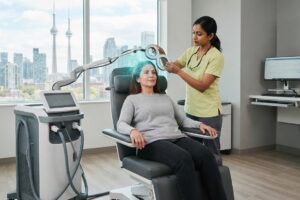
MagVenture rTMS systems require specialized attention due to their high-energy output. Maintenance protocols must focus on coil cooling efficiency and pulse consistency to ensure therapeutic efficacy. Because these systems are complex, authorized technical support is essential for maintaining the internal cooling loops and capacitor banks. You can schedule a technical consultation to ensure your neuromodulation hardware meets manufacturer safety specifications and avoids unnecessary downtime.
Maximizing ROI: Service Contracts and Clinical Training
Investing in neurodiagnostic equipment maintenance Canada represents a strategic commitment to facility efficiency and fiscal responsibility. A comprehensive service contract serves as operational insurance against catastrophic hardware failure, providing predictable costs while minimizing the risk of extended downtime. When equipment remains reliable, patient throughput increases, directly helping to reduce diagnostic waitlists in clinics across the country. Reliable hardware is the backbone of clinical success and sustainable healthcare delivery.
Novus Medical positions itself as a long-term partner rather than a mere vendor, offering the technical expertise and clinical education necessary to ensure your diagnostic suite thrives. We act as a bridge between global innovation and local care, ensuring that your facility has the resources to maintain high standards of patient care. Consistency in maintenance leads to consistency in outcomes.
The Value of Clinical Training in Device Longevity
Hardware longevity is often determined by how staff interact with sensitive technology on a daily basis. Properly trained clinicians reduce physical wear on delicate connectors and sensors, preventing the “user-error” damage that frequently leads to costly repairs. Programs like the MagVenture Accelerator Training Program provide the technical depth required to operate high-energy systems safely. Similarly, the Nerve Conduction Fundamentals Workshop empowers staff to identify whether a signal issue is a technical hardware fault or a clinical technique error, reducing unnecessary service calls. Proficiency preserves technology.
Evaluating Medical Equipment Service Contracts in Canada
When reviewing service agreements, facilities should look beyond basic repair and focus on total lifecycle support. The same due diligence applied when selecting a medical device distributor Canada facilities depend on for long-term operational stability should inform how you evaluate service contract terms. A high-quality contract must include:
- Guaranteed response times for on-site technical support
- Inclusion of travel costs for national coverage across Canada
- Regularly scheduled software and firmware updates
- Access to OEM-certified parts and proprietary diagnostic tools
You can explore Novus Medical service and technical support options to see how we support your facility’s long-term goals and ensure your neurodiagnostic equipment maintenance Canada remains at the highest standard.
Securing the Future of Your Neurodiagnostic Suite
Maintaining the clinical precision of your facility requires a shift from reactive repairs to a culture of technical excellence. By prioritizing specialized calibration and OEM-authorized support, you protect the micro-signal integrity essential for accurate neurological diagnosis. We’ve explored how consistent maintenance protocols and staff training reduce downtime and ensure your diagnostic hardware meets Health Canada’s rigorous safety standards. Accuracy is the foundation of patient trust.
As the exclusive Canadian distributor for Cadwell and MagVenture, Novus Medical provides a specialized alternative to generic repair depots. Our OEM-authorized technical service team offers national support coverage for hospitals and medical centres, ensuring your technology remains at peak performance. You can contact Novus Medical for specialized neurodiagnostic equipment maintenance Canada to safeguard your investment and optimize patient throughput. Reliability is a long-term commitment.
Taking these proactive steps today ensures your diagnostic suite remains a dependable pillar of patient care for years to come. We’re here to support your mission of clinical excellence.
Frequently Asked Questions
What is included in a standard neurodiagnostic equipment maintenance contract in Canada?
A standard neurodiagnostic equipment maintenance Canada contract typically includes annual preventive maintenance visits, electrical safety testing, and mandatory firmware updates. It also covers priority technical support and access to OEM-certified replacement parts. These agreements are structured to provide hospitals with predictable costs while ensuring that high-sensitivity hardware, like Cadwell Arc EEG systems, remains compliant with national safety standards and manufacturer specifications.
How often should EEG and EMG machines be calibrated to ensure signal accuracy?
Professional calibration for EEG and EMG machines should occur at least once per year to maintain signal accuracy and baseline performance. High-volume clinical environments often benefit from semi-annual checks to account for heavy hardware use. Regular calibration ensures that amplifiers and stimulators isolate microvolt signals correctly. This prevents the accumulation of signal artifacts that can lead to diagnostic errors or misinterpretation of neurological data during patient studies.
Can any biomedical engineer service specialized neuro-diagnostic hardware?
While general biomedical engineers handle standard patient monitors, specialized neurodiagnostic hardware requires OEM-authorized technicians. Systems like MagVenture rTMS or Cadwell Sierra Summit EMG involve complex signal acquisition modules that general electronics training doesn’t cover. Authorized service teams have exclusive access to proprietary diagnostic software and factory-specified calibration tools. Relying on specialized experts ensures that repairs don’t inadvertently introduce electrical noise or compromise the device’s clinical efficacy.
What are the Health Canada requirements for medical device technical support?
Health Canada requires that medical devices be maintained according to the manufacturer’s instructions to ensure they remain safe and effective throughout their lifecycle. Facilities must keep detailed service records to support their Medical Device Licence and demonstrate compliance during audits. Using authorized technical support ensures that all repairs utilize licensed parts and follow documented procedures that align with the latest Canadian regulatory updates and CSA safety standards.
How does authorized technical support differ from third-party electronics repair?
Authorized technical support provides access to proprietary firmware, factory-certified components, and specialized neurodiagnostic equipment maintenance Canada relies on for clinical precision. Third-party repair shops often focus on generic board-level fixes that may not account for the micro-signal sensitivity of EEG or EMG amplifiers. Authorized service ensures that every component is tracked by serial number, maintaining full traceability and preserving the manufacturer’s warranty for the device.
Disclaimer
Disclaimer: Articles on this website are produced with the assistance of automated content tools (AutoSEO) and are intended solely for general informational purposes. This content does not constitute professional advice. While we strive to maintain accurate and up-to-date information, readers should verify key details independently before taking action based on any content found on this site.
Leave a Reply
Your email is safe with us.