
Approximately 33% of Canadian patients diagnosed with major depressive disorder don’t achieve remission after standard antidepressant trials and psychotherapy. When assessing the clinical applications of transcranial magnetic stimulation, hospital administrators and clinicians face the challenge of turning fragmented research into reliable care. Successful clinical neuromodulation depends as much on rigorous protocol training and hardware dependability as it does on the underlying neurobiology.
You already know that repetitive transcranial magnetic stimulation offers a viable, non-invasive therapeutic pathway for treatment-resistant patients, but aligning provincial funding guidelines with staff proficiencies can slow implementation. This guide reviews established and emerging therapeutic protocols in Canadian healthcare environments, outlining current Health Canada indications alongside necessary equipment standards. Ahead, you’ll examine verified clinical frameworks, throughput strategies using theta burst stimulation, and the professional training required to integrate treatment programs across your facility.
Key Takeaways
- Review the validated clinical applications of transcranial magnetic stimulation for treatment-resistant depression and obsessive-compulsive disorder under active Health Canada licensing.
- Examine how targeted cortical stimulation drives neuroplasticity in emerging neurological areas, including post-stroke motor rehabilitation and chronic pain management.
- Identify core clinical infrastructure requirements, including dedicated coil cooler units and an isolation transformer to ensure electrical safety and continuous operation.
- Establish a practical framework to operationalize neuromodulation services within Canadian hospital or outpatient suites through structured staff training protocols.
Advancing Patient Care with Non-Invasive Neuromodulation
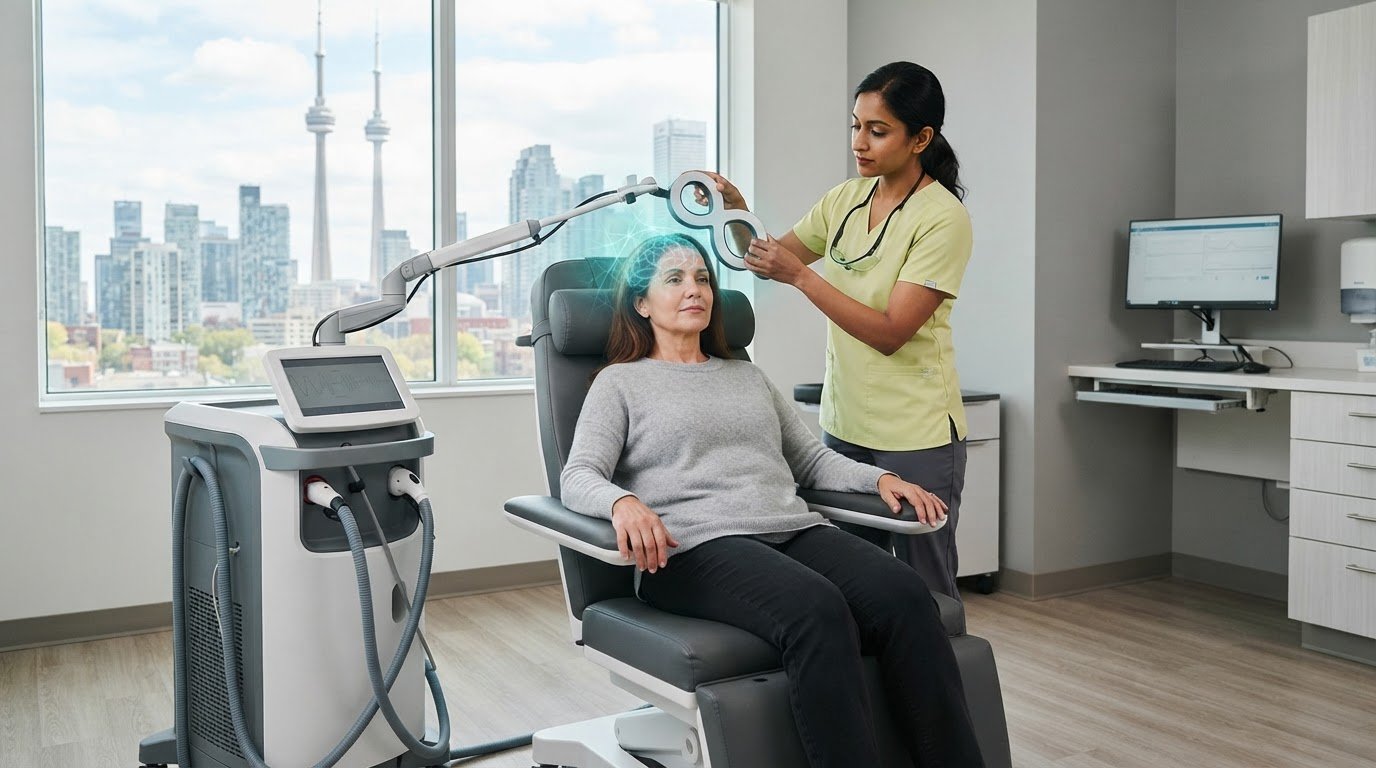
Modern psychiatric and neurological practice increasingly relies on targeted physical interventions to bypass the systemic adverse events associated with oral pharmaceuticals. At its foundation, transcranial magnetic stimulation is a non-invasive procedure that uses pulsed magnetic fields to stimulate depolarisation in cortical nerve cells. By generating brief electromagnetic pulses through an insulated coil, the system induces localized electrical currents in underlying cortical tissues, directly altering neuronal excitability and modulating synaptic networks without anaesthesia or systemic drug toxicity.
Canadian healthcare facilities face growing pressure to manage treatment-resistant conditions safely and predictably. In response, Health Canada licensing serves as the essential benchmark for medical hardware, verifying that electromagnetic field output and thermal thresholds comply with rigorous performance standards. Expanding the clinical applications of transcranial magnetic stimulation allows hospital departments to transition difficult cases from open-ended pharmaceutical trials to precise, circuit-based neurotherapeutics.
To review how clinicians explain these mechanisms during therapeutic delivery, watch this overview:
The Science of Cortical Excitability and Neuroplasticity
Therapeutic rTMS protocols modulate synaptic plasticity by triggering long-term potentiation or long-term depression. High-frequency stimulation (such as 10 Hz or intermittent theta burst) increases cortical excitability, whereas low-frequency trains (1 Hz) inhibit overactive cortical nodes. Coil positioning directly dictates clinical efficacy. Treatment teams determine individual resting motor thresholds by monitoring evoked responses, connecting surface electromyography sensors to a bedside remote input box to guarantee anatomical targeting precision across all clinical applications of transcranial magnetic stimulation.
Primary Psychiatric Clinical Applications and Evidence
Psychiatric care forms the foundation of established neuromodulation in Canada, where standard pharmaceutical approaches often fail. Outpatient registries show that 50% to 60% of treatment-resistant patients achieve a meaningful antidepressant response following an acute treatment series. Distinguishing approved therapeutic interventions from investigational uses is vital for maintaining regulatory compliance across Canadian hospital networks. Standardizing dosage, coil positioning, and train duration ensures reproducible patient outcomes across inpatient and ambulatory settings.
The MagVenture rTMS system delivers these psychiatric protocols with regulatory clearance, holding active Health Canada medical device licensing for major depressive disorder and as an adjunct therapy for obsessive-compulsive disorder. Its precise field delivery allows clinical teams to deploy established psychiatric therapies safely while maintaining equipment reliability throughout full clinical schedules.
Major Depressive Disorder (MDD) and Treatment Resistance
Under CANMAT neurostimulation clinical guidelines, rTMS serves as a first-line non-pharmacological treatment for adults with treatment-resistant depression who haven’t responded to one or more adequate antidepressant trials. Standard interventions target the left dorsolateral prefrontal cortex (DLPFC). The Canadian THREE-D multicentre trial confirmed that a 3-minute intermittent theta burst stimulation (iTBS) protocol matches conventional 37.5-minute 10 Hz stimulation, producing a 49% response rate and 32% remission rate across 20 to 30 sessions.
Obsessive-Compulsive Disorder (OCD) Protocols
For treatment-refractory OCD, protocols target deeper cortical networks, specifically the dorsomedial prefrontal cortex and anterior cingulate cortex. Clinicians deliver high-frequency 20 Hz trains to disrupt hyperactive cortico-striato-thalamo-cortical loops. These sessions incorporate individualized provocation immediately before coil discharge, activating symptom-specific circuits to improve clinical response when paired with cognitive-behavioural exposure therapies. This structured approach highlights how psychiatric indications represent the most rigorously validated clinical applications of transcranial magnetic stimulation today.

Expanding Neurological Applications and Research Directions
Canadian tertiary hospitals and research centres are expanding the clinical applications of transcranial magnetic stimulation beyond mood disorders. Presurgical motor mapping is an established neurological practice, enabling surgical teams to identify functional motor pathways before resecting brain tumours or epileptogenic tissue. In clinical trials, emerging protocols evaluate repetitive stimulation for chronic neuropathic pain and migraine prophylaxis by modulating thalamocortical networks. These protocols involve high pulse counts that generate substantial thermal loads. Deploying a specialized coil cooler unit is necessary to eliminate thermal shutdown, maintaining uninterrupted session delivery throughout continuous diagnostic runs. Structuring these procedures safely mirrors best practices for the clinical administration and safety of TMS.
Post-Stroke Motor Rehabilitation and Recovery
Neurorehabilitation units evaluate rTMS to facilitate motor recovery following ischemic stroke. By applying low-frequency stimulation to downregulate the contralesional hemisphere, or excitatory high-frequency pulses to the ipsilesional motor strip, therapy rebalances interhemispheric inhibition. Clinicians deliver stimulation immediately prior to physical rehabilitation to consolidate motor relearning. Quantitative electromyography and precise nerve conduction diagnostics monitor these motor evoked potentials, ensuring exact cortical targeting for paretic limbs.
Investigational Uses in Neurodegenerative Disorders
Academic centres are investigating multi-site cortical stimulation for cognitive and motor stabilization in Alzheimer’s disease and Parkinson’s disease. In Canada, these neurological applications remain investigational and require rigorous clinical trial designs and ethics board approvals. As the clinical applications of transcranial magnetic stimulation broaden into advanced neurotherapeutics, specialized infrastructure becomes essential. To evaluate research configurations for your hospital, consult Novus Medical for specialized equipment support.
Operationalizing TMS Therapy in Canadian Clinical Settings
Deploying a neuromodulation suite within an acute hospital or outpatient department demands careful facility planning. High-power magnetic pulses create electrical transients that can disrupt sensitive medical electronics. Facilities must install a dedicated isolation transformer to reduce leakage current, distribute regulated power, and maintain electrical safety during high-output discharge sequences. Securing a reliable medical equipment service contract protects daily capacity, preventing unforeseen interruptions to scheduled treatment blocks. Practical implementation requires three technical foundations:
- Electrical compliance using a hospital-grade isolation transformer.
- Rigorous mechanical positioning, stabilized by the patented MagVenture Flow Arm.
- Continuous cooling loops to maintain pulse consistency.
Professional Training and the MagVenture Accelerator
Competent delivery across all clinical applications of transcranial magnetic stimulation requires structured hands-on education. The MagVenture Accelerator Training Program provides Canadian healthcare teams with detailed instruction covering motor threshold determination, anatomical localization, seizure management, and coil positioning. Operators transition from theory to clinical execution, establishing standardized treatment practices that maintain patient comfort while upholding procedural safety.
Technical Reliability and Maintenance Standards
Sustained therapeutic accuracy relies on factory-calibrated components that deliver exact electromagnetic outputs over years of continuous use. Novus Medical supports hospital departments and specialized clinics nationwide through ISO 14001:2015-certified processes, backed by more than 40 years of experience selling and supporting medical devices across Canada. Healthcare providers receive end-to-end customer service and direct Canadian-based technical support by phone, internet, and remote connection. This domestic technical backing ensures rapid diagnostic response, regular preventative maintenance, and dependable warranty fulfillment, allowing clinical teams to expand their clinical applications of transcranial magnetic stimulation with minimal operational risk.
Establishing Neuromodulation Excellence in Canadian Healthcare
Deploying advanced neuromodulation bridges the gap between pharmaceutical non-response and clinical recovery. Integrating evidence-based interventions for major depressive disorder and obsessive-compulsive disorder establishes a dependable pathway for patients facing complex illnesses. As ongoing trials validate emerging neurological treatments, hospital departments require dependable infrastructure, dedicated electrical protection, and standardized protocols to expand the clinical applications of transcranial magnetic stimulation successfully.
Sustainable clinical care depends on high-precision engineering and responsive domestic support. As the exclusive Canadian distributor for MagVenture rTMS, Novus Medical provides Health Canada licensed systems backed by over 40 years of Canadian clinical support experience. When your treatment team pairs factory-calibrated hardware with professional operator training through the MagVenture Accelerator, your department secures lasting diagnostic and therapeutic reliability. Contact Novus Medical to discuss TMS implementation for your facility and deliver reproducible patient care with confidence.
Frequently Asked Questions
What are the primary clinical applications of TMS approved in Canada?
In Canada, Health Canada formally licenses rTMS for major depressive disorder and as an adjunct therapy for obsessive-compulsive disorder. Therapeutic systems are also licensed for diagnostic stimulation of the central and peripheral nervous system. While university hospitals evaluate stroke rehabilitation and pain management, mood and obsessive disorders represent the primary therapeutic clinical applications of transcranial magnetic stimulation approved for routine practice.
Is TMS therapy Health Canada licensed for clinical use?
Yes, TMS therapy holds active Health Canada medical device licensing for specific therapeutic protocols. Therapeutic rTMS gained regulatory recognition for major depressive disorder in 2002, with subsequent licensing covering obsessive-compulsive disorder. Platforms like MagVenture rTMS comply with federal electromagnetic and electrical standards, allowing Canadian healthcare providers to integrate neuromodulation into routine clinical workflows without regulatory friction.
How effective is rTMS for treatment-resistant depression compared to medication?
For patients who haven’t achieved symptom relief through conventional antidepressants, rTMS produces meaningful clinical outcomes where additional medication efficacy drops. Canadian real-world registry data demonstrates that 50% to 60% of patients with treatment-resistant depression experience a positive clinical response, with roughly one-third achieving full remission. Crucially, rTMS achieves these remission rates without systemic side effects like weight gain, gastrointestinal upset, or sedation.
What is the difference between TMS and rTMS in a clinical setting?
Single-pulse or paired-pulse TMS delivers isolated magnetic discharges primarily used for diagnostic neurophysiology, such as assessing motor threshold and corticomotor conduction. Repetitive TMS (rTMS) applies structured pulse trains at defined frequencies to induce lasting neuroplastic changes in cortical excitability. While single pulses provide neurodiagnostic assessment, therapeutic clinical applications of transcranial magnetic stimulation rely entirely on rTMS protocols to modulate dysfunctional brain networks over time.
What professional training is required to operate a clinical TMS system?
Operating a clinical neuromodulation system requires specialized hands-on instruction in motor threshold determination, anatomical landmarking, and seizure management. In Canada, operators typically complete formal curriculum courses, such as the MagVenture Accelerator Training Program. This professional education ensures psychiatrists, technicians, and nurses maintain procedural consistency, correctly configure cooling systems, and navigate emergency protocols to uphold patient safety during high-output clinical delivery.
Disclaimer
Disclaimer: Articles on this website are produced with the assistance of automated content tools (AutoSEO) and are intended solely for general informational purposes. This content does not constitute professional advice. While we strive to maintain accurate and up-to-date information, readers should verify key details independently before taking action based on any content found on this site.

Leave a Reply
Your email is safe with us.