
Can a negative home sleep test rule out obstructive sleep apnea? Not always. When assessing the diagnostic accuracy of level 3 sleep study results, clinicians need to consider patient selection, signal quality and interpretation, not just the device. A technically adequate home test can support assessment in appropriate adults, but it doesn’t measure every parameter captured by laboratory polysomnography.
This distinction matters when symptoms persist despite a negative or inconclusive result. Clinical assessment may indicate the need for another testing approach, including polysomnography. This article explains what Level 3 home sleep apnea testing can detect, what it cannot measure, and how recording conditions affect results. It also compares HSAT with laboratory testing and offers practical criteria for evaluating a device, including the Cadwell ApneaTrak Level 3 HSAT. Consider documented evidence, specifications, workflow requirements and available technical support when reviewing any device.
Key Takeaways
- Confirm what a Level 3 HSAT records and which clinical questions it can help address before selecting a testing approach.
- Assess the diagnostic accuracy of level 3 sleep study results in context, including the patient population, testing protocol and reference standard.
- Distinguish a negative result from a technically incomplete recording, and consider whether clinical findings warrant further testing.
- Evaluate devices such as the Cadwell ApneaTrak Level 3 HSAT against documented specifications, workflow needs and available technical support.
What does a Level 3 sleep study measure, and what does accuracy mean?
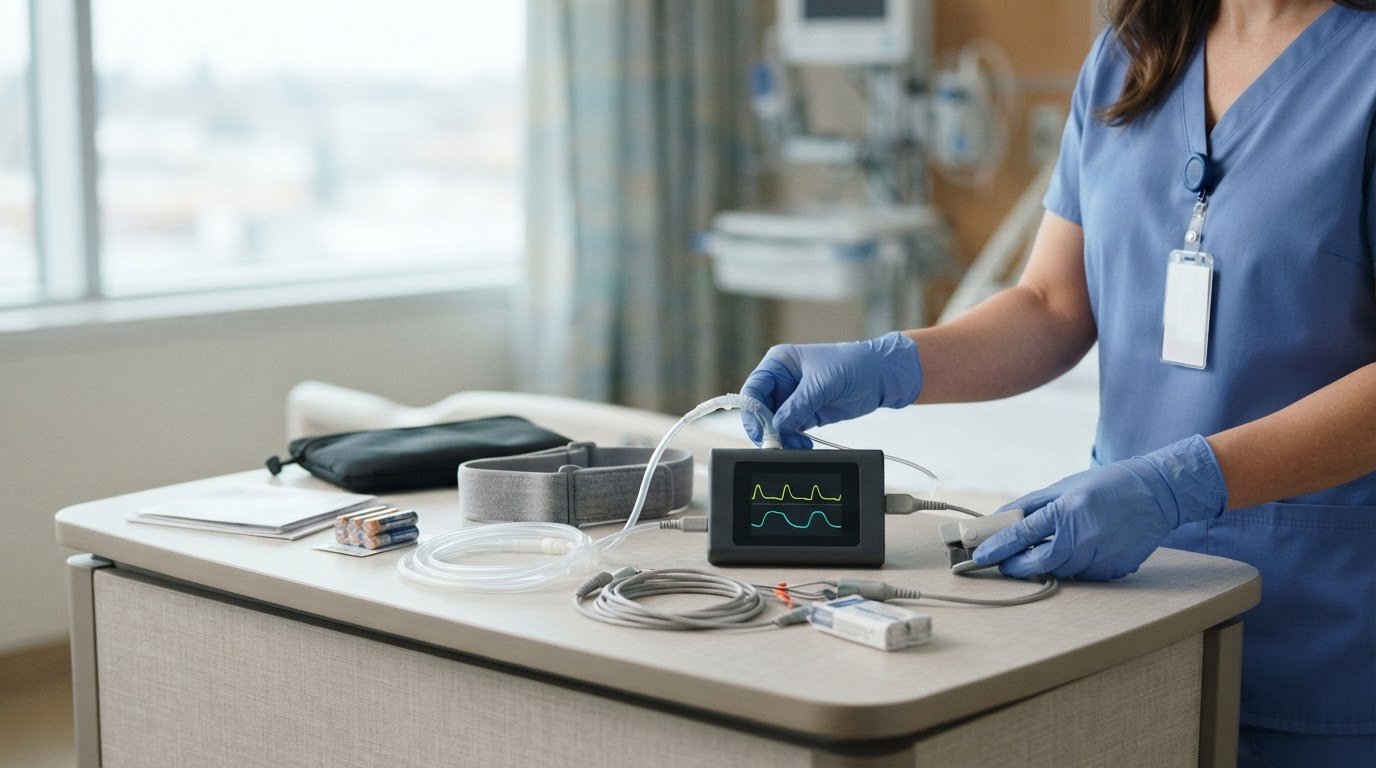
A Level 3 home sleep apnea test (HSAT) is an out-of-centre sleep test, typically conducted without an overnight technologist present. Depending on the device and protocol, it may record signals such as airflow, breathing effort, blood oxygen saturation and heart rate. Check the documented channels for the specific test. A Level 3 designation alone doesn’t confirm which signals are recorded.
Diagnostic accuracy describes how well a test distinguishes people with and without a condition in a defined study population. Sensitivity and specificity measure different aspects of test performance. An individual’s probability of disease also depends on clinical findings and pre-test likelihood. No single accuracy figure represents every patient, device or testing protocol.
The following video discusses the diagnostic accuracy of a clinical score, not the performance of a Level 3 sleep test:
How Level 3 HSAT differs from laboratory polysomnography
Polysomnography (PSG) is an in-lab approach that can include sleep staging and other measurements not necessarily collected by HSAT. Because channels vary by test and device, compare documented signals rather than assuming the two approaches have the same scope. Polysomnography provides an overview of sleep-study types. PSG is not automatically the reference for every clinical question.
What AHI and REI can, and can’t, tell you
The apnoea-hypopnoea index (AHI) is the number of scored breathing events per hour of sleep. The respiratory event index (REI), commonly reported with HSAT, divides scored events by monitoring time rather than measured sleep time. If monitoring time includes periods awake, the REI may differ from an AHI. These indices aren’t interchangeable. Interpret them alongside symptoms, recording quality and clinical assessment. That context is central to the diagnostic accuracy of level 3 sleep study results.
How accurate is a Level 3 sleep study across different clinical situations?
There isn’t one accuracy percentage that applies to every Level 3 home sleep apnea test (HSAT). Published results depend on who was tested, the device and protocol, the reference standard, and the outcome being assessed. Sensitivity and specificity describe performance in the study group. Predictive values also vary with the likelihood of disease in the population being tested. Read the diagnostic accuracy of level 3 sleep study results alongside the evidence behind the specific figure, not as a guarantee for an individual.
Study performance describes a group under defined conditions; it cannot determine with certainty whether a particular patient has sleep apnea. For an individual patient, symptoms, history, test quality and clinical assessment all matter.
Why patient selection affects HSAT interpretation
The AASM clinical practice guideline supports HSAT for appropriately selected adults with signs and symptoms indicating an increased risk of moderate to severe obstructive sleep apnea, when they have no significant complicating conditions. Comorbidities or features suggesting another sleep-related breathing disorder can change the appropriate testing pathway. Review the clinical history and reason for testing before deciding whether HSAT is a suitable fit.
When a negative or inconclusive result needs clinical review
A negative result may not resolve the question if clinical suspicion remains. An inconclusive or technically inadequate recording may not provide a dependable basis for interpretation. In the context addressed by the AASM guideline, polysomnography is recommended after a single negative, inconclusive or technically inadequate HSAT. Follow-up should be clinician-directed: review the patient’s presentation and recording, then select the next step that addresses the unresolved question.
Clinics assessing the Cadwell ApneaTrak Level 3 HSAT can ask Novus Medical about device information and workflow requirements. Explore Novus Medical’s sleep diagnostic devices.

What can reduce Level 3 sleep study accuracy or complicate results?
Home testing depends on usable signals collected according to the test protocol. Displaced sensors, interrupted connections or limited recording time may affect whether a recording can be interpreted. These are possible sources of data limitation, not proof that a particular device or test has failed. The diagnostic accuracy of level 3 sleep study results depends in part on whether the recorded data are adequate for the clinical question.
A technically incomplete recording is not the same as a negative result. An incomplete recording may not provide enough interpretable information. A negative result still needs to be considered alongside the patient’s presentation and recording quality. Trained review, clinical history and established interpretation protocols help determine what the result can support and whether it resolves the question.
Signal quality, recording conditions, and usable data
Before testing, consult the specific test protocol and manufacturer instructions for sensor placement, setup, recording duration and data-quality criteria. After recording, check whether the required signals are present and interpretable, and document any limitations. Don’t infer that data are adequate from recording duration alone, or assume every signal issue has the same clinical effect.
Match the test pathway to the clinical question
HSAT may support assessment in appropriately selected patients, but it doesn’t answer every sleep-related diagnostic question. Symptoms, medical history, comorbidities and concern for other sleep disorders can affect the testing pathway. Consult current clinical guidance, such as the AASM clinical practice guideline, when deciding whether HSAT is suitable or further assessment is needed.
For a practical overview of home testing, see Level 3 HSAT and modern sleep diagnostics. To discuss the Cadwell ApneaTrak Level 3 HSAT, device information or workflow requirements, contact Novus Medical.
How should clinics evaluate a Level 3 sleep study device?
Evaluate a device against your clinical service’s needs, not a headline accuracy claim. Start with intended use, then review documented channels, data handling, staff workflow and available support. The diagnostic accuracy of level 3 sleep study findings cannot be inferred from a product name or category. Confirm that the device’s official documentation aligns with the patient population and clinical questions your service addresses.
Questions to ask when reviewing device documentation
- Intended use: Which patients and diagnostic purpose does the manufacturer specify?
- Signals and setup: Which sensors and channels are documented, and what are the placement and recording instructions?
- Data workflow: How are recordings reviewed, and what report outputs are available to support clinical interpretation?
- Evidence and regulatory information: What performance evidence applies to the exact device and intended population? Verify applicable regulatory details directly rather than assuming them.
Compare the documented specifications with your protocols and clinical requirements. Don’t assume that a Level 3 designation confirms particular channels, reporting functions or performance. For broader purchasing considerations, see Canadian hospital medical equipment guidance.
Connect device selection with training and ongoing support
Before procurement, assess how staff will learn setup and recording review, how technical questions can be addressed, and what warranty terms apply. Confirm the details with the supplier and in current product documentation. Novus Medical supplies the Cadwell ApneaTrak Level 3 HSAT and provides sales, technical support and warranty services to hospitals and healthcare providers across Canada. These services can inform a professional evaluation, but they don’t establish device-specific clinical performance.
To review device information and workflow requirements, discuss the Cadwell ApneaTrak Level 3 HSAT with Novus Medical.
Apply the evidence to your next testing decision
The diagnostic accuracy of level 3 sleep study results depends on appropriate patient selection, usable signals and interpretation in clinical context. Review what the test records and what its evidence supports. A negative result and an incomplete recording aren’t equivalent, and persistent clinical concerns may call for a different testing pathway.
When evaluating a device, compare its documented intended use, channels and workflow with your clinic’s requirements. The Cadwell ApneaTrak Level 3 HSAT is among Novus Medical’s offerings, but device selection should be based on verified information, not assumed performance. Novus Medical provides sales, technical support and warranty services to hospitals and healthcare providers across Canada.
Discuss the Cadwell ApneaTrak Level 3 HSAT with Novus Medical to review device information, support and workflow considerations for your team. An evidence-based approach helps clinicians make informed testing decisions and plan appropriate follow-up for patients.
Frequently Asked Questions
How accurate is a Level 3 sleep study for diagnosing sleep apnea?
Accuracy varies with the patient population, test protocol, device signals, reference standard and outcome measured. Research findings from a defined group don’t guarantee the same result for an individual. Consider the diagnostic accuracy of level 3 sleep study results alongside the patient’s symptoms, clinical history and recording quality. Review the evidence for the specific test and population rather than relying on a single general accuracy figure.
Can a Level 3 sleep study miss sleep apnea?
Yes. A Level 3 home sleep apnea test can fail to identify sleep apnea, including when signals are incomplete or the result doesn’t align with the clinical picture. Home tests may also use monitoring time rather than measured sleep time when calculating an index. If symptoms or clinical concern remain despite a negative result, the clinician can review the recording and decide whether further testing is appropriate. Physical indicators can also emerge across other routine healthcare visits; for example, dental care providers such as Dental Plus may notice signs like tooth wear or airway narrowing during routine check-ups, reinforcing the need for comprehensive assessment.
A Level 3 study is an out-of-centre home test that records selected signals for assessment of sleep-related breathing. Polysomnography is generally performed in a sleep laboratory and can record a broader range of measurements, including brain activity used to assess sleep. The exact channels depend on the test and device. The approaches aren’t interchangeable, and the appropriate one depends on the patient and clinical question.
Does a Level 3 sleep study measure sleep stages?
Typically, a Level 3 home sleep apnea test doesn’t measure sleep stages because it doesn’t record the brain activity used to identify them. Check a particular device’s documented channels rather than assuming them from its category. Without measured sleep time, some HSAT reports use monitoring time to calculate the respiratory event index, which may differ from an index based on sleep time.
When should a Level 3 sleep study result be followed up?
Follow-up is appropriate when a result is inconclusive, the recording is technically inadequate, or the findings don’t resolve the clinical question. For adults evaluated in the context addressed by its guideline, the American Academy of Sleep Medicine recommends polysomnography after a single negative, inconclusive or technically inadequate HSAT. A clinician should consider the patient’s presentation and test quality when choosing the next step.
Managing demanding clinical schedules, rigorous diagnostic workflows, and patient care often leaves healthcare providers with limited time for their personal lives. Clinicians seeking meaningful relationships outside the clinic can discover DownToDate to connect with fellow professionals who understand the unique realities of a medical career.
Disclaimer
Disclaimer: Articles on this website are produced with the assistance of automated content tools (AutoSEO) and are intended solely for general informational purposes. This content does not constitute professional advice. While we strive to maintain accurate and up-to-date information, readers should verify key details independently before taking action based on any content found on this site.
Leave a Reply
Your email is safe with us.