

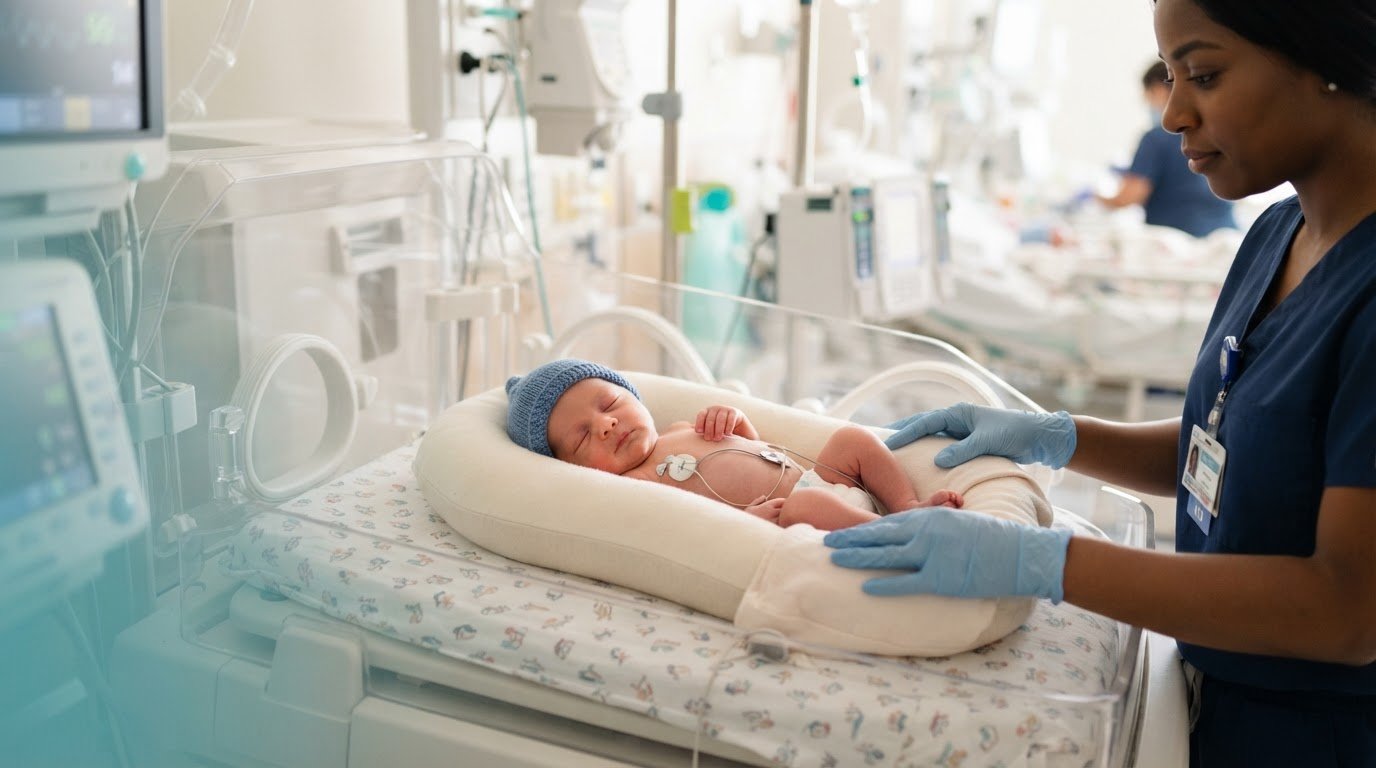
In the NICU, positioning is part of developmental care, not simply a way to keep an infant still. Neonatal developmental positioning aids can support flexed alignment, head positioning and comfort while helping limit unnecessary movement. Their use should be tailored to the infant’s needs and clinical care.
For neonatal clinicians, selecting and applying positioning supports means considering posture, pressure points, respiratory needs and the infant’s response. A thoughtful approach can create a more contained environment for rest and caregiving, while keeping positioning appropriate to the infant’s condition and monitoring needs.
This article explains how nests, rolls, bumpers and pillows can support alignment, head shape, development and comfort in the NICU. It also covers practical repositioning considerations, signs of discomfort and how therapeutic positioning differs from the safe sleep environment used before discharge.
Key Takeaways
- Match nests, rolls, bumpers and pillows to the infant’s posture, clinical needs and available monitoring.
- Use positioning to support flexion and midline alignment, while watching for pressure marks or other signs of discomfort.
- Adjust positioning as the infant grows, and plan the transition to supine sleep on a flat, firm surface before discharge.
- Learn how Novus Medical’s LungFit® PH fits into a facility’s respiratory support equipment considerations.
Musculoskeletal alignment and head-shape concerns
In the NICU, choose positioning supports to suit each newborn’s posture, clinical needs and response. Place the infant within the aid’s boundaries, support a flexed posture and secure the support without restricting movement.
Individualized Positioning and Alignment
Assess the infant’s head, trunk and limb position before choosing or adjusting a nest, roll or other support. The goal is comfortable alignment and stability, not a fixed posture that disregards the infant’s condition. For example, a newborn who consistently turns their head to one side may need a repositioning plan that varies head direction and reduces prolonged pressure on one area.
Plagiocephaly is treatable and can result from too much pressure on one side of a baby’s head. Positioning aids can help clinicians support postural changes, but they do not replace ongoing assessment of head shape, skin and movement.
Joint Alignment and Symmetry
Check whether the shoulders, hips and limbs rest in a balanced position, with the arms and legs comfortably flexed. Compare both sides during routine care. Persistent asymmetry, restricted movement or a limb held away from the body may mean the support needs adjustment. A contained position should allow spontaneous movement, not hold joints in forced extension or close adduction.
Leave room for spontaneous kicking when swaddling. Tight wrapping that restricts hip mobility can increase vulnerability to developmental dysplasia of the hip. Check the hips and legs after securing fabric or positioning supports.
Positioning and Securing a Newborn
Centre the newborn on the support, then bring its boundaries close enough to provide containment without pressing on the face, airway, lines or tubes. Position the head and limbs according to the infant’s clinical plan, and confirm the face remains visible. Arrange fabric or support components smoothly, without tight pressure across the chest, hips or joints.
After each adjustment, reassess alignment, breathing, skin and behavioural cues. If the newborn slides, becomes unsettled or develops redness or pressure marks, adjust the aid and reassess the fit. Repeat these checks during care and as the infant grows.
NICU infant positioning and developmental support
In neonatal care, positioning combines supportive boundaries with planned changes in posture. The approach should reflect the infant’s respiratory status, developmental needs and response to care.
Support for Preterm and Ill Infants
For a preterm infant, a nest can provide boundaries that encourage flexion and reduce tiring, unnecessary movement. Conserving energy supports the infant’s capacity for growth. A naturally supported posture may also help facilitate lung expansion and oxygenation, but each position must suit the infant’s clinical plan.
For babies born at or before 32 weeks of gestation, midline head positioning in supine or side-lying may be considered during the first 3 days after birth. Preterm infants positioned prone in the NICU need continuous cardiorespiratory and oxygen-saturation monitoring.
Swaddling and Movement Support
Swaddled containment can provide boundaries during caregiving while allowing movement. In a reported study, infants at 32 to 35 weeks postmenstrual age recovered autonomic and motor stability within 5 minutes after weighing and bathing with swaddled containment. This example highlights why clinicians assess an infant’s response during transitions, rather than relying on one position alone.
When swaddling, leave room for spontaneous kicking. Tight wrapping that restricts hip movement can increase vulnerability to developmental dysplasia of the hip. Adjust the wrap to provide containment without limiting comfortable limb movement.
Position changes also matter. Repositioning infants in intensive care at intervals of 3 to 4 hours can support postural alignment, extremity movement and physiological stability. Clinicians can vary supine, side-lying and prone positions according to the infant’s condition and monitoring needs. A nest’s boundaries may help an infant bring hands near the face and mouth, supporting exploration and self-soothing.
Observe breathing, oxygenation, posture and behavioural cues after each change. For infants needing respiratory support, a position that promotes natural posture may assist lung expansion, but it must fit their clinical needs. Dandle-Lion infant developmental care products are one option for neonatal teams considering positioning supports; explore infant developmental care products as part of that assessment.

Positioning nests, bumpers, and pillows
In the NICU, each aid has a different purpose, from providing boundaries to supporting a specific posture. Choose one according to the infant’s size, clinical needs and care plan.
Positioning Aids and Containment Nests
Containment nests create boundaries around an infant, while bumpers provide localized support and pillows support a particular area, such as the head. These neonatal developmental positioning aids should fit the infant while keeping the face, airway and clinical equipment visible and accessible.
Use supports during close monitoring, not as a substitute for observation. Consider the positioning goal and the infant’s response, and ensure staff can still assess the patient.
Nests for Different Gestational Ages
Gestational age and body size inform nest selection, alongside fit and clinical needs. The Dandle Prone Pad is listed for infants weighing less than 1,000 g to 4,400 g; the Dandle WRAP Stretch is listed for infants weighing less than 1,000 g to 4,500 g.
These ranges can guide size selection, but should not determine positioning on their own. Reassess fit as the infant grows, ensuring the support allows comfortable movement and access for care.
Comparing Purpose, Materials, and Clinical Use
Compare aids by function, contact area, fit and cleaning instructions. A nest provides surrounding boundaries, a pillow supports a localized area, and a wrap contains the infant while leaving room for movement. Material and intended use help determine how to clean each product.
In Canadian NICUs, follow facility infection-prevention procedures and the manufacturer’s cleaning instructions. These provide guidance for handling and cleaning each specific product.
Types of Aids Used in NICUs
Common types include nests, positioning rolls, bumpers, pillows, wraps and prone supports. Dandle•LION gel pillows come in eight sizes and two thicknesses, giving clinical teams options when selecting neonatal developmental positioning aids for their intended use.
Choose an aid based on the required position, infant size and care activity, such as feeding or a procedure. After placing or adjusting it, reassess the infant and maintain access to monitoring.
Positioning, stress reduction, and comfort
Comfort-focused positioning can reduce unnecessary disturbance and support rest during NICU care. Before discharge, medically stable infants should transition to supine sleep on a flat, firm surface without positioning aids or loose bedding.
At home, place the baby on their back to sleep in a cot clear of nests, towels, bumpers and toys. This sleep setup differs from therapeutic positioning used in hospital under close monitoring.
During procedures, a frog-shaped positioning aid may be placed around the head, neck or hips, or used to provide comforting contact. It can also help maintain a midline head position. Keep touch gentle, and offer it when the baby is awake or distressed, not during quiet sleep.
Assess the infant’s behavioural and physiological responses before, during and after touch. Changes in breathing, colour, movement or behaviour can help guide whether to continue, adjust or pause contact. For example, reduce stimulation if the baby becomes more unsettled during a procedure.
Comfort also depends on fit and pressure. Excessive fussiness, disrupted sleep, redness or pressure marks may indicate discomfort or poor positioning. Reassess the support and the infant’s posture when these signs appear, including after a change in position or caregiving activity.
Settled infants may show more stable heart rates and breathing, while quality sleep supports growth, brain development and recovery from illness. Positioning boundaries can help promote rest by limiting unnecessary movement, but must not obstruct observation or clinical care. Staff should continue assessing the infant’s response rather than assume a position remains comfortable.
In the NICU, prone positioning may be used as a therapeutic intervention with appropriate monitoring. Before discharge, transitioning to supine sleep on a clear, flat, firm surface helps establish a consistent home sleep environment.
Novus Medical: LungFit® PH
LungFit® PH is an inhaled nitric oxide system offered by Novus Medical to healthcare facilities evaluating respiratory support equipment. It does not replace developmental positioning aids; it addresses a separate respiratory-care consideration for neonatal teams.
For clinicians and medical device purchasers, assess respiratory equipment alongside the unit’s clinical requirements and workflow. LungFit® PH uses patented Plasma Pulse Technology® to generate inhaled nitric oxide from ambient air, a product feature to consider when reviewing respiratory support systems.
Novus Medical also offers the EO-150 Ventilator and Monnal™ T60 Advanced for facilities reviewing respiratory therapy equipment. These offerings are distinct from positioning nests, wraps and pillows, which support infant posture and containment.
Contact Novus Medical to discuss LungFit® PH, or visit novusmedical.ca.
Make positioning part of ongoing care planning
As an infant’s condition and care needs change, review whether the positioning approach still fits the clinical plan. Include bedside observations and input from the neonatal care team when refining how neonatal developmental positioning aids are selected and used. This makes positioning an active part of care planning rather than a one-time setup.
For teams considering dedicated infant-care products, Novus Medical offers Dandle-Lion infant developmental care products. These products relate directly to the positioning and containment needs discussed in this guide; choose according to the intended clinical use and the infant’s needs.
Take the next step by discussing your unit’s infant-care requirements with Novus Medical. Contact Novus Medical about positioning aids and continue building a considered approach to developmental care for NICU infants.
Frequently Asked Questions
What are the developmental benefits of positioning aids for premature and newborn infants?
Positioning aids can provide boundaries that help infants maintain a supported posture and bring their hands closer to their face. This can encourage exploration and self-soothing during monitored NICU care. For example, a clinician may observe whether an infant can bring a hand toward the mouth while supported. Reassess as the infant’s movement, alertness and care needs change.
Which positioning aids are recommended for preterm infants in Canadian NICUs?
There is no single aid for every preterm infant; the choice should match the infant’s clinical needs and the unit’s care plan. NICU teams may consider nests, wraps, positioning rolls, pillows, bumpers or prone supports. For example, a nest may suit an infant who needs surrounding boundaries, while a pillow may support a more localized positioning goal. Check the fit and maintain access for care.
What are the risks of positioning aids, including suffocation, overheating, and pressure injuries?
Risks include an aid or loose material interfering with the infant’s airway, excess warmth and pressure-related skin changes. Use positioning supports only during closely monitored neonatal care, keep the face visible and avoid unnecessary layers. Check skin and temperature during care; reassess if redness or pressure marks appear. For sleep at home, keep the cot clear of positioning aids and loose items.
When should positioning aids be discontinued as an infant grows or prepares for discharge?
Reassess fit as the infant grows, and transition away from therapeutic supports before discharge to model the home sleep environment. For medically stable infants, plan supine sleep on a flat, firm surface without positioning aids or loose bedding. The care team can include this transition in discharge planning so caregivers know how to set up the infant’s sleep space at home.
What Canadian standards or guidelines govern the use and cleaning of neonatal positioning aids?
In Canadian NICUs, follow facility infection-prevention procedures and the manufacturer’s cleaning instructions for each product. Use positioning aids during close monitoring and select them to suit the infant’s needs.
Disclaimer
Disclaimer: Articles on this website are produced with the assistance of automated content tools (AutoSEO) and are intended solely for general informational purposes. This content does not constitute professional advice. While we strive to maintain accurate and up-to-date information, readers should verify key details independently before taking action based on any content found on this site.


Leave a Reply
Your email is safe with us.